 WhatsApp Us Now

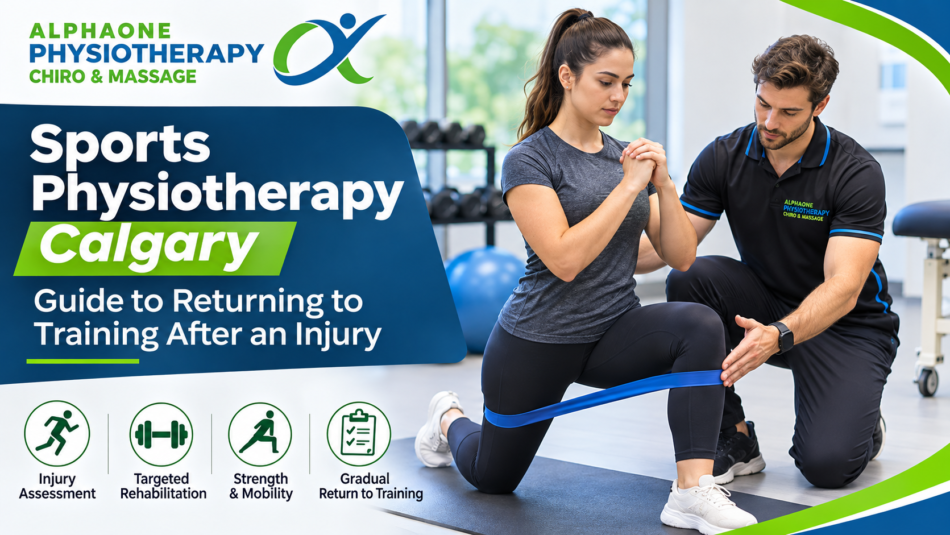
Returning to training after an injury should be based on function, strength and movement tolerance, not simply on whether the pain has disappeared. Working with sports physiotherapy Calgary services can help identify what still needs rehabilitation before you return to full exercise, sport or gym activity.
At AlphaOne Physiotherapy, Chiro & Massage, rehabilitation can be tailored to the injury, activity level and goals of the individual. The aim is to build a gradual return-to-training plan rather than rushing from rest straight back into normal activity.
Why Returning Too Quickly Can Be a Problem
Pain often improves before strength, control or confidence fully return. That can create a false sense that the body is ready for the same training load as before the injury.
A sports physiotherapy Calgary assessment can look at the movement demands of your activity rather than focusing only on the painful area. Depending on the injury, the physiotherapist may assess mobility, strength, balance, coordination and how well you perform movements related to your sport or training routine.
AlphaOne’s sports rehabilitation content also emphasises detailed assessment, individualised treatment plans and sport-specific rehabilitation rather than a fixed programme for every athlete.
Returning too soon may also lead you to compensate. For example, if one ankle still feels unstable, you may place more demand on the opposite leg without realising it.
What Does Sports Physiotherapy Assess Before You Return?
A return-to-training assessment should answer a practical question: Can your body currently handle the movements and load required by your activity?
A physiotherapist may look at:
- Range of motion
- Muscle strength
- Balance and stability
- Joint control
- Functional movement
- Exercise tolerance
- Sport-specific movements
- Confidence performing the activity
The exact assessment depends on the type of injury and what you are trying to return to.
For example, someone returning to running after an ankle injury may need adequate calf strength, balance and tolerance for repeated loading. Someone returning to upper-body gym training after a shoulder strain may need sufficient shoulder mobility, control and strength before progressing to heavier resistance.
This is why sports injury physiotherapy Calgary should be individualised rather than based on a generic recovery timeline.
How Is a Return-to-Training Plan Built?
A gradual return usually involves increasing demand in stages.
Early rehabilitation may focus on restoring comfortable movement and basic strength. Later stages can introduce more demanding exercises that better reflect the movements used in training or sport.
AlphaOne’s recent rehabilitation guidance gives general examples such as ankle mobility and balance work for minor ankle sprains, controlled squats and step-ups for knee discomfort, and resistance exercises for shoulder strains. These are examples rather than universal prescriptions, and the appropriate exercises depend on assessment findings.
A progression may move through stages such as:
- Comfortable basic movement
- Controlled strengthening
- Balance or movement-control work
- Functional exercises
- Higher-load or faster movements
- Sport-specific or gym-specific drills
- Gradual return to normal training
Progress should depend on how the body responds, not just on how many days have passed since the injury.
Why Strength and Movement Control Matter
Strength is only one part of successful rehabilitation. The body also needs to control movement under the demands of real activity.
A person may be able to perform a simple exercise in a clinic but still struggle when speed, fatigue or direction changes are added.
For that reason, sports physiotherapy Calgary may include exercises that progressively challenge balance, coordination and movement quality.
AlphaOne’s sports rehabilitation resources describe approaches such as flexibility work, taping, biomechanical analysis, proprioceptive training and sport-specific exercises. These techniques are used according to individual needs and should not be treated as mandatory for every injury.
The practical goal is to close the gap between basic rehabilitation and the actual demands of the activity you want to resume.
Can Massage Therapy Support Sports Injury Recovery?
Massage therapy Calgary NE may be useful when muscle tightness or general muscular discomfort is part of the recovery process.
Massage can complement rehabilitation by focusing on soft-tissue comfort and relaxation. However, it should not be treated as a substitute for restoring strength, movement control or exercise capacity after an injury.
AlphaOne’s current content makes the same distinction: massage may support comfort, but progressive strengthening and rehabilitation remain important for functional recovery.
For some people, combining physiotherapy and massage may make sense. The appropriate combination depends on the injury, symptoms and rehabilitation goals.
What About Physiotherapy for General Injuries in NE Calgary?
Not every injury happens during organised sport. Gym training, recreational exercise, running, lifting and everyday physical activity can all lead to injuries or irritation.
People looking for broader physiotherapy Calgary NE services can still receive an assessment focused on movement, pain and rehabilitation goals.
AlphaOne’s current website lists sports injuries, musculoskeletal concerns, acute pain, chronic pain and post-surgical rehabilitation among the issues addressed through physiotherapy.
The important point is that treatment should match the person’s actual activity demands.
Practical Example of a Gradual Return
Consider someone who experiences a minor knee injury while training.
After the initial discomfort settles, they may feel capable of walking normally again. That does not automatically mean the knee is ready for heavier squats, running or repeated jumping.
A rehabilitation programme might first focus on controlled lower-body strength and movement. Later, exercises can become more demanding as the individual demonstrates better tolerance and control.
The progression could include:
- Controlled squats
- Step-ups
- Single-leg balance work
- Gradual resistance increases
- Faster or more dynamic movement
- A structured return to normal gym exercises
These examples illustrate progression, not a treatment plan for every knee injury.
The safest sequence depends on the assessment and how the person responds.
Common Mistakes When Returning to Training
Going Back Because the Pain Is Gone
Pain reduction is useful, but it does not prove that strength or movement capacity has fully returned.
Restarting at the Previous Training Load
Jumping straight back to the same weights, speed or volume can place more demand on the recovering area than it is ready to tolerate.
Ignoring Movement Changes
Compensating, limping or avoiding certain positions can indicate that the body is not yet moving normally.
Skipping Strengthening
Rest alone does not rebuild the physical capacity required for sport or gym activity.
Following Someone Else’s Timeline
Recovery depends on the injury, the individual and the activity being resumed. Another person’s return date is not a reliable benchmark for your own rehabilitation.
Key Takeaways
- Returning to activity should depend on movement and function, not pain alone.
- Sports physiotherapy Calgary can assess strength, mobility, balance and activity-specific demands.
- Rehabilitation should progress gradually from basic movement to higher-level functional activity.
- Sports injury physiotherapy Calgary should be tailored to the individual and the type of activity they want to resume.
- Massage therapy Calgary NE may complement rehabilitation when muscle tension is part of the problem.
- A broader physiotherapy Calgary NE assessment may also be appropriate for gym, recreational or everyday activity injuries.
Frequently Asked Questions
How do I know when I am ready to return to sport?
Readiness should be based on factors such as strength, mobility, balance, movement control and tolerance for activity. A physiotherapist can assess these areas and help determine whether training should be progressed.
Should I wait until I have no pain before exercising?
Not every rehabilitation programme requires complete absence of symptoms before all activity begins. The appropriate level of exercise depends on the injury, the stage of recovery and the physiotherapist’s assessment.
Can sports physiotherapy help gym injuries?
Yes. Sports rehabilitation principles can also apply to injuries associated with gym training, recreational exercise and other physically demanding activities.
Is massage enough for a sports injury?
Massage may help with muscle tension and comfort, but it does not replace progressive rehabilitation when strength, balance, mobility or movement capacity need to be restored.
Build a Safer Return to Training With AlphaOne
Returning to exercise after an injury is not about waiting for a date on the calendar. It is about rebuilding the physical capacity required for the activity you want to perform.
AlphaOne Physiotherapy, Chiro & Massage provides sports physiotherapy Calgary services for people looking for structured rehabilitation and a progressive return to activity.
The clinic is located at 108 78 Saddlepeace Manor NE, Calgary, AB T3J 2H9.


