 WhatsApp Us Now
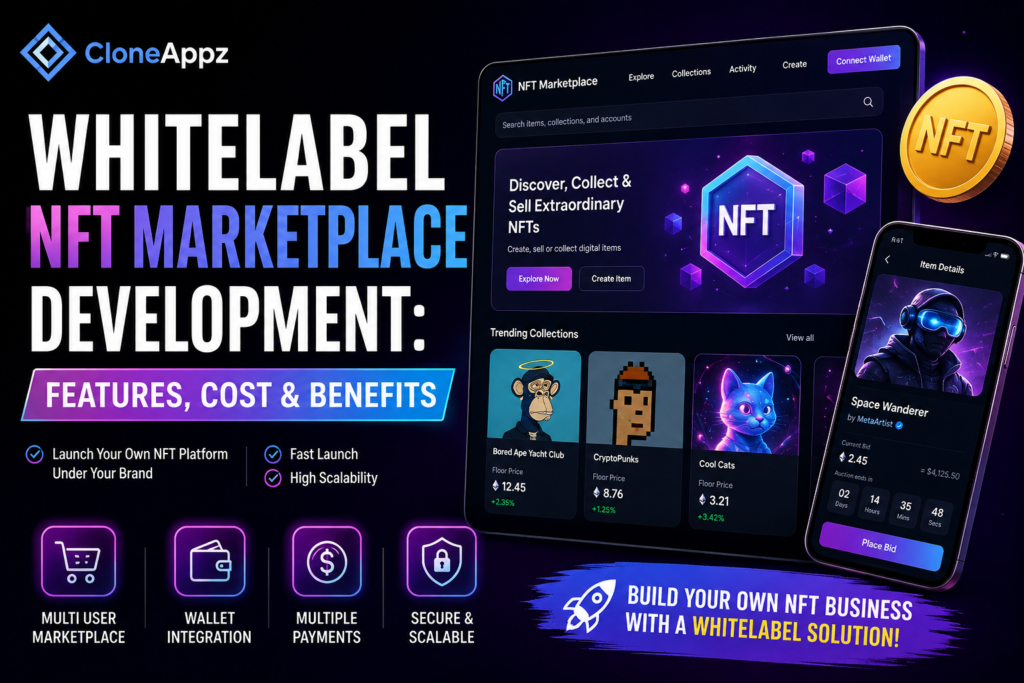
The NFT market has moved beyond digital artwork. Today, businesses are exploring NFTs for gaming assets, memberships, collectibles, digital certificates, event tickets, virtual goods, and other blockchain-based products. For entrepreneurs, this creates an opportunity to launch a branded NFT marketplace without spending years building every component from scratch.
A whitelabel NFT marketplace provides a ready-made foundation that businesses can customize with their own brand, features, payment options, and marketplace rules. This approach can make launching an NFT platform more practical, especially for startups that want to test a business idea quickly.
At the same time, the marketplace needs to offer more than attractive NFT listings. Security, wallet integration, transaction management, user experience, and blockchain compatibility all play an important role in building a platform that users can trust.
What Is a Whitelabel NFT Marketplace?
A whitelabel NFT marketplace is a pre-built NFT trading platform that can be customized and launched under a company’s own brand.
Instead of developing every component independently, the business starts with an existing marketplace framework. The platform can then be adapted to its target audience and business model.
A typical marketplace may allow users to:
- Create accounts
- Connect crypto wallets
- Mint NFTs
- Upload digital assets
- List NFTs for sale
- Buy and sell NFTs
- Place bids
- Manage collections
- View transaction history
- Receive notifications
The administrator can manage users, collections, transactions, fees, listings, reports, and platform settings through an admin dashboard.
The important point is that whitelabel does not mean the business has to operate an identical copy of another marketplace. A properly customized solution should have its own branding, user experience, features, and business strategy.
Why Choose Whitelabel NFT Marketplace Development?
Launching a blockchain marketplace from scratch can involve considerable development work. A ready-made platform can reduce some of the initial technical effort.
Faster Time to Market
One of the biggest advantages is speed. Core marketplace functionality can already be available, allowing the business to focus on customization and launch preparation.
For a startup, getting a minimum viable product into the market can be more useful than spending a long period developing features that users may not even need.
Lower Initial Development Effort
Custom blockchain development requires work across frontend interfaces, backend systems, smart contracts, wallet integrations, databases, security, and testing.
A ready-made solution can provide the foundation for these components. Businesses can then allocate resources toward features that actually differentiate their marketplace.
Custom Branding
A marketplace should represent the company operating it.
A whitelabel solution can typically be customized with:
- Brand name
- Logo
- Colors
- User interface
- Domain
- Marketplace categories
- Fee structure
- Supported payment methods
- Platform-specific features
This allows the final product to feel like a standalone business rather than a generic software product.
Key Features of a Whitelabel NFT Marketplace
The required features depend on the type of NFT marketplace being launched. However, several capabilities are commonly important.
NFT Minting
Creators should be able to convert digital assets into NFTs through a straightforward minting process.
The platform may support different asset formats depending on the marketplace’s requirements and selected blockchain.
NFT Listing and Trading
Users need a simple way to list NFTs, set prices, manage listings, and complete transactions.
A clean listing page should clearly display important information such as ownership, price, collection details, transaction history, and other relevant attributes.
Crypto Wallet Integration
Wallet connectivity is an important part of an NFT marketplace.
Users should be able to connect supported wallets to buy, sell, mint, and manage NFTs. The exact wallet options depend on the blockchain networks supported by the platform.
Auctions and Bidding
An auction feature can make the marketplace more engaging for certain categories of NFTs.
Sellers can establish auction rules, while buyers can submit bids during a defined period. The system should clearly communicate current bids, deadlines, and auction status.
Search and Filters
As the number of NFTs grows, finding the right asset becomes more difficult.
Search, categories, price filters, collection filters, creator profiles, and sorting options can help users navigate a large marketplace more efficiently.
User Profiles
Creator and buyer profiles can display collections, listed NFTs, purchase history, and other public information.
A strong profile system can also help creators establish their identity within the marketplace.
Admin Dashboard
The administrator needs control over the platform.
An admin dashboard can be used to manage:
- Users
- NFT collections
- Listings
- Transactions
- Platform fees
- Reported content
- Categories
- Promotions
- Blockchain settings
- Analytics
This central control is important for maintaining marketplace operations.
Security Should Be a Priority
Blockchain transactions can involve valuable digital assets, so security should not be treated as an optional feature.
A marketplace should use appropriate security practices around account authentication, wallet connections, smart contracts, APIs, payment processing, and data protection.
Smart contracts should also be properly tested and audited where appropriate. Before launch, businesses should conduct functional, security, and transaction testing rather than assuming that a ready-made platform is automatically secure.
How Does an NFT Marketplace Make Money?
A marketplace can generate revenue through different models.
Transaction Fees
The platform can charge a percentage or fixed fee when users complete NFT transactions.
Listing Fees
Businesses can charge creators for listing NFTs, depending on the marketplace strategy.
Minting Fees
A fee may be charged when creators mint new NFTs on the platform.
Featured Listings
Creators or collection owners can pay for additional visibility within selected areas of the marketplace.
Creator Royalties
Depending on the marketplace design and applicable blockchain standards, creator royalty mechanisms may provide an additional revenue opportunity.
The best model depends on the audience and type of NFTs being traded. Excessive fees can discourage creators and buyers, so pricing should be competitive.
How Much Does Whitelabel NFT Marketplace Development Cost?
There is no universal development price for a whitelabel NFT marketplace.
The final cost depends on the scope of the project, including:
- Blockchain network
- Number of supported wallets
- UI/UX customization
- Smart contract requirements
- NFT minting functionality
- Auction and bidding features
- Payment integrations
- Admin dashboard
- Security requirements
- Mobile application requirements
- Third-party integrations
- Maintenance and support
A basic marketplace with essential trading functionality will generally require less development work than a multi-chain platform with advanced smart contracts, mobile apps, analytics, and extensive customization.
The most reliable way to estimate the budget is to define the required features first and then obtain a project-specific development proposal.
Whitelabel vs Custom NFT Marketplace
Both approaches have their place.
A completely custom marketplace provides maximum control over architecture and functionality. However, it generally requires more development time and a larger technical budget.
A whitelabel marketplace starts with an existing foundation, making it useful for businesses that prioritize faster deployment and lower initial development effort.
For many startups, a practical strategy is to launch with essential functionality and add advanced features after gaining real user feedback.
What Other Ready-Made Platforms Can Teach Us
The ready-made software model is not limited to blockchain.
For example, an Amazon Clone Script can provide a foundation for entrepreneurs planning an eCommerce marketplace. Similarly, a CashApp Clone App can serve as a starting point for businesses exploring peer-to-peer payment solutions.
These examples highlight an important principle: ready-made software can accelerate development, but the final product still needs a clear business purpose.
An NFT marketplace should therefore be designed around a specific audience instead of trying to support every possible NFT category from day one.
How to Launch a Whitelabel NFT Marketplace
A successful launch requires more than setting up the software.
1. Select Your Niche
Decide what type of NFTs your marketplace will focus on. This could include art, gaming assets, collectibles, memberships, or another specialized category.
2. Select the Blockchain
Choose a blockchain based on transaction costs, ecosystem, speed, wallet support, and the needs of your users.
3. Define Your Features
Separate must-have features from advanced functionality. Start with the features required to operate the marketplace effectively.
4. Customize the Platform
Apply your brand identity, marketplace rules, fee structure, categories, and user experience.
5. Test Smart Contracts and Transactions
Test buying, selling, minting, bidding, wallet connections, and transaction handling before launch.
6. Build Creator Partnerships
A marketplace needs quality content. Working with creators and collection owners can help generate initial activity.
7. Promote the Platform
SEO, content marketing, social media, creator partnerships, community building, and targeted advertising can help attract the first users.
Final Thoughts
Whitelabel NFT marketplace development can be a practical route for entrepreneurs who want to enter the NFT market with a ready-made technical foundation.
The biggest advantage is not simply faster development. It is the ability to start with essential marketplace functionality and customize the product around a specific audience.
However, success depends on more than the technology. A clear niche, reasonable fees, strong security, reliable wallet integration, useful features, and an effective marketing strategy are equally important.
Whether you are exploring an NFT marketplace, an Amazon Clone Script , or a CashApp Clone App, the same principle applies: use ready-made technology to accelerate the launch, but build a business experience that gives users a reason to stay


