 WhatsApp Us Now
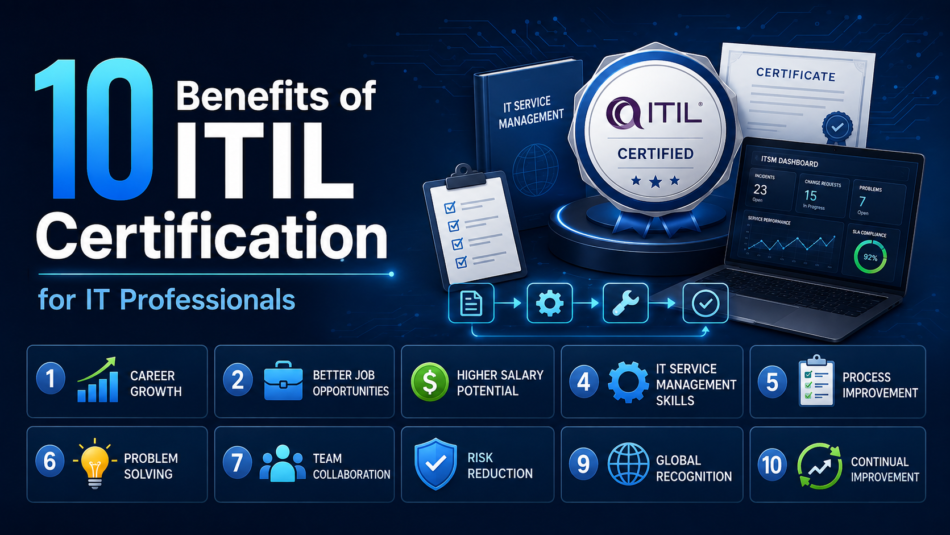
ITIL certification can be a valuable choice for IT professionals who want to improve their understanding of service management, digital operations, customer experience, continual improvement, and business value.
In 2026, the ITIL qualification structure continues to evolve, with ITIL Foundation (Version 5) serving as the current entry point for new learners. The updated framework places stronger emphasis on digital products and services, value creation, transformation, sustainability, and responsible use of AI.
For professionals working in IT support, cloud, infrastructure, cybersecurity, DevOps, service delivery, or management, ITIL can complement technical certifications by adding a broader understanding of how technology services should be designed, operated, measured, and improved.
Here are ten important benefits.
1. Builds Strong IT Service Management Skills
One of the biggest benefits of ITIL certification is learning a structured approach to managing IT services.
The framework helps professionals understand concepts involving:
- Service delivery
- Value creation
- Service relationships
- Governance
- Continual improvement
- Digital products
- Customer outcomes
Instead of looking only at whether a server, application, or cloud platform is technically working, ITIL encourages professionals to consider whether the service is delivering the required business value.
This broader perspective is especially useful as professionals move into more responsible operational roles.
2. Improves Incident and Problem Management
IT professionals regularly deal with outages, performance problems, failed applications, and user issues.
ITIL provides structured approaches for managing these situations.
A key distinction is understanding that an incident is generally focused on restoring service, while problem management looks deeper into causes and recurring issues.
This helps professionals avoid treating every technical issue as an isolated event.
Better incident and problem-management skills can support roles such as:
- Service Desk Analyst
- IT Support Specialist
- System Administrator
- Operations Engineer
- Incident Manager
The result is a more organized approach to maintaining service reliability.
3. Helps Professionals Manage Change More Effectively
Changes are a normal part of modern IT.
Organizations constantly update:
- Cloud environments
- Applications
- Servers
- Security controls
- Network configurations
- Business systems
Poorly planned changes can cause outages or operational disruption.
ITIL teaches professionals to consider the risk, business impact, timing, authorization, deployment, and expected outcome of a change.
This is valuable for:
- Cloud Engineers
- DevOps Professionals
- System Administrators
- Infrastructure Teams
- Application Support Teams
The goal is not to slow down technology teams. It is to make changes more predictable and controlled.
4. Creates a Common Language Across IT Teams
Modern IT environments involve many different groups.
A single service may depend on:
- Developers
- Network engineers
- Security teams
- Cloud teams
- Service desk staff
- Vendors
- Business users
Each group may describe problems differently.
ITIL provides a shared service-management vocabulary that helps teams communicate more consistently across incidents, problems, changes, service levels, requests, and continual improvement.
This can be especially valuable in large enterprises where many teams contribute to the same digital service.
5. Connects Technical Work With Business Value
Technical professionals often focus naturally on technical outcomes.
For example:
Is the system online?
Is the network responding?
Did the deployment succeed?
ITIL encourages another question:
Did the technology create the intended value?
The current Foundation framework emphasizes value co-creation and considering outcomes, costs, risks, experience, and sustainability when managing digital products and services.
This perspective becomes increasingly important as professionals move toward:
- Service management
- IT leadership
- Architecture
- Product management
- Consulting
- Digital transformation
Understanding business value can help technical specialists communicate more effectively with nontechnical stakeholders.
6. Strengthens Continual Improvement Skills
IT environments are never finished.
Organizations continually need to improve:
- Performance
- Availability
- User experience
- Security
- Efficiency
- Cost
- Processes
ITIL provides a structured continual-improvement mindset.
Instead of waiting for major failures before making changes, teams can regularly evaluate:
- Where they are now
- Where they want to be
- What should improve
- How improvement will be measured
- Whether the change produced the expected result
This approach can apply to nearly any IT environment.
For example, a service desk can improve resolution time while a cloud team can improve reliability or reduce unnecessary operational effort.
7. Supports Career Growth Into Management Roles
ITIL can be particularly useful for professionals who want to move from technical work into broader operational or management responsibilities.
Current advanced qualification paths support roles involving service management, operations, experience, product management, transformation, and strategy.
Potential career directions include:
- IT Service Manager
- Service Delivery Manager
- IT Operations Manager
- Service Desk Manager
- Transformation Lead
- Product Manager
- Service Improvement Manager
Technical knowledge remains important, but these positions also require understanding of processes, stakeholders, service quality, and organizational outcomes.
ITIL helps build that additional perspective.
8. Provides Vendor-Neutral Knowledge
Another important benefit is that ITIL is not tied to one cloud provider, operating system, networking vendor, or enterprise application.
The concepts can be applied to environments involving:
- Public cloud
- Private cloud
- Hybrid infrastructure
- Enterprise applications
- Cybersecurity platforms
- Networking
- Service management systems
This makes ITIL complementary to technical certifications.
For example:
Cloud certification + ITIL
can combine platform expertise with service-management knowledge.
Similarly:
Cybersecurity certification + ITIL
can help professionals understand security operations in the broader context of incidents, change, governance, service continuity, and business value.
9. Helps Professionals Measure Service Performance
IT teams need more than technical activity reports.
They need meaningful ways to evaluate whether services are performing effectively.
ITIL helps professionals think about:
- Service levels
- Key performance indicators
- User experience
- Business outcomes
- Service quality
- Improvement targets
This becomes important when working with service-level agreements or operational reporting.
For example, a team may close hundreds of support tickets every month.
That number alone does not tell management whether:
- Users are satisfied
- Critical issues are resolved quickly
- Problems repeatedly return
- Service availability is improving
ITIL encourages professionals to select measurements that reflect actual service outcomes.
10. Adds a Recognized Service-Management Credential
ITIL is widely used as a structured framework for managing digital products and services.
Foundation is currently positioned as the entry point into the certification path and is designed for professionals at different career stages.
Certification can therefore help demonstrate that you understand established service-management principles.
It can complement experience in:
- IT support
- Infrastructure
- Operations
- Cloud
- DevOps
- Cybersecurity
- Service delivery
Cert Mage can also be used as part of an exam-focused preparation approach alongside official learning materials, practical ITSM experience, revision notes, and scenario-based practice.
Certification by itself does not guarantee a promotion or new role, but it can strengthen a professional profile when the credential is relevant to the position.
ITIL Is Becoming More Relevant to Modern Digital Work
ITIL is no longer focused only on traditional IT support.
The current framework places greater emphasis on managing digital products and services throughout their lifecycle.
It also reflects modern areas such as:
- AI-enabled environments
- Digital transformation
- Product management
- Customer experience
- Sustainability
- Responsible AI
The current Foundation version specifically incorporates modern digital product and service management alongside responsible AI concepts.
That makes the framework relevant beyond traditional service desk roles.
ITIL 4 vs ITIL Version 5 in 2026
There is an important transition underway.
ITIL 4 remains available in 2026, while the newer ITIL Version 5 framework is being introduced progressively.
For new candidates, ITIL Foundation Version 5 is now positioned as the current entry point. Professionals who already hold ITIL 4 credentials can continue using them and can also follow transition routes into the newer framework.
The current plan is for ITIL 4 modules to remain available until December 31, 2027.
Existing ITIL 4 knowledge therefore remains relevant during the transition.
Who Should Consider ITIL Certification?
ITIL can be particularly useful for:
- IT Support Specialists
- Service Desk Analysts
- System Administrators
- Cloud Engineers
- DevOps Professionals
- Infrastructure Engineers
- Incident Managers
- Change Managers
- IT Operations Managers
- Service Delivery Managers
- IT Managers
- Digital Transformation Professionals
It can also benefit technical specialists who increasingly need to communicate with business stakeholders.
Is ITIL Certification Worth It in 2026?
For professionals working with IT services, operations, support, or digital transformation, it can be.
The value is strongest when ITIL knowledge is combined with technical skills and practical experience.
For example:
Networking skills + ITIL
can support network operations.
Cloud skills + ITIL
can support cloud service delivery.
Cybersecurity skills + ITIL
can support security operations and incident processes.
Technical experience + ITIL
can support progression toward IT management.
ITIL should therefore be viewed as a complementary professional skill rather than a replacement for technical expertise.
Conclusion
ITIL certification can provide valuable benefits for IT professionals in 2026 because modern technology careers require both technical knowledge and the ability to deliver reliable digital services.
The ten major benefits are:
- Stronger IT service-management knowledge
- Better incident and problem management
- More effective change management
- Improved communication across teams
- Better alignment between IT and business value
- Continual improvement skills
- Stronger career progression opportunities
- Vendor-neutral service-management knowledge
- Better service-performance measurement
- A recognized professional credential
For professionals working in IT support, cloud, infrastructure, cybersecurity, DevOps, operations, service delivery, or management, ITIL can add a valuable service-management layer to existing technical expertise.
The strongest approach is:
Technical skills + ITIL knowledge + practical experience
Together, these can help professionals understand not only how technology works, but how to operate it effectively as a valuable business service.
FAQs
What is the biggest benefit of ITIL certification?
One of the biggest benefits is learning how to manage IT and digital services in a structured way while focusing on business value, service quality, and continual improvement.
Is ITIL useful for technical professionals?
Yes. Cloud engineers, system administrators, cybersecurity professionals, support specialists, and DevOps professionals can apply ITIL concepts to operations, incidents, changes, and service delivery.
Is ITIL only for IT managers?
No. Foundation-level ITIL is suitable for professionals at different career stages, while advanced paths support roles in operations, service management, strategy, product management, and transformation.
Is ITIL Version 5 available in 2026?
Yes. ITIL Foundation Version 5 is currently available and serves as the entry point into the updated qualification framework.
Is ITIL 4 still valid in 2026?
Yes. ITIL 4 remains available during the transition, with the current plan setting December 31, 2027 as the sunset date for ITIL 4 modules.
Can ITIL help with career advancement?
It can support career progression when service management is relevant to the role, particularly in IT operations, service delivery, management, product, and transformation positions.
Read More: ISC2 ISSAP Exam Guide: Eligibility, Domains, Cost, and Preparation


