 WhatsApp Us Now
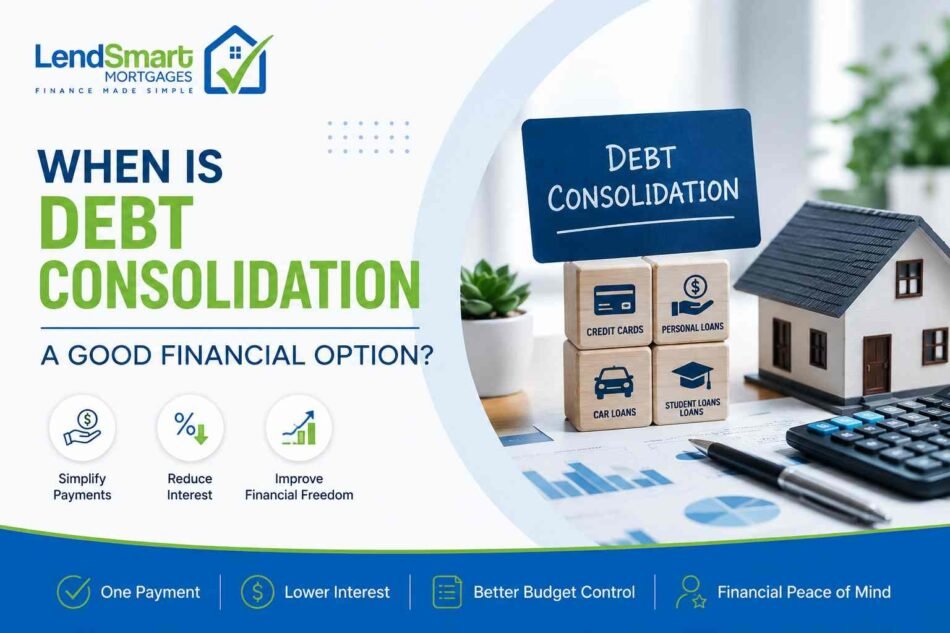
Managing multiple debts can become difficult when different loans and credit accounts have different interest rates, payment dates, and terms. When several monthly payments start putting pressure on your budget, debt consolidation may appear to be a practical solution. It allows borrowers to combine multiple debts into one new loan or payment arrangement, making repayment easier to manage.
At LendSmart, we provide personalised mortgage solutions designed to simplify the home-buying journey. With competitive rates, flexible loan options, and expert support throughout the process, we help you choose a mortgage that aligns with your budget, financial situation, and homeownership goals.
However, debt consolidation is not automatically the right choice for everyone. Its benefits depend on your current debts, credit profile, income, interest rates, and spending habits. Before choosing this option, it is important to understand how debt consolidation works, when it can save money, and when it may create additional financial problems.
What Is Debt Consolidation?
Debt consolidation means combining several existing debts into one new debt. Instead of making separate payments toward credit cards, personal loans, or other eligible debts, you make one payment to a single lender or financial institution.
For example, suppose you have three credit cards with different balances and interest rates. You may take a debt consolidation loan and use the funds to pay off those balances. After that, instead of managing three credit card payments, you make one monthly payment toward the consolidation loan.
The main purpose is to simplify debt repayment and, in some situations, reduce the total interest you pay. However, consolidation does not make the debt disappear. You are still responsible for repaying the borrowed amount, and the new loan may have fees, interest charges, or a longer repayment period.
When You Have Multiple High-Interest Debts
Debt consolidation can be a good financial option when you are dealing with several high-interest debts. Credit card balances are a common example because their interest rates can be significantly higher than those of certain personal loans or secured lending products.
If you qualify for a consolidation loan with a lower interest rate, more of your monthly payment may go toward reducing the principal rather than paying interest. Over time, this can potentially reduce the overall cost of borrowing.
The key is to compare the actual annual percentage rate, fees, and repayment period of the new loan with your existing debts. A lower monthly payment alone does not necessarily mean you are saving money.
When Managing Several Payments Becomes Difficult
Keeping track of multiple payment dates can be challenging, particularly when you have several credit accounts. Missing even one payment may result in late fees and can potentially affect your credit profile.
Debt consolidation can simplify this process by replacing several payments with one regular payment. This can make your monthly finances easier to organize and reduce the risk of forgetting a payment.
For borrowers who have enough income to repay their debt but struggle with managing multiple accounts, consolidation can provide a more structured repayment approach.
When You Can Secure a Lower Interest Rate
One of the most important factors to consider is whether the new loan actually offers better borrowing terms. If your credit score, income, and overall financial position have improved since you originally borrowed money, you may qualify for a more competitive interest rate.
For instance, someone who previously relied on high-interest credit cards may later qualify for a personal loan at a lower rate. Consolidating those balances could make financial sense if the new loan has lower overall borrowing costs.
Before making a decision, compare the interest rate on the consolidation loan with the weighted average rate of your existing debts. Also consider origination charges, processing fees, early repayment penalties, and other costs.
If you’re looking for a reliable Home Loan Adelaide, LendSmart Mortgages offers personalised lending solutions tailored to your financial needs. With competitive interest rates, flexible mortgage options, and professional guidance, we make the home loan process easier, clearer, and more manageable from application to settlement.
When You Have a Stable Income
Debt consolidation generally works best when you have a reliable source of income and can comfortably afford the new monthly payment. Consolidating debt does not solve an underlying income problem.
If your income is stable, you can create a repayment plan around a predictable monthly amount. This makes it easier to budget for essential expenses while consistently reducing your debt.
On the other hand, if your income is highly uncertain or you are already struggling to cover basic living expenses, taking another loan may not address the real financial problem. In that situation, reviewing your overall budget and seeking professional financial guidance may be more appropriate.
When You Have a Clear Repayment Plan
Debt consolidation should be part of a larger debt repayment strategy rather than simply a way to move balances from one account to another. Before consolidating, you should understand how much you owe, what interest rates you are paying, and how quickly you want to become debt-free.
A clear repayment plan can help you avoid taking on unnecessary new debt. Once high-interest credit card balances have been consolidated, continuing to spend heavily on those cards can leave you with both the new consolidation loan and new credit card balances.
The goal should be to use consolidation as a tool for better debt management, not as an opportunity to increase available borrowing.
When You Can Avoid Taking on New Debt
Your spending habits play an important role in determining whether debt consolidation will actually help. If excessive credit card spending was the main reason your balances increased, consolidation alone may provide only temporary relief.
After consolidating your debts, it is important to control new borrowing and maintain a realistic monthly budget. Otherwise, you could end up paying the consolidation loan while rebuilding balances on your old accounts.
For this reason, debt consolidation is generally more useful when you are prepared to change the financial habits that contributed to the original debt.
When the New Loan Has Reasonable Fees
Interest rate is not the only cost you should consider. Some consolidation loans may include application fees, origination fees, administrative charges, or other costs.
A loan with a lower advertised interest rate may not necessarily be cheaper once all charges are included. You should calculate the total amount you will repay over the entire loan term.
For example, extending repayment from three years to seven years may reduce your monthly payment but could result in substantially more interest being paid over time. A lower monthly payment should therefore be evaluated alongside the total cost of the loan.
When Your Credit Profile Is Strong Enough
Your credit history can influence the interest rate and terms you receive from a lender. Borrowers with stronger credit profiles may have access to better consolidation options.
If your credit score has declined significantly because of missed payments or high credit utilization, the available consolidation loans may carry higher interest rates. In such circumstances, consolidation may not provide enough financial benefit to justify taking a new loan.
Improving your credit profile before applying, where practical, may help you access better terms. This can include making payments on time, reducing outstanding balances, and avoiding unnecessary new credit applications.
When Debt Consolidation May Not Be the Right Choice
Debt consolidation is not suitable in every situation. If the new loan has an interest rate similar to or higher than your existing debts, there may be little financial advantage.
It may also be unsuitable if consolidation requires you to secure unsecured debt against an asset, such as your home. While secured borrowing can sometimes offer lower interest rates, failure to repay the loan could put the secured asset at risk.
Another concern is extending the repayment period unnecessarily. Although a longer term can make monthly payments more manageable, it may increase the total interest paid.
How to Evaluate a Debt Consolidation Offer
Before accepting a consolidation loan, look beyond the monthly payment. Review the interest rate, annual percentage rate, loan term, fees, total repayment amount, and any penalties associated with the agreement.
Compare these details with your existing debts. You should also check whether the consolidation loan has a fixed or variable interest rate and understand how changes could affect your payments.
It can help to calculate how much you currently pay toward all debts each month and how much you would pay under the new arrangement. More importantly, compare the total cost rather than focusing only on short-term monthly savings.
Final Thoughts
Debt consolidation can be a good financial option when it reduces borrowing costs, simplifies multiple payments, and fits comfortably within a realistic budget. It can be particularly useful for borrowers managing several high-interest debts who have stable income and qualify for better loan terms.
However, consolidation is not a quick solution to excessive spending or unaffordable debt. The right decision depends on the complete financial picture, including interest rates, fees, income, credit history, repayment period, and spending habits.
Before choosing debt consolidation, carefully compare your current debts with the proposed new loan. If the numbers show genuine savings and you have a clear plan for avoiding additional debt, consolidation can become a useful part of a responsible debt repayment strategy.


