 WhatsApp Us Now
Walk into any bustling international airport terminal or high end luxury hotel lobby and you might look down to see the familiar warm rosy tones of chima pink granite. This beautiful natural stone quarried mostly in the Jalore region of Rajasthan India is highly famous across the globe for its soft peach background mixed with striking black and white speckles. It is an incredibly popular material for commercial builders because it offers extreme durability and a very welcoming aesthetic.
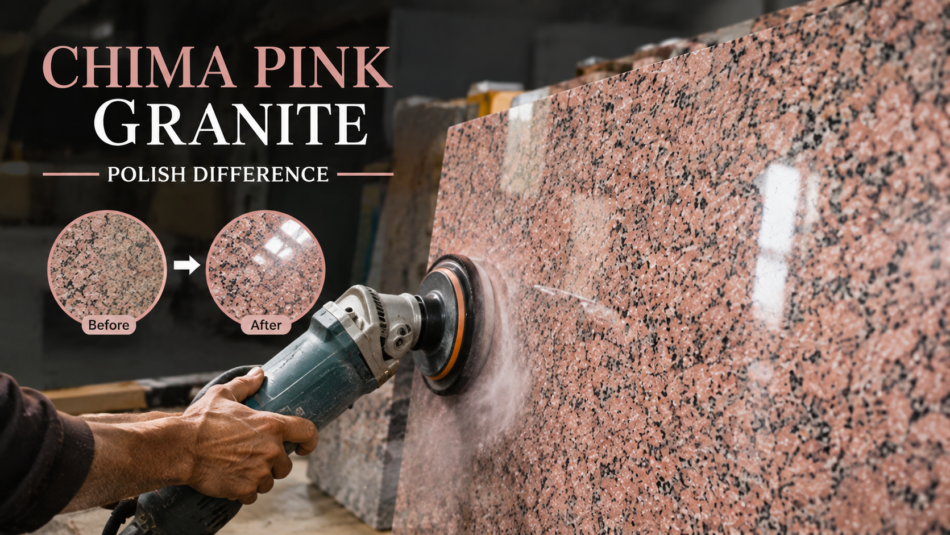
But if you look closely at different construction projects you might notice something a little bit strange. Sometimes the floor looks like a perfect glass mirror reflecting the bright ceiling lights flawlessly. Other times the exact same type of stone looks a bit dull hazy or cloudy. Why does this happen? How can two pieces of the exact same stone look so different under the light? The answer comes down to natural geology heavy machinery and the specific processing choices made by the factory.
It Begins with the Rough Granite Blocks
The journey to a perfect mirror finish does not actually start inside a dusty factory. It starts deep inside the side of a mountain. When miners extract stone from the earth using heavy explosives and massive wire saws they pull out gigantic heavy pieces called rough granite blocks.
Not all blocks are created equal because nature is highly unpredictable. Some blocks are perfectly solid and structurally sound while others have tiny microscopic cracks called micro fissures running deep through them. When a factory tries to polish a block that has too many natural voids or heavy fissures the stone will never ever achieve that ultimate wet look. The broken surface will always scatter the light instead of reflecting it perfectly back at your eyes. This is why strict block selection right at the quarry edge is so incredibly important for the final finished product. If you start with a bad block you will end up with bad granite slabs.
The Mineral Lottery of Quartz and Mica
To really understand the polishing process you have to understand what this specific material is actually made of. Granite is an igneous rock which means it formed from slowly cooling liquid magma millions of years ago. It is not just one solid material but rather a mixture of different minerals packed tightly together. Chima pink granite is mostly composed of quartz feldspar and flaky black mica.
This mixed mineral makeup is the exact reason why polishing can be so tricky. Quartz is an extremely hard and dense mineral. When the heavy grinding wheels hit the quartz spots it polishes up incredibly well taking on a brilliant glass like shine. Feldspar also takes a very good polish but it is slightly softer than quartz. Mica on the other hand is very flaky and very soft.
If a particular slab has larger clusters of black mica near the top surface those specific spots will not polish nearly as well as the pink quartz spots. Slabs that happen to have a tighter more uniform grain structure with a very healthy amount of quartz will always polish much better than slabs with loose flaky mineral deposits. You can not change the geology but a good supplier knows how to pick the blocks with the tightest grain.
The Magic of Modern Epoxy Resin Treatment
Even if you have the best quality blocks nature still leaves tiny little pits and open pores on the surface of the natural rock. Many years ago factories just polished the stone exactly as it was resulting in a finish that was decent but never truly perfect. Today the absolute best processing facilities use advanced epoxy resin technology to fix this natural problem.
After the raw block is sliced down into individual thin pieces the wet stone is placed into a massive oven to dry completely. Then skilled factory workers pour a specialized clear liquid epoxy resin over the entire top surface. This liquid is spread out and seeps down deep into every single microscopic pore fissure and pit on the face of the stone. The material is then baked again in a second oven to cure the liquid resin making it rock hard.
When the treated stone finally goes through the polishing line the grinding wheels cut right through both the hard rock and the hardened resin. The resin permanently fills the empty gaps creating a perfectly flat continuous surface that reflects light beautifully. Factories that skip this expensive resin step to save money or those who use cheap poor quality epoxy will always produce material that looks dull and pitted by comparison.
Machine Settings on the Line Polisher
You can not just throw a piece of heavy stone onto a machine press a green button and expect pure magic. The polishing phase requires a massive expensive piece of equipment called a line polisher. This long machine has a conveyor belt that slowly moves the material under a series of heavy spinning grinding heads. A typical high quality polishing line might have twenty or thirty different heads working in a row.
Each spinning head is fitted with special abrasive pads. The process always starts with very coarse diamond metal abrasives to flatten out the stone and then it slowly moves to extremely fine abrasives to bring out the final bright color and shine.
If a factory manager runs the conveyor belt too fast because they are trying to produce more material in less time the abrasives simply do not have enough time to do their job properly. The stone rushes through the machine and the final polish suffers terribly. The absolute best shine comes from a slow steady machine pace where the spinning heads can really work the surface and generate the proper friction.
Abrasive Quality and Water Cooling Pressure
The actual grinding pads attached to those spinning heads make a huge difference too. Polishing abrasives wear out very quickly just like sandpaper. Cheap factories will always try to squeeze too much life out of their abrasive pads running them long after they should have been thrown in the trash. When you try to polish stone with worn out flat pads you just end up rubbing the stone instead of actually cutting it smoothly. This always results in a hazy cloudy finish.
On the flip side a premier expert company like bbv impex ensures their machine operators swap out the abrasive pads exactly when they need to be changed. They also pump hundreds of gallons of clean recycled water directly over the stone during the entire polishing process. The water keeps the diamond pads cool. If there is not enough water pressure the friction creates massive intense heat which can actually burn the epoxy resin and ruin the polish completely. The combination of fresh sharp abrasives and perfect water pressure is what creates that breathtaking mirror reflection everyone wants.
Calibration and Even Surface Pressure
We also need to talk about calibration before we finish. Before the stone even reaches the first polishing head it needs to be made perfectly flat. If a slab is thicker on the left side and thinner on the right side the heavy polishing heads will press down much harder on the thick side as it passes under.
This uneven machine pressure means the thick side might get a decent polish while the thin side barely gets touched by the finer finishing abrasives. Calibrating the stone to an exact uniform thickness using special milling wheels before polishing guarantees that the spinning heads apply the exact same pressure across every single square inch of the material. There is many factories that struggle with this specific calibration step and it always shows up as dull patches in the final reflection.
Proving the Polish with Gloss Meters
Professional buyers do not just look at a piece of stone and guess if the polish is good enough. They use science to prove it. In top tier factories quality control inspectors use handheld digital tools called gloss meters.
An inspector will place the gloss meter flat against the surface of the chima pink granite. The tool shoots a beam of light at the stone and measures exactly how much light bounces back into the sensor. It gives a numerical reading usually from one to one hundred. A reading above eighty five or ninety means the polish is exceptionally high quality and ready for export. If the number reads too low the inspector knows something went wrong on the polishing line and they will send the material back to be reprocessed. This completely removes human opinion from the quality control process.
Packaging to Protect the Hard Work
Achieving a brilliant bright polish is only half the battle in the stone industry. Protecting that delicate surface during international shipping is just as important. You could have the most beautifully polished pink material in the entire world but if the warehouse team just throws the pieces into a shipping container loosely they will rub against each other during the violent ocean voyage.
The rough back side of one piece will easily scratch the highly polished face of the piece sitting right next to it ruining all that expensive hard work. Professional suppliers take the extra time and money to place protective plastic sheets or thick foam barriers between every single polished face. They bundle the material tightly in heavy wooden export frames so absolutely nothing can shift or vibrate while the cargo ship crosses the ocean.
Getting that perfect glossy finish is never an accident. It takes a massive amount of effort precise heavy machinery and serious financial investment in the right processing technology. From selecting the absolute healthiest raw material at the quarry edge to managing the delicate epoxy resin curing process every single step matters greatly. When you are buying material for a large commercial project you simply can not afford to take chances with dull hazy stone. Taking the time to ask your stone partner about their resin process their line polishing speed and their gloss meter quality control checks will save you alot of headaches and money in the long run.


