 WhatsApp Us Now

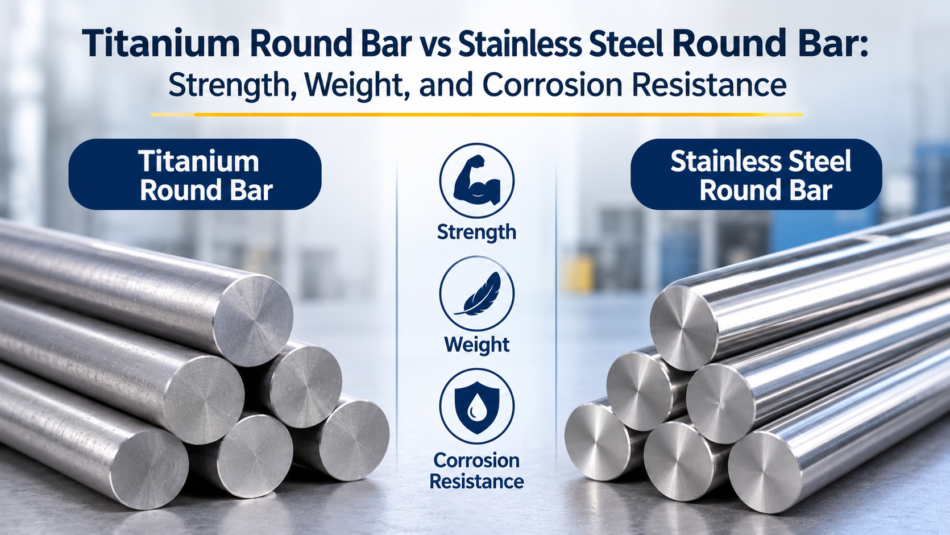
In many industrial situations, it is essential to use a corrosion-resistant metal, and titanium and stainless steel are both recommended choices. The two materials come in solid cylindrical shapes and offer different strengths, weights, corrosion resistance, temperature ranges and costs of materials. The correct material is always a function of the specific application, operating environment, mechanical requirements and fabrication requirements. Comparing the performance of a Titanium Round Bar with a Stainless Steel Round Bar helps understand their unique engineering properties in various industries.
What Is a Titanium Round Bar?
A Titanium Round Bar is a solid cylindrical product manufactured directly from commercially pure titanium or specific titanium alloys. The material is fundamentally defined by its low density and lightweight construction. It delivers a remarkably high strength-to-weight ratio compared to heavier industrial metals. The metal exhibits excellent corrosion resistance in harsh settings. It retains good performance in demanding environments over extended service periods. Typical applications include aerospace components, chemical processing equipment, marine systems, and medical components. Engineers frequently select this specific alloy product when excess weight creates structural limitations in an assembly.
What Is a Stainless Steel Round Bar?
A Stainless Steel Round Bar is a solid cylindrical product available in many different stainless steel grades. Material properties vary strictly depending on the selected grade. Common options include 304, 316, duplex, and several other alloy families. These bars generally provide good mechanical strength and adequate corrosion resistance. They boast wide availability in different sizes and surface finishes. Many grades offer distinct ease of fabrication and machining. Standard applications involve machinery, construction, chemical processing, food processing, marine systems, and general industrial equipment. Factories use these bars heavily for everyday structural needs.
Titanium Round Bar vs Stainless Steel Round Bar: Key Differences
Evaluating these metals means comparing specific grades rather than treating all titanium and stainless steel grades as identical. The resulting differences dictate their exact mechanical suitability in any industrial project.
| Factor | Titanium Round Bar | Stainless Steel Round Bar |
| Density | Lower and lightweight | Higher than titanium |
| Strength-to-Weight Ratio | Very high | Varies by grade |
| Corrosion Resistance | Excellent in many aggressive environments | Excellent, depending on grade |
| Mechanical Strength | High for its weight | Varies significantly by grade |
| Heat Performance | Suitable for selected elevated temperature applications | Grade-dependent |
| Fabrication | Requires controlled processing for some applications | Generally easier to fabricate |
| Material Cost | Generally higher | Usually more economical |
| Typical Use | Aerospace, marine, chemical, medical | General industrial, construction, chemical, food, marine |
How Do Titanium and Stainless Steel Compare in Strength?
Evaluating material strength involves looking at density and specific mechanical properties. Engineers calculate yield and tensile parameters to determine the exact structural limits of components.
Titanium Strength-to-Weight Ratio
The relatively low density of titanium gives the material a distinctly high strength-to-weight ratio. This characteristic proves valuable where weight reduction is critically important to the design. Aerospace and high-performance applications utilize this property extensively.
Stainless Steel Mechanical Strength
Stainless steel strength varies considerably by the exact grade and material condition. Precipitation-hardened, martensitic, and duplex grades can offer very high strength. You must select the specific grade based strictly on the required tensile and yield strength.
Which Factors Affect Strength?
Several variables influence the final mechanical limits. These include the grade and chemical composition, specific heat treatment, and prior cold working. The initial product condition and the ambient operating temperature also directly alter the overall metal strength.
Which Is Lighter: Titanium or Stainless Steel?
A large density difference exists between titanium and standard stainless steel. Titanium possesses a significantly lower baseline density. This lower density can fundamentally reduce the weight of a component manufactured with comparable dimensions. Material weight reduction remains deeply important in aerospace, transportation, marine, and portable equipment manufacturing sectors. Less mass translates directly to fuel savings and easier handling. The actual final component weight always depends on the bar diameter, total length, finished geometry, and the exact material density of the chosen alloy.
Titanium vs Stainless Steel for Corrosion Resistance
Both metals resist degradation but utilize different surface mechanisms. The local operating environment dictates which material will survive longer under continuous chemical or moisture exposure.
Titanium Corrosion Resistance
The metal demonstrates strong resistance to corrosion due to its naturally forming protective oxide layer. It shows immense suitability for seawater and selected chemical environments in marine and processing systems.
Stainless Steel Corrosion Resistance
Stainless steel corrosion resistance depends heavily on the grade. General-purpose 304 differs from molybdenum-bearing 316 in chloride environments. Duplex and super duplex grades handle more demanding corrosion conditions.
Why Environment Matters
Material degradation accelerates based on local factors. Engineers evaluate chloride concentration, acidity and alkalinity, and temperature. Seawater exposure, chemical composition, and crevice and galvanic corrosion conditions dictate the final selection.
Titanium Round Bar vs Stainless Steel Round Bar: Applications
Applications of Titanium Round Bars
Industries specify this lightweight material for structural parts that face aggressive elements or require strict weight limits in their assembly.
- Aerospace components
- Marine equipment
- Chemical processing components
- Medical and biomedical components
- High-performance engineering applications
Applications of Stainless Steel Round Bars
Factories rely heavily on these strong alloys to build durable mechanical parts capable of supporting heavy loads during daily operations.
- Shafts and machine components
- Fasteners
- Food-processing equipment
- Chemical processing equipment
- Construction and fabrication
- Marine and general industrial applications
How Do Cost and Availability Compare?
A Titanium Round Bar generally carries a higher material cost than common stainless steel grades. Conversely, stainless steel is widely available in many different grades, sizes, and finishes across local supply chains. You should always evaluate the base material cost alongside potential weight savings, long-term corrosion resistance, expected service life, machining difficulty, and future maintenance requirements. Selecting a metal solely on the initial purchase price often leads to premature mechanical failure. Total lifetime expenditure provides a more accurate financial comparison.
How to Choose Between Titanium and Stainless Steel Round Bars?
Selecting the proper solid bar requires a strict evaluation of the mechanical forces and chemical exposures the part will endure during its projected operational lifespan.
Consider Weight Requirements
You must choose titanium when reducing the total component weight remains a major engineering design requirement. Stainless steel may be perfectly suitable when excess material weight is ultimately less critical.
Evaluate the Corrosive Environment
Always match the metal directly to the specific chemicals present in the facility. You must calculate the exact chloride exposure, ambient temperature, and all expected physical service conditions completely accurately.
Check Strength Requirements
Compare the required tensile strength, yield strength, material hardness, and strength to weight ratio. Select the specific grade and condition rather than comparing materials only by their common industrial name.
Consider Fabrication and Machining
Evaluate all necessary cutting, turning, drilling, welding, and finishing requirements before purchasing. You must carefully consider your available fabrication capabilities and the specific tooling required to cut hard industrial metals.
Review Standards and Dimensions
Always verify the required diameter, length, tolerance, finish, grade, and applicable material standards. You must ensure the round bar fully meets the project testing and strict material certification compliance requirements. Companies like Niko Steel Centre supply these specific round bars directly to heavy industrial manufacturing facilities.
Conclusion
Titanium’s greatest strength is its strength-to-weight ratio. Stainless steel provides a wide range of grades that offer corrosion resistance, strength, availability and formability. Corrosion resistance is a function of the alloy and service environment. The choice of material should be determined by weight, strength, corrosion exposure, operating conditions, fabrication needs, availability, and specific requirements of the application.


