 WhatsApp Us Now

Introduction
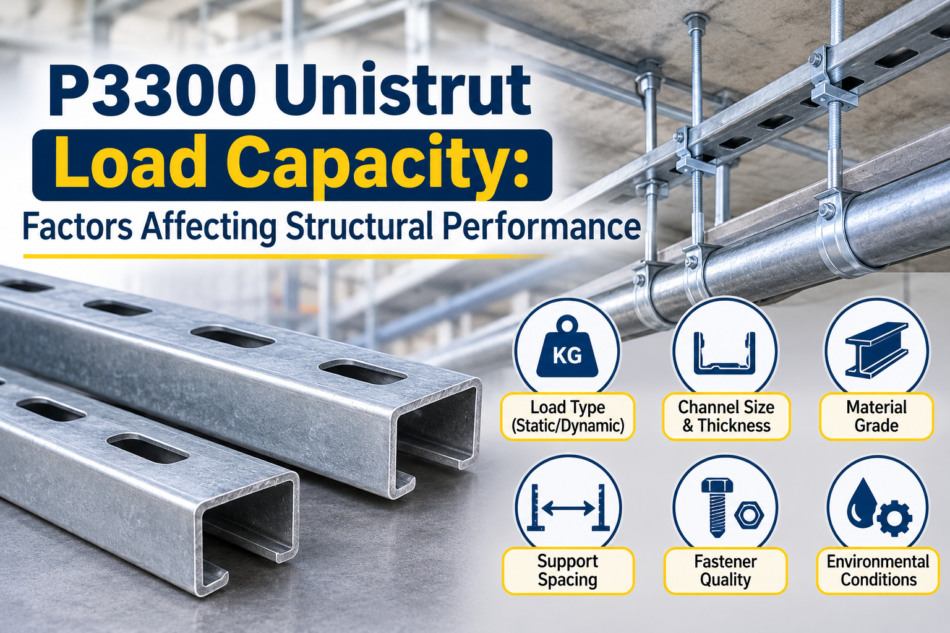
P3300 Unistrut is a half-height metal strut channel supporting electrical conduits, cable trays, piping and mechanical equipment in industrial and commercial installations. Understanding P3300 Unistrut Load Capacity keeps supports stable and prevents the deflection that turns a working installation into a maintenance problem. P3300 load capacity is not a single universal value. It depends on material thickness, span, loading pattern, support spacing, orientation and installation conditions.
What Is a P3300 Unistrut Channel?
The P3300 is a strut channel profile measuring 1-5/8 inches (41 mm) wide by 7/8 inch (22 mm) high, rolled from 12 gauge material at 0.105 inch (2.7 mm) nominal thickness. That half-height section distinguishes it from full-height channels of the same width.
Its channel shape, with a continuous slotted opening along one face, accepts brackets, channel nuts, fasteners and accessories anywhere along the length. No drilling is needed, so frameworks assemble and adapt quickly.
Installations use it for pipes, cable trays, HVAC equipment, conduits, and mechanical plants. Materials include 304 and 316 stainless to ASTM A240, pregalvanized steel to A653, hot-dip galvanised to A123 and plain low carbon steel to A1011. Verify dimensions, grade, finish, and thickness against the manufacturer’s specification first.
Understanding P3300 Unistrut Load Capacity
P3300 Unistrut Load Capacity is the maximum load a specified channel configuration safely supports under defined span, orientation, and loading conditions. Change any one condition, and the answer changes. Uniformly distributed loads spread weight along the span, as a cable tray does. Concentrated loads apply at a point, as a pump bracket does. The same total weight produces very different bending moments depending on which applies.
Published figures give an allowable moment of 1,800 in-lbs (200 N·m) for the P3300 profile, with maximum bearing loads of 6,800 lbs (30.25 kN) at 1-5/8 inch bearing length. Ratings and deflection limits should come from the manufacturer’s engineering tables for your configuration.
One point gets overlooked repeatedly. A complete assembly is limited by its weakest component, often a fastener, bracket, anchor, or the building structure rather than the channel.
Key Factors Affecting P3300 Unistrut Structural Performance
Channel Thickness and Material Grade
Wall thickness and material strength set bending resistance and stiffness. The P3300 has a published cross-sectional area of 0.395 in² for the specified 12-gauge configuration.
Carbon steel offers higher strength at a lower cost; 304 and 316 stainless trade some strength for corrosion resistance in wet, coastal or chemically exposed locations. Check the product specification rather than assuming every P3300 carries identical ratings.
Span Length and Support Spacing
Increasing support spacing raises both bending moment and deflection. Use the manufacturer’s load tables for the actual span rather than relying on a generic capacity value.
Load Distribution
An evenly distributed load produces lower peak bending than the same weight concentrated at midspan. Equipment mounted at one point creates local stresses a distributed-load rating does not cover. Dynamic loads, impact and vibration demand additional assessment, since repeated loading introduces fatigue that static ratings ignore.
Channel Orientation and Installation
Orientation changes capacity dramatically on a half-height profile. The P3300 carries a section modulus of 0.072 in³ about one axis and 0.176 in³ about the other, so loading it the wrong way cuts bending resistance by more than half.
Correct fastening, alignment and mounting accessories keep the designed capacity intact. Loose channel nuts, misaligned brackets and inadequate anchorage reduce what the system carries regardless of how the channel was specified.
How Span Length Influences Strut Channel Load Ratings
Span governs load rating more strongly than any other variable. Bending moment rises with the square of span length, so a modest increase in spacing produces a disproportionate rise in stress. Deflection responds more sharply still, scaling with the fourth power of span under uniform load.
Evaluate bending stress and serviceability together. Deflection limits frequently govern before the material reaches its strength limit, particularly on longer spans where a structurally safe channel still sags visibly. Use load tables matched to your span, loading type and end-support conditions rather than a single generic rating.
P3300 Unistrut Load Capacity for Different Applications
Electrical and Cable Tray Supports
Channel systems carry conduits, cable trays, and associated equipment as distributed loads. Account for cable weight, tray weight, accessories, and the circuits added years later.
Pipe Support Systems
P3300 channels support industrial and utility piping. Design load includes pipe contents, insulation, valves and fittings, with thermal movement and vibration adding demands a static calculation misses.
HVAC and Mechanical Installations
Ductwork, smaller mechanical equipment and related components mount on strut channel regularly. Consider operating vibration alongside weight, and check how load distributes across supports.
Industrial Support Frameworks
Equipment mounting, service racks, and modular structures use the Metal Strut Channel as a building system. Check the complete assembly, including loads transferred through connections to anchors and the host structure.
How to Calculate and Verify P3300 Unistrut Load Requirements
Determine the total supported weight, including equipment, accessories, pipe contents and any anticipated future loads. Identify whether loading is distributed, concentrated, or dynamic. Measure the unsupported span and confirm orientation. Consult load tables matching your exact specification and support conditions. Check allowable load and deflection together, since either may govern. Verify the capacity of channel nuts, brackets, bolts, anchors, and the supporting structure. Obtain a qualified engineer’s assessment for critical, heavy, suspended, or vibration-sensitive installations.
Common Mistakes When Assessing Unistrut Load Capacity
- Using ratings from a different channel profile or thickness.
- Ignoring how longer spans reduce allowable load.
- Treating concentrated loads as uniformly distributed.
- Overlooking deflection limits and vibration.
- Failing to account for pipe contents or accessories.
- Assuming the channel rating covers the whole assembly.
- Using incompatible or under-rated fasteners and anchors.
- Relying on generic online estimates instead of manufacturer data.
How to Select the Right P3300 Strut Channel
Confirm channel dimensions, thickness, material and finish against the published specification. Calculate the design load and how it distributes. Determine the required span and acceptable deflection. Weigh environmental exposure and corrosion protection when choosing between galvanised and stainless. Check compatibility with the fittings, brackets and hardware the design needs. Review manufacturer documentation and project standards, and consult a structural engineer wherever loads are significant or the application is safety-critical. When comparing suppliers, buyers can also consider established strut channel suppliers such as Robex Strut based on product specifications, load data, material options and technical documentation.
Conclusion
P3300 Unistrut load capacity depends on channel specification, support spacing, load distribution, installation and every connected component. Longer spans and concentrated loads affect bending and deflection disproportionately, which is why generic ratings mislead. Manufacturer-approved load tables and verification of the complete assembly, not the channel alone, produce a reliable result. Correct specification, careful installation and engineering verification support dependable performance across electrical, piping, HVAC and industrial applications.


