 WhatsApp Us Now
A person can spend years reading the Quran and still find some Arabic words unfamiliar. The verses may sound familiar, but understanding the meaning of individual words requires a different type of learning.
This is where learning Quran vocabulary becomes useful. Instead of depending only on translation, learners can begin recognising the words they see and hear regularly during Quran recitation.
Understanding the Quran is not only about reading the Arabic text. It also involves becoming familiar with the language used throughout the Quran and noticing how words carry meaning within verses.
Why Understanding Quranic Words Matters
Many learners start their Quran journey by learning Arabic letters and improving their reading ability. This creates an important foundation, but recognising individual words can make the reading experience more meaningful.
When a learner begins to understand Quranic words, familiar verses can feel less distant. Words that once required a translation may become recognisable through repeated exposure.
Building this familiarity does not require learning the entire Arabic language before starting. A focused approach that introduces common Quran vocabulary can help beginners develop confidence without feeling overwhelmed.
Building Quran Vocabulary Through Common Words
The Quran contains words and expressions that appear repeatedly. Learning these words can help learners notice patterns and recognise familiar vocabulary during recitation.
A practical vocabulary approach can include:
Learning frequently occurring Quranic words.
Understanding their approved meanings.
Listening to their pronunciation.
Reviewing words after learning them.
Recognising them when they appear again.
The purpose is not simply to memorise translations. The aim is to become familiar with the Arabic words themselves.
As recognition improves, learners can begin connecting the words they read with the meanings they already know.
A Practical Way to Understand Quran With Meaning
For beginners, learning smaller groups of words can often be more manageable than trying to study everything at once.
A learner can start by:
Recognising the Arabic form of a word.
Understanding what the word means.
Listening to how it is pronounced.
Practising recall through activities.
Seeing the word again during review.
This type of practice helps move vocabulary from something recently learned into something more familiar.
Repetition plays an important role because language is built through continued exposure. A word that feels difficult today can become easier after seeing and hearing it multiple times.
Different Ways to Learn Quranic Vocabulary
People absorb information differently. Some learners remember better through listening, while others benefit from visual or written activities.
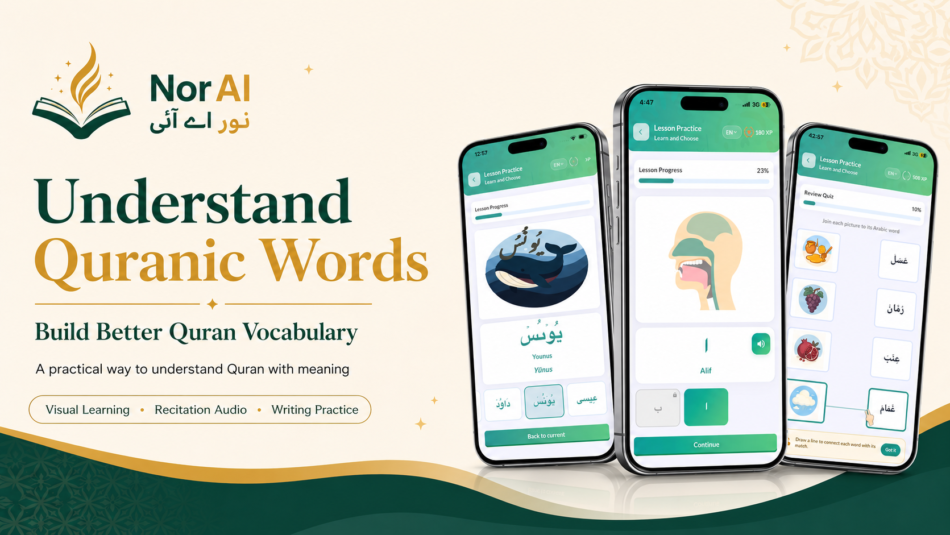
Visual learning can help connect suitable words with their meanings.
Audio practice allows learners to hear Quranic words clearly and become familiar with pronunciation.
Writing activities help learners notice Arabic letters and word forms.
Review exercises allow learners to revisit vocabulary and strengthen recognition.
Using different practice methods gives learners more opportunities to remember the same word.
How Structured Learning Can Support Understanding the Quran
A clear learning structure can make Quranic Arabic study easier to follow. Without a plan, learners may collect vocabulary from different sources but struggle to know what to learn next.
A structured approach introduces words in an organised way and provides opportunities to practise them regularly.
NorAI is designed to help learners understand Quranic words through structured Quranic Arabic lessons. It uses visual learning, audio practice, articulation guidance, writing activities, and review to help learners become more familiar with Quranic vocabulary.
The focus is on vocabulary recognition and learning support. It does not provide tafseer, religious rulings, or replace qualified teachers and scholars.
Learning Beyond Lesson Completion
Completing a lesson does not always mean a word has been fully remembered.
A learner may answer correctly during practice but still need more exposure before the word becomes familiar.
This is why review and retention are important parts of vocabulary learning.
NorAI separates lesson progress from word mastery, helping show the difference between completing an activity and remembering vocabulary over time.
Helping Families and Individual Learners
Quran learning looks different for every person. Some adults prefer learning independently, while families may want a structured way to support children.
A learning environment that provides clear progress information can help parents understand how learning is developing.
NorAI includes parent-managed learner profiles and family features that allow parents to follow learning progress while keeping the learner experience focused.
Final Thoughts
To understand the Quran with meaning, learners need more than translation alone. Becoming familiar with Quranic words can help create a stronger connection between the Arabic text and its meaning.
Learning Quran vocabulary through regular practice, review, and recognition can make the process more manageable.
Understanding the Quran begins with recognising the words that appear within it and gradually becoming more comfortable with the language being read and recited.


