 WhatsApp Us Now

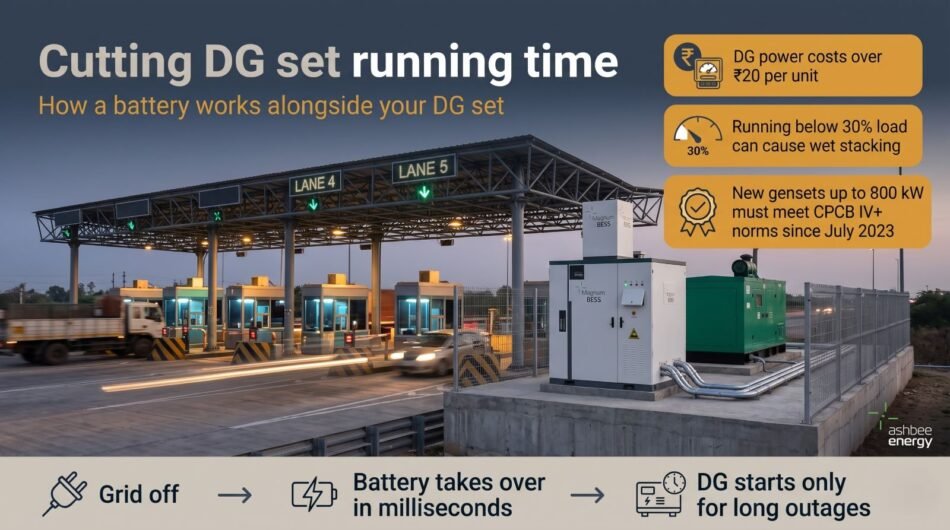
Picture a toll plaza at 2 a.m. when the grid trips. Booths and lane cameras all need power right now. The only thing standing between the site and a dark plaza is a diesel generator that takes a few seconds to start. It works. It also costs fuel every hour it runs. Somebody has to refill it and service it.
Many Indian businesses live with some version of this factories, cold rooms, hospitals and warehouses. This guide shows how a battery can cut DG set running cost.
Where the Diesel Money Really Goes
Fuel is the obvious line on the invoice. Power from a DG set costs over ₹30 per unit. The less obvious costs are maintenance visits and the lost minutes when a generator takes time to start. Add those up across a year, and the number gets uncomfortable.
Running a genset at low load adds another cost. Caterpillar explains that long periods below 30% load can cause wet stacking. Unburnt fuel and carbon build up in the exhaust. Over time this can speed up engine wear. Rules have tightened too. Since 1 July 2023, new diesel gensets with engines up to 800 kW must meet stricter emission norms, often called CPCB IV+.
This is one reason businesses are looking at BESS solutions..A battery system can switch over in milliseconds. So the switchover is quick and quiet. The generator no longer has to be the first line of defence.
What BESS Does for a Business
A BESS power backup stores electricity in batteries and releases it when you need it. Simple idea. Its value depends on what it is paired with .Paired with rooftop panels, it becomes a solar battery energy storage system that saves the afternoon surplus for the evening shift. Paired with a DG set, it carries short outages and small loads. The genset then starts only when a long outage needs it.
What a Good System Includes
A good commercial and industrial energy storage system combines LFP cells, a battery management system, the power conversion system and the cabinet in one unit. For sites with a DG set, look for a port to connect it. The battery management system sits quietly in the background, watching cell temperature and voltage so that one weak cell does not pull down the whole pack. LFP is a stable chemistry that suits hot sites Buying it as one system with one warranty keeps responsibility in one place.
An Example from the Toll Plaza
Back to the toll plaza. At the Battery Show India 2026, Ashbee Energy showed its Magnum Marg Shakti. It is a cabinet system with 100 kWh of storage and 50 kW of power, designed for toll plazas. Taiyang News reported the launch. According to its datasheet, it can carry a 30 kW load for up to 3.15 hours. At its full 50 kW, it runs for up to 2 hours. During an outage, it switches to backup within milliseconds and can share the load with the DG set. The aim is to cut how long the plaza’s DG set has to run. A storage cabinet needs no refuelling trips. Many routine checks can be done remotely on a screen.
How to Plan a Battery Alongside a DG Set
Start with the outage record. How often does the grid fail and for how long? Short and frequent outages suit a battery best. For long outages, the battery carries the load first and hands over to the DG set. Size the battery for the critical loads rather than the whole site. This keeps the system smaller and cuts DG set running cost where it matters most.
FAQs
Q. What is a BESS and who needs one?
Ans. A battery system that stores power and releases it when needed. Factories, warehouses, hospitals, and toll plazas are common users. So is any site where an outage or a diesel bill hurts.
Q. Can BESS power backup reduce DG set running hours?
Ans. Yes. The battery carries short outages and small loads. So the DG set runs mainly for long outages. How many hours are saved depends on the site, the tariff and the load pattern.
Q. What is wet stacking in a diesel generator?
Ans. It is a build-up of unburnt fuel and carbon in the exhaust. Caterpillar says it can happen when a genset runs below 30% load for long periods. Over time it can speed up engine wear.
Q. What are CPCB IV+ norms for DG sets?
Ans. They are stricter emission norms for diesel gensets with engines up to 800 kW. They apply to new gensets from 1 July 2023.
Q. How long can a 100 kWh battery run a toll plaza?
Ans. It depends on the load. The datasheet for one 100 kWh toll plaza system gives up to 3.15 hours at 30 kW and up to 2 hours at 50 kW.


