 WhatsApp Us Now

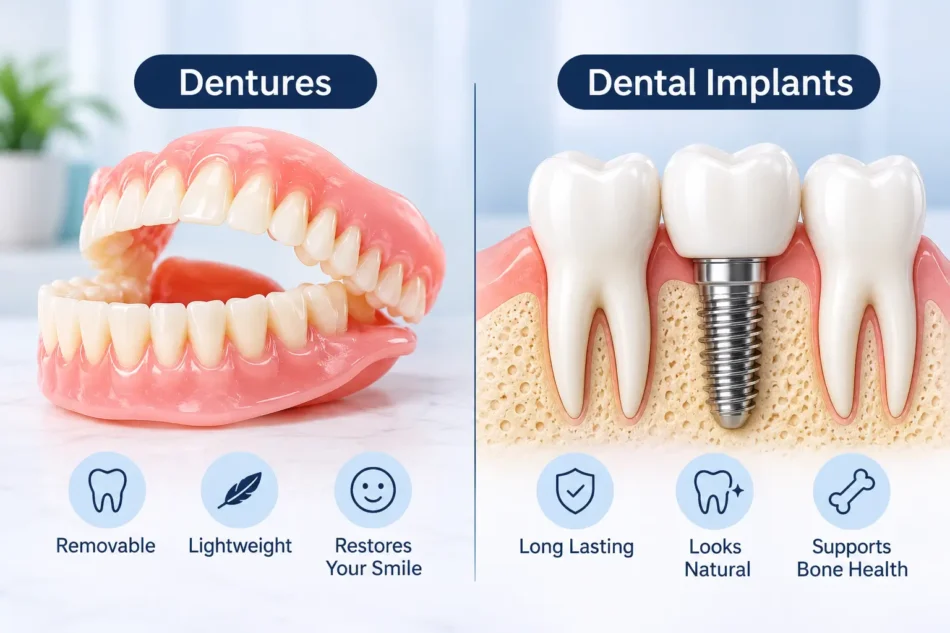
Losing teeth can affect many parts of everyday life, from eating and speaking to smiling and socialising. Fortunately, modern dentistry offers several options for replacing missing teeth, including Dental Implants and removable dentures.
While both can restore the appearance and function of missing teeth, the day-to-day experience can be different. Dental implants are anchored into the jawbone, whereas removable dentures are designed to be taken out for cleaning and maintenance.
If you are considering safe dental implants in Nepal, understanding these everyday differences can help you discuss your options with your dentist and choose a treatment approach that suits your needs.
What Are Dental Implants?
Dental implants are artificial tooth roots placed into the jawbone to support replacement teeth. Depending on the patient’s needs, implants may support:
- A single dental crown
- An implant-supported bridge
- An implant-supported denture
- A full-arch implant restoration
Because implants are anchored into the jaw, they can provide a stable foundation for replacement teeth.
Implant treatment usually involves several stages, including examination, treatment planning, implant placement, healing, and placement of the final restoration.
What Are Removable Dentures?
Removable dentures are dental appliances designed to replace several or all missing teeth. They can be removed by the patient for cleaning and generally come in two main forms:
Complete dentures: Replace all teeth in an upper or lower arch.
Partial dentures: Replace multiple missing teeth while some natural teeth remain.
Dentures can restore appearance and chewing ability and may be an appropriate option for patients who prefer or require a removable solution.
Dental Implants vs Removable Dentures: Everyday Differences
The most noticeable difference is how the replacement teeth feel and function during daily activities.
| Everyday Factor | Dental Implants | Removable Dentures |
| Stability | Anchored to the jaw | Can move depending on fit and anatomy |
| Eating | Generally provides stable chewing support | May require adaptation to certain foods |
| Speaking | Usually feels similar to natural teeth once adapted | Some patients need an adjustment period |
| Removal | Usually remain in place | Removed for cleaning and usually at night |
| Cleaning | Brushing, flossing, and implant-specific cleaning | Removed and cleaned separately |
| Jawbone | Implant can provide stimulation to surrounding bone | Does not replace the tooth root |
| Adjustment | Usually does not need daily removal | May require periodic adjustment or relining |
| Treatment process | Surgical and usually takes multiple stages | Generally non-surgical for conventional dentures |
Individual experiences vary, and factors such as the number of missing teeth, bone condition, denture design, and oral health can influence the outcome.
Eating and Chewing
Food is one of the biggest everyday considerations when replacing missing teeth.
With Dental Implants
Because implants are fixed within the jaw, they can provide a stable foundation for the replacement teeth. This can make chewing feel more secure for many patients.
However, patients still need to follow their dentist’s instructions during the healing period and should maintain good oral hygiene after treatment.
With Removable Dentures
Dentures can restore chewing function, but some people need time to adapt. Certain hard, sticky, or particularly chewy foods may be more challenging depending on the denture fit and individual comfort.
A properly fitted denture can significantly improve function, but the experience can differ from natural teeth or implant-supported restorations.
Speaking and Communication
Missing teeth and poorly fitting replacements can affect speech.
Dental implants are fixed in position, so once the patient has adapted to the restoration, speech generally does not require managing a removable appliance.
With removable dentures, some patients may initially notice changes in pronunciation. The tongue and oral muscles usually need time to adapt to the new appliance.
If a denture becomes loose or its fit changes, speech may also be affected. Regular dental reviews can help identify whether an adjustment or relining is required.
Comfort and Stability
Dental implants are anchored to the jawbone, which means they do not move in the same way as conventional removable dentures.
For some patients, this can provide a greater sense of stability during:
- Eating
- Speaking
- Laughing
- Socialising
- Everyday activities
Removable dentures can also be comfortable when properly designed and fitted. However, changes in the gums and jawbone over time can affect their fit.
Oral Hygiene and Daily Cleaning
Both treatment options require regular maintenance, but the cleaning routine is different.
Dental Implant Care
Patients with implants generally need to:
- Brush twice daily
- Clean between teeth and around implants
- Follow their dentist’s recommended cleaning routine
- Attend regular dental check-ups
- Monitor the gums around the implant
Your dental team may recommend interdental brushes, floss, or other cleaning aids depending on the restoration.
Removable Denture Care
Dentures should generally be:
- Removed and cleaned regularly
- Cleaned using products recommended for dentures
- Stored appropriately when not being worn
- Checked regularly for fit
- Supported by good oral hygiene of the gums and any remaining natural teeth
Dentures should not be treated as maintenance-free simply because they are removable.
What Happens to the Jawbone?
One important difference is what happens after tooth loss.
Natural tooth roots provide stimulation to the jawbone. After a tooth is removed, the surrounding bone can gradually reduce.
A dental implant acts as an artificial root and can provide stimulation to the surrounding bone.
Conventional removable dentures sit on the gums and do not replace the tooth root. Bone changes can therefore continue over time, which may eventually affect denture fit.
This is one reason regular dental assessments are important for denture wearers.
Can Dental Implants Feel Like Natural Teeth?
Dental implants are designed to provide a stable replacement for missing teeth, but they are not identical to natural teeth.
Once treatment is complete and the patient has adapted, implant-supported restorations can feel secure during everyday activities. However, they do not contain natural nerves, and the sensation can therefore differ from a natural tooth.
The final experience also depends on the restoration, implant position, bite, and surrounding tissues.
Are Safe Dental Implants in Nepal Available?
Dental implant treatment is available in Nepal, including Kathmandu and Lalitpur. However, safety depends on appropriate patient selection, diagnosis, treatment planning, surgical technique, infection-control procedures, implant selection, restoration, and follow-up care.
If you are considering safe dental implants in Nepal, look for a dental team that can provide:
- Comprehensive clinical examination
- Appropriate diagnostic imaging
- Individualised treatment planning
- Experienced implant professionals
- Quality implant systems
- Proper sterilisation and infection-control protocols
- Appropriate restorative and laboratory support
- Regular post-treatment monitoring
Patients should also provide their dentist with a complete medical and dental history so potential risk factors can be identified before treatment.
Dr. Nikita Agarwal: Expertise in Dental Implant and Prosthodontic Care
Choosing the right tooth replacement option requires careful assessment of both oral health and individual needs. Dr. Nikita Agarwal is a Prosthodontist, Oral Implantologist, and Digital Dentist based in Nepal, with experience in dental implants, restorative dentistry, full mouth rehabilitation, and digital dentistry.
Her prosthodontic and implantology expertise allows treatment planning to consider not only the placement of dental implants but also the final restoration, function, aesthetics, and long-term maintenance. Depending on the patient’s condition, options may include individual dental implants, implant-supported dentures, bridges, or conventional removable dentures.
A personalised consultation can help determine which tooth replacement approach is appropriate based on factors such as bone condition, gum health, number of missing teeth, bite, lifestyle, and treatment goals.
Which Option Is Easier to Maintain?
Neither option is completely maintenance-free.
Dental implants require ongoing cleaning around the implant and regular professional examinations. Removable dentures require daily cleaning, proper storage, and periodic assessment of their fit.
The best maintenance routine depends on the treatment chosen and the patient’s individual oral condition.
What About Lifestyle and Social Situations?
The difference can become noticeable in social situations.
Patients with implant-supported restorations may appreciate not having to remove their teeth during everyday activities. Conventional denture wearers need to manage their appliance as part of their daily routine.
However, a well-fitted denture can also provide confidence and allow patients to eat, speak, and participate in normal activities.
Personal preference plays an important role when choosing between the two.
Cost and Treatment Time
Dental implants and removable dentures differ in both treatment process and cost.
Implant treatment generally involves:
- Detailed diagnosis
- Surgical implant placement
- A healing period
- Restoration placement
- Long-term maintenance
Conventional removable dentures usually involve a non-surgical process of impressions or digital records, fabrication, fitting, and adjustment.
The cost of either treatment depends on the number of teeth being replaced, materials, complexity, laboratory requirements, additional procedures, and follow-up care.
Patients should consider the complete treatment plan rather than comparing only the initial price.
How to Choose a Dental Clinic in Kathmandu & Lalitpur
If you are looking for a dental clinic in Kathmandu & Lalitpur, consider the overall quality of care rather than choosing a clinic based solely on price or online reviews.
Look for a clinic that offers:
- Comprehensive dental examinations
- Experienced dentists
- Implant and restorative treatment options
- Digital diagnostic technology where appropriate
- Good infection-control standards
- Clear treatment explanations
- Quality dental materials
- Follow-up and maintenance services
A consultation should include a discussion of your dental condition, treatment goals, available options, expected timeline, potential risks, and long-term maintenance.
Can You Combine Dental Implants and Dentures?
Yes. Patients do not always have to choose between conventional dentures and fixed individual implants.
Implant-supported dentures use dental implants to provide additional support to a removable denture. This can help reduce movement and improve stability for selected patients.
The number of implants and the design of the restoration depend on the patient’s anatomy, oral health, and treatment plan.
Questions to Ask Before Choosing Your Treatment
Before deciding between dental implants and removable dentures, consider asking your dentist:
- How many teeth need to be replaced?
- Is my jawbone suitable for implants?
- Are my gums healthy enough for treatment?
- Would a bridge or denture be another option?
- Would implant-supported dentures be suitable for me?
- How long will treatment take?
- What maintenance will I need?
- What are the potential risks?
- What will the complete treatment cost?
- How often will I need follow-up appointments?
A detailed consultation can help you understand how each option may fit into your everyday life.
Both dental implants and removable dentures can help restore missing teeth, but the everyday experience can be different.
Dental implants provide a fixed, stable foundation and may offer advantages in chewing, comfort, and convenience for suitable patients. Removable dentures provide a non-surgical, removable approach and can be an appropriate solution for many people with extensive tooth loss.
There is no single solution that is right for everyone. The best choice depends on your oral health, bone condition, number of missing teeth, lifestyle, treatment preferences, budget, and long-term goals.
If you are considering safe dental implants in Nepal, consult a qualified dental professional for a personalised evaluation. Whether you are looking for treatment at a dental clinic in Kathmandu & Lalitpur or elsewhere, understanding the differences between your options is an important first step toward informed dental care.


