 WhatsApp Us Now
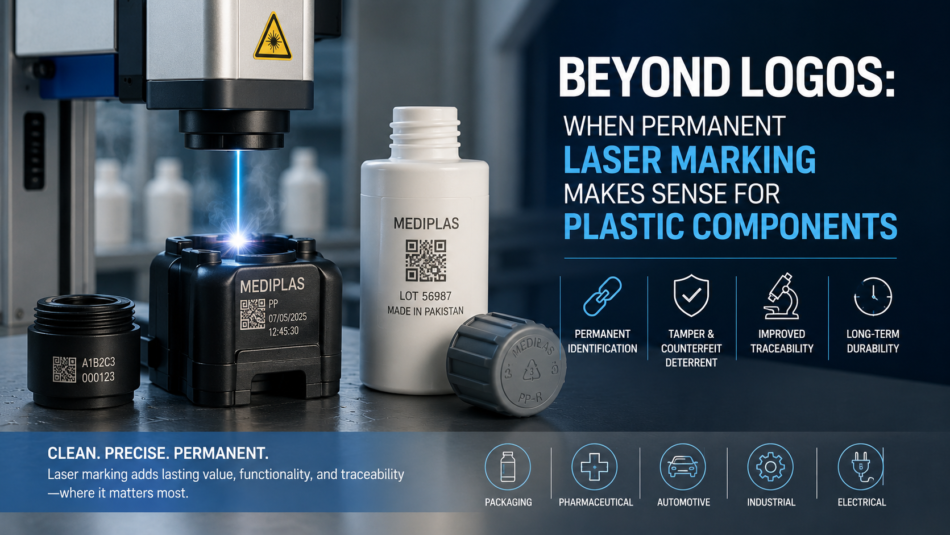
Laser engraving is often introduced as a branding technique.
Put a logo on a product.
Add a premium detail.
Personalize an item.
Those are legitimate uses, but they represent only one side of permanent marking.
For manufacturers, packaging companies and industrial buyers, laser marking can also solve a more practical problem:
How do we place information on a component without depending on a conventional printed graphic?
Permanent Identification Has a Different Goal From Decoration
Brand decoration aims to attract attention and communicate identity.
Functional marking may need to communicate:
- part identification
- orientation
- measurement information
- production code
- technical instructions
- simple brand identification
The best marking method depends on what the mark needs to accomplish.
Why Printed Ink Is Not Always the Only Option
Printing can be ideal when colour and graphics are important.
But some applications prioritize permanence, precision or minimal visual treatment.
This is where laser-based marking may deserve consideration.
Industrial Components Can Benefit From Simple Identification
A moulded plastic part may need a small but durable mark rather than decorative artwork.
Examples can include:
- reference information
- position indicators
- production identification
- small symbols
The mark becomes part of usability rather than advertising.
Minimalist Packaging Can Use Marking as a Design Feature
Not every premium package needs strong colour.
Some brands prefer:
- subtle logos
- small permanent marks
- clean monochrome appearance
- texture rather than printed graphics
For suitable components, laser marking can support that visual direction.
Cosmetic Packaging Is One Possible Application
Beauty packaging is frequently handled around moisture, oils and everyday friction.
A permanent mark may be useful for selected:
- brand details
- component identification
- premium decorative elements
Suitability must still be assessed for the actual material and finish.
Functional Marks Must Remain Readable
A permanent mark is not useful if it is too small, poorly contrasted or positioned where the user cannot see it.
Good marking design considers:
- size
- contrast
- location
- orientation
- viewing distance
Component Geometry Still Matters
Laser systems may be precise, but the physical component still defines what is practical.
Deep curves, hidden surfaces and difficult orientation can affect the marking approach.
Providing a physical sample helps determine feasibility.
Material Compatibility Must Be Evaluated
Different plastic materials can respond differently to laser energy.
The desired visual effect therefore needs to be evaluated using the actual component or representative material.
A general statement that “plastic can be laser engraved” is not enough to define production parameters for every resin and finish.
Laser Marking vs Silk-Screen Printing
These processes solve different problems.
Silk-screen printing can be highly effective for strong logos and repeat graphics.
Laser marking can be more relevant when the desired result is:
- permanent
- precise
- minimal
- without conventional printed colour
Laser Marking vs UV Printing
UV-related printing is particularly useful where artwork relies on colour and graphic presentation.
Laser marking becomes more interesting where durability and permanence take priority over colour complexity.
One is not universally superior.
Some Products May Use Both
A package can potentially combine:
- printed consumer-facing graphics
- permanent marked identification
The roles do not have to compete.
Marking Requirements Should Be Shared Early
If a moulded component needs a laser mark in a precise location, tell the product-development team before the component design is final.
The design may benefit from a suitable marking area rather than forcing the process onto an inconvenient surface later.
How to Brief a Laser-Marking Supplier
Provide:
- Physical component or material sample
- Required mark or artwork
- Mark dimensions
- Preferred position
- Expected quantity
- Required appearance
- Functional or decorative purpose
Why Samples Matter
A test sample allows buyers to evaluate:
- readability
- contrast
- edge quality
- position
- overall appearance
It also helps ensure the result suits the brand or technical requirement before commercial production.
Pakistan’s Manufacturing Use Case Is Broader Than Gift Engraving
Laser engraving is often marketed toward personalized consumer items.
Industrial manufacturers have different priorities.
They may be looking for repeatable marking on packaging or plastic components as one stage of a larger manufacturing workflow.
Companies investigating those production-focused applications can review current capabilities around laser engraving in Pakistan and compare permanent marking with the other decoration methods available for the component.
Final Thoughts
Laser engraving becomes most useful when buyers stop asking whether it looks impressive and start asking whether permanence, precision and minimal visual treatment solve a real requirement.
For the right plastic component, the result can be both functional and visually refined.
The key is matching the marking technology to the material, geometry and purpose.


