 WhatsApp Us Now
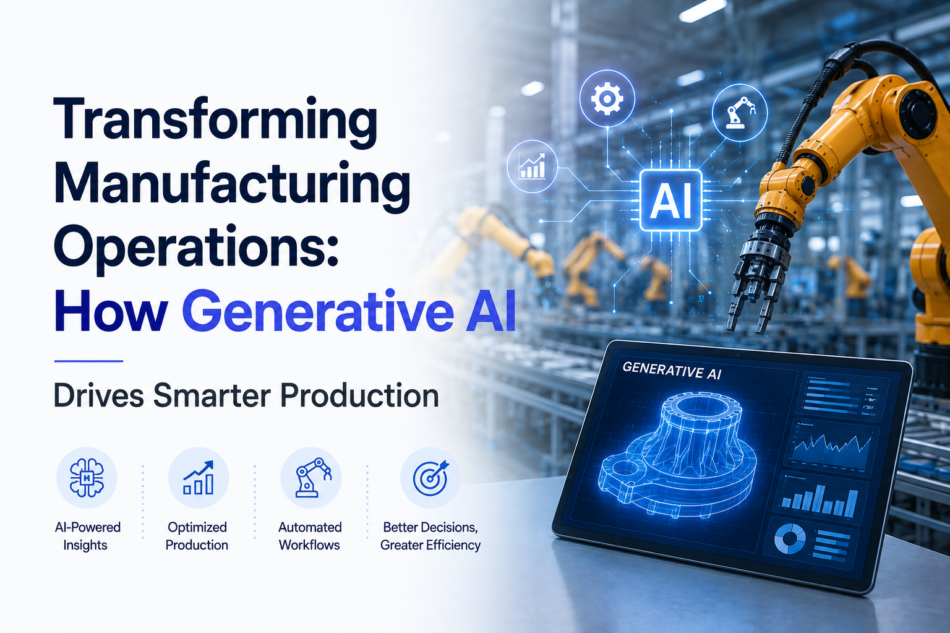
Manufacturing is evolving rapidly as businesses adopt new technologies to improve efficiency, reduce operational challenges, and respond to changing market demands. Automation, robotics, connected systems, and data analytics have already transformed production environments. Now, generative AI is creating new opportunities by helping manufacturers process information, improve decision-making, support employees, and streamline everyday operations.
The value of generative AI goes beyond creating text or answering simple questions. In manufacturing, it can support product design, maintenance, quality management, production planning, supply chain operations, and knowledge sharing. Many manufacturers are also working with AI development companies to explore how generative AI can fit into their existing technology environment and solve practical business challenges.
Understanding the Role of Generative AI in Manufacturing
Generative AI uses existing information and patterns to create useful outputs such as content, summaries, recommendations, reports, and technical documentation. In a manufacturing environment, these capabilities can help employees work with large volumes of complex information that may otherwise take significant time to review and understand.
For example, engineers can use AI to summarize technical documents, maintenance teams can quickly access troubleshooting information, and production managers can generate reports based on operational data. The goal is not to replace existing manufacturing systems but to add an intelligent layer that makes information easier to access and use.
Improving Product Design and Engineering
Product development involves several stages, including research, design, testing, documentation, and evaluation. Engineers often need to consider multiple factors at the same time, such as material requirements, manufacturing limitations, performance standards, costs, and product specifications.
Generative AI can support engineers by helping them explore design concepts, organize technical information, and create documentation more efficiently. Businesses can work with AI development companies to build customized solutions that connect generative AI capabilities with engineering workflows, internal data, and existing product development systems.
Making Production Planning More Efficient
Production planning requires manufacturers to coordinate equipment, employees, materials, inventory, and schedules. Changes in demand, supplier availability, or machine performance can quickly affect the production process. As a result, managers often need access to accurate information before making important operational decisions.
Generative AI can help by summarizing production data and presenting important information in a more accessible format. Instead of manually reviewing multiple reports and systems, teams can use AI-powered tools to identify relevant details and generate useful summaries that support faster decision-making.
Supporting Equipment Maintenance and Reliability
Unexpected equipment failures can lead to production delays, increased costs, and operational disruptions. Maintenance teams often need to review technical manuals, equipment records, maintenance history, and troubleshooting documents before identifying the best way to address a problem.
Generative AI can simplify this process by helping technicians locate relevant information more quickly. AI development partners can create intelligent knowledge systems that connect approved maintenance documents and equipment data, allowing employees to ask questions and access useful guidance without manually searching through multiple sources.
Enhancing Quality Control Processes
Quality management is essential for maintaining product standards and reducing waste. Manufacturing teams regularly review inspection results, identify defects, analyze quality reports, and investigate recurring problems that may affect production performance.
Generative AI can help organize and summarize quality-related information, making it easier for teams to identify patterns and investigate potential issues. When combined with technologies such as computer vision and machine learning, AI can support a more intelligent quality management process while allowing human experts to review important findings.
Improving Knowledge Access Across the Organization
Manufacturing companies often have valuable information stored across technical manuals, engineering documents, training resources, maintenance records, and internal systems. Employees may spend a considerable amount of time searching for the information they need, especially when they are dealing with technical problems or unfamiliar equipment.
Generative AI can support the creation of internal knowledge assistants that allow employees to ask questions using natural language. With the help of experienced AI development companies, manufacturers can build secure systems that retrieve information from approved internal sources and provide employees with faster access to relevant knowledge.
Supporting Workforce Training and Knowledge Transfer
Experienced employees often possess valuable knowledge that has been developed through years of hands-on work. When this knowledge is not properly documented, newer employees may struggle to access the guidance they need to perform their jobs effectively.
Generative AI can help manufacturers organize existing information and make internal expertise easier to access. AI-powered assistants can support training by providing relevant procedures, technical explanations, and process guidance. This approach can improve knowledge sharing while allowing experienced employees to focus on more complex responsibilities.
Strengthening Supply Chain Operations
Supply chain disruptions can affect inventory, production schedules, delivery timelines, and customer commitments. Manufacturing organizations need to process information from suppliers, logistics providers, inventory systems, and internal planning platforms to understand potential risks.
Generative AI can help supply chain teams summarize communications, organize updates, and analyze large amounts of information. AI development partners can also integrate these capabilities with existing business systems, helping manufacturers create more connected workflows without requiring employees to manually transfer information between platforms.
Integrating Generative AI With Manufacturing Systems
A standalone AI application may have limited value if employees need to leave their regular workflow every time they want to use it. Manufacturing businesses already rely on systems such as ERP platforms, manufacturing execution systems, quality management software, and internal databases.
The real value of generative AI often increases when it integrates with these existing technologies. AI development companies can help manufacturers connect AI-powered applications with relevant data sources and business systems while maintaining appropriate access controls and operational security.
Maintaining Data Security and Reliability
Manufacturing companies often manage sensitive information, including product designs, technical specifications, operational procedures, supplier information, and proprietary business data. Before implementing generative AI, organizations need to establish clear rules for how information will be accessed, processed, and protected.
Reliability is equally important because generative AI can sometimes produce inaccurate or incomplete responses. Manufacturers should establish validation processes and maintain human oversight for important decisions. The right AI development partners can help businesses design systems with security controls, trusted data sources, and appropriate safeguards.
Starting With Practical Manufacturing Use Cases
Manufacturers do not need to implement generative AI across every department at the same time. Starting with a focused use case allows businesses to test the technology, collect employee feedback, and measure results before expanding the solution.
An organization may begin with an internal knowledge assistant, automated reporting, maintenance support, technical documentation, or production data analysis. Working with experienced AI development companies can help manufacturers identify use cases that offer realistic business value and create a structured plan for implementation.
Measuring the Impact of Generative AI
Businesses should measure generative AI based on practical results rather than technical complexity. Depending on the use case, manufacturers may evaluate time saved, improved employee productivity, faster access to information, reduced reporting effort, or improved response times.
Clear performance measurements can help organizations understand whether the technology is delivering meaningful value. They can also provide useful insights for improving the solution over time and identifying additional areas where generative AI may support manufacturing operations.
Preparing Manufacturing Operations for Future Growth
As manufacturers expand their use of generative AI, they may discover new opportunities across engineering, production, maintenance, quality, and supply chain management. A solution that begins with one department can eventually support multiple teams when the business establishes a strong technical and operational foundation.
Scalability should therefore be considered during the planning process. AI development partners can help manufacturers create flexible solutions that support current requirements while allowing for future integrations, additional users, and new AI capabilities as business needs continue to evolve.
Conclusion
Generative AI has the potential to become an important part of modern manufacturing operations. It can help businesses improve access to information, support employees, streamline reporting, strengthen maintenance processes, and create more intelligent workflows across the production environment.
However, successful implementation requires more than simply adopting a new technology. Manufacturers need clear business goals, reliable information, secure systems, and practical use cases. By working with experienced AI development companies and trusted AI development partners, manufacturing organizations can move beyond experimentation and build generative AI solutions that support long-term efficiency, productivity, and innovation.