 WhatsApp Us Now

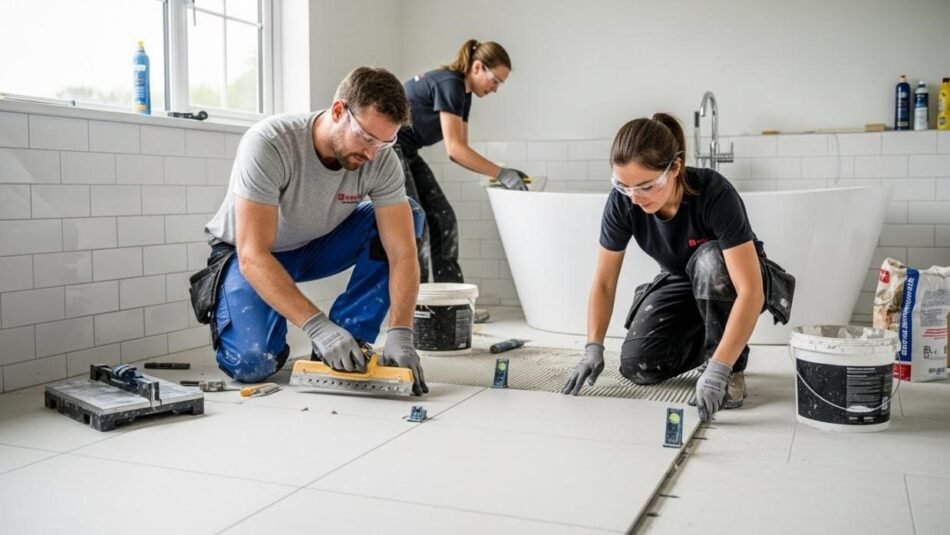
Commercial tilers in Melbourne supply and install ceramic, porcelain, natural stone and large-format tiles for retail, hospitality, office, civic, healthcare and strata developments. Commercial tiling is a specialist trade governed by Australian Standard AS 3958 and strict slip-rating, waterproofing and access requirements that differ from residential tiling.
Key takeaways
- Commercial tilers in Melbourne are not required to hold a trade licence.
- Commercial contracts typically require high-level public liability insurance.
- AS 3958 covers ceramic tile installation standards.
- Many commercial tilers hold Certificate III in Wall and Floor Tiling.
- Commercial tiling jobs typically carry multi-year warranties against installation defects.
- CSCS site induction is required for commercial site access.
What Tile Materials Are Used in Commercial Projects?
The main commercial tile materials are: porcelain (the dominant commercial choice – dense, low-porosity, available in large formats up to 1200×2400 mm, suited to high-traffic floors and walls, available in stone-look, timber-look and concrete-look finishes); ceramic wall tiles (lighter-duty, suited to commercial walls and wet areas); natural stone (granite for high-traffic commercial floors, bluestone for civic and premium commercial, marble for premium lobbies and hospitality, travertine and limestone for hospitality); terrazzo (premium poured or tile terrazzo for lobbies and retail); and specialist tiles (anti-slip industrial tile for commercial kitchens, hygienic tile for healthcare, acoustic tile for offices). For engaging commercial tilers in Melbourne, the material is driven by use, traffic, slip requirement, budget and architectural intent.
Do commercial tilers in Melbourne need to be licensed?
No, commercial tilers in Melbourne are not required to hold a trade licence, but commercial contracts typically require evidence of competency, public liability insurance of $10-20 million, and familiarity with AS 3958 (ceramic tile installation). Many commercial tilers hold a Certificate III in Wall and Floor Tiling and CSCS site induction.
How Much Does Commercial Tiling Cost in Melbourne?
Indicative 2026 Melbourne supply-and-install pricing per m2: standard commercial porcelain floor tile (600×600 mm) $80-$140 per m2; large-format porcelain (900×1800 mm or 1200×2400 mm) $140-$220 per m2 (more complex installation, requires mechanical lifting); commercial ceramic wall tile $70-$120 per m2; natural stone commercial floor (granite, bluestone) $180-$350 per m2; premium marble or terrazzo $250-$500 per m2; anti-slip industrial tile for commercial kitchens $150-$250 per m2; fully waterproofed commercial wet-area tiling $150-$280 per m2. Pricing includes tile, adhesive, grout, waterproofing (where required), substrate preparation and installation. Commercial tiling is typically 30-80% more per m2 than residential tiling due to after-hours work, large-format complexity, slip-rated tile cost, and AS 3958 compliance.
What Is AS 3958 and Why Does It Matter for Commercial Tiling?
Australian Standard AS 3958.1 (Ceramic tiles – Guide to the installation of ceramic tiles) and AS 3958.2 (Guide to the selection of a ceramic tiling system) are the governing standards for tile installation in Australia. AS 3958 covers: substrate preparation (concrete curing, screed flatness, movement joints); adhesive selection and coverage (minimum 80% adhesive coverage for dry areas, 95% for wet and exterior); grout joint width and material; movement (control) joints at specified spacing and locations; waterproofing of wet areas (in conjunction with AS 3740); tile selection by traffic and slip requirement. A commercial tiling installation that does not comply with AS 3958 will not pass building certification and will fail prematurely. The commercial tiler must specify compliance at quote stage and document the installation.
Do commercial tiling jobs require warranties in Melbourne?
Yes, commercial tiling jobs in Melbourne typically carry a 5-10 year warranty against installation defects when completed to AS 3958 standards. Material warranties are separate and provided by tile manufacturers. The installer’s warranty covers workmanship issues such as lipping, hollow-sounding tiles, drummy spots and grout failure, but excludes substrate movement.
What Are the Slip-Rating Requirements for Commercial Tiles?
Commercial floor tiles must meet the slip-resistance requirements of AS 4586 (Slip resistance classification of new pedestrian surface materials) and the recommendations of AS 4663 (Slip resistance measurement of existing pedestrian surfaces). Slip ratings are classified as P0 (lowest) to P5 (highest) for the pendulum test, or R9-R13 for the ramp test. Typical commercial requirements: dry commercial floors (offices, retail) minimum P2/R9; wet commercial areas (entries, hospitality, bathrooms) minimum P3-P4/R10-R11; commercial kitchens, pool surrounds and ramps P5/R12-R13. The slip rating must be specified in the tile selection and documented – a tile that fails the required slip rating is a safety and liability risk and will not pass certification. The commercial tiler confirms the tile’s slip rating certificate from the manufacturer.
How Is Waterproofing Done in Commercial Wet-Area Tiling?
Commercial wet-area tiling (bathrooms, kitchens, laundries, hospitality wet areas, pool surrounds) requires waterproofing to AS 3740 (Waterproofing of domestic wet areas) and the NCC. The process: prepare the substrate (concrete or screed) to the correct fall (minimum 1:100 toward the drain); install a compliant membrane (sheet membrane, liquid membrane or a combination) to the substrate, lapping up walls at least 150 mm above the floor (1800 mm in shower areas); seal all penetrations (drain flanges, pipe penetrations, junctions); perform a flood test (mandatory for showers and some commercial wet areas – 24 hours with no leakage); install the tile over the cured membrane with a compatible thin-set adhesive; grout with a suitable grout and seal. The waterproofer must be licensed (in Victoria, a registered plumber with a waterproofing endorsement) and issue a compliance certificate. Skipping or skimping waterproofing causes structural damage and mould within years.
How Do You Choose a Commercial Tiler in Melbourne?
Look for: documented commercial tiling experience in comparable Melbourne projects (retail, hospitality, office, healthcare, civic); a portfolio of completed commercial jobs; AS 3958 compliance at quote stage; slip-rating certification for floor tiles; licensed waterproofing for wet areas; $10-20 million public liability; capacity for large-scale commercial work (multiple tilers on a program, after-hours work, scheduled stages to minimise business disruption); an itemised quote specifying tile type and slip rating, adhesive, grout, waterproofing, substrate prep, movement joints and total m2; and references from recent Melbourne commercial clients. Avoid contractors who quote without measuring, who cannot specify AS 3958 compliance or slip ratings, who propose to skip waterproofing, or who lack capacity for the scale of commercial work.
Frequently Asked Questions
How much does commercial tiling cost in Melbourne?
Indicative 2026 supply-and-install per m2: standard commercial porcelain floor (600×600) $80-$140; large-format porcelain (900×1800+) $140-$220; commercial ceramic wall $70-$120; natural stone floor $180-$350; premium marble or terrazzo $250-$500; anti-slip industrial $150-$250; waterproofed wet-area $150-$280. Commercial tiling is 30-80% more per m2 than residential.
What is AS 3958?
The Australian Standard governing tile installation – covers substrate preparation, adhesive coverage (80% dry, 95% wet/exterior), grout, movement joints, waterproofing of wet areas (with AS 3740), and tile selection by traffic and slip requirement. A commercial installation that does not comply with AS 3958 will not pass certification and will fail prematurely.
What slip rating does a commercial floor tile need?
Slip resistance is classified under AS 4586 as P0-P5 (pendulum) or R9-R13 (ramp). Typical requirements: dry commercial (offices, retail) minimum P2/R9; wet commercial (entries, hospitality, bathrooms) P3-P4/R10-R11; commercial kitchens, pool surrounds and ramps P5/R12-R13. The tile’s slip rating must be specified and documented.
Is waterproofing required for commercial wet-area tiling?
Yes, mandatory under AS 3740 and the NCC for bathrooms, kitchens, laundries, hospitality wet areas and pool surrounds. The waterproofer must be licensed (a registered plumber with waterproofing endorsement in Victoria) and issue a compliance certificate. Flood testing is mandatory for showers and some commercial wet areas. Skipping waterproofing causes structural damage and mould within years.
How do I choose a commercial tiler in Melbourne?
Look for documented commercial experience, AS 3958 compliance at quote stage, slip-rating certification, licensed waterproofing, $10-20m public liability, capacity for large-scale and after-hours work, an itemised quote specifying tile, slip rating, adhesive, grout, waterproofing and movement joints, and references from recent Melbourne commercial clients.
Conclusion
Commercial tilers in Melbourne deliver durable, attractive surface finishes for retail, hospitality, office and public buildings when engaged with clear specifications and proper substrate preparation. Confirm AS 3958 compliance, $10-20 million public liability insurance, and warranty terms. Quality commercial tiling delivers long-term performance, easy maintenance, and a professional finish that enhances the appearance and value of Melbourne’s commercial interiors and exterior façades.


