 WhatsApp Us Now

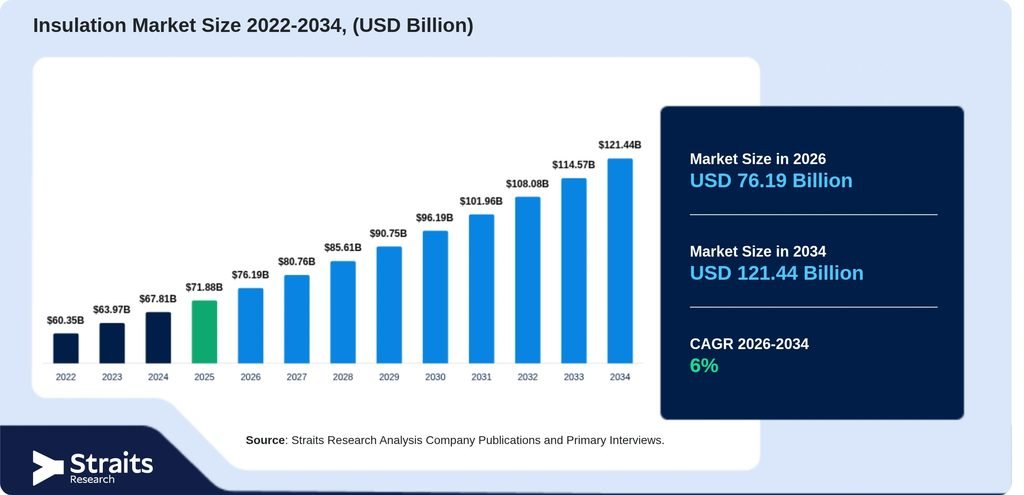
According to Straits Research, the global insulation market size was valued at USD 71.88 billion in 2025 and is projected to grow from USD 76.19 billion in 2026 to USD 121.44 billion by 2034, registering a CAGR of 6% during the forecast period (2026–2034). Asia Pacific dominated the insulation market with a share of 38.45% in 2025.
Insulation materials are used to reduce heat transfer, sound transmission, and energy loss across buildings, industrial facilities, transportation systems, and equipment. Common insulation materials include fiberglass, mineral wool, polyurethane foam, polystyrene, cellulose, and other specialized materials. Insulation plays an important role in improving energy efficiency, maintaining indoor comfort, reducing heating and cooling requirements, and protecting industrial systems from temperature fluctuations. Growing construction activity, energy conservation initiatives, building renovation, and demand for thermal efficiency are supporting market growth.
Get Full Report: https://straitsresearch.com/report/insulation-market
Growth Drivers of the Insulation Market
Rising Demand for Energy-Efficient Buildings
Increasing focus on reducing energy consumption in residential, commercial, and industrial buildings is driving insulation adoption. Insulation helps minimize heat loss and heat gain, reducing heating and cooling requirements while improving indoor temperature stability.
Growing Construction and Infrastructure Development
Rapid urbanization and expanding construction activity are increasing demand for insulation materials in residential buildings, offices, factories, warehouses, and infrastructure projects. Insulation is an important component of modern building design and construction.
Increasing Building Renovation and Retrofitting
Older buildings often require insulation upgrades to improve energy performance and indoor comfort. Renovation programs, building modernization, and energy-efficiency improvements are encouraging the replacement or installation of insulation in existing structures.
Stringent Energy Efficiency Regulations
Governments and regulatory authorities are introducing building energy codes, efficiency standards, and sustainability requirements. These regulations are encouraging construction companies and property owners to adopt insulation solutions that reduce energy use and improve building performance.
Expansion of Industrial Insulation Applications
Industrial facilities require insulation to manage heat transfer across pipelines, processing equipment, boilers, storage tanks, and manufacturing systems. Increasing industrial activity and demand for energy-efficient operations are supporting the use of specialized insulation materials.
Growing Awareness of Sustainable Construction
Increasing emphasis on sustainable buildings and environmentally responsible construction is driving demand for insulation products that reduce energy consumption. Manufacturers are also focusing on recycled content, lower-impact materials, and more efficient production processes.
Applications of the Insulation Market
Residential Buildings
Insulation is used in walls, roofs, floors, ceilings, attics, and foundations to maintain indoor temperatures and improve energy efficiency. It helps reduce heating and cooling costs while improving residential comfort.
Commercial Buildings
Offices, hotels, hospitals, shopping centers, schools, and other commercial facilities use insulation to manage indoor temperature, reduce energy consumption, and improve building performance.
Industrial Facilities
Industrial insulation is applied to equipment, pipelines, tanks, furnaces, boilers, and processing systems. It helps reduce thermal losses, protect equipment, maintain process temperatures, and improve operational efficiency.
HVAC Systems
Insulation is used in heating, ventilation, and air conditioning systems to reduce heat transfer through ducts, pipes, and equipment. Proper insulation helps improve HVAC efficiency and reduce energy losses.
Transportation
Automotive, railway, aerospace, and marine industries use insulation materials for thermal management, acoustic performance, passenger comfort, and protection of temperature-sensitive components.
Cold Storage and Refrigeration
Insulation is essential in refrigerated warehouses, cold rooms, food processing facilities, and temperature-controlled logistics infrastructure. It helps maintain low temperatures and reduce refrigeration energy requirements.
Emerging Trends in the Insulation Market
Development of High-Performance Insulation Materials
Manufacturers are developing insulation products with improved thermal resistance, lower weight, moisture resistance, fire performance, and durability. Advanced material formulations are helping address demanding construction and industrial requirements.
Increasing Adoption of Sustainable Insulation
Recycled fibers, bio-based materials, and lower-impact insulation products are gaining attention as construction companies focus on sustainability. These materials are being developed to reduce environmental impact while maintaining insulation performance.
Growing Demand for Spray Foam Insulation
Spray foam insulation is gaining use in building applications because it can conform to irregular surfaces, fill gaps, and create continuous insulation and air-sealing layers. Its use is increasing in selected residential, commercial, and industrial applications.
Integration of Insulation with Modern Building Design
Insulation is increasingly incorporated into energy-efficient building envelopes, prefabricated construction systems, and advanced building designs. Integrated solutions help improve thermal performance and support energy-conscious construction.
Increasing Focus on Fire Safety and Material Performance
Building owners and developers are paying greater attention to fire resistance, moisture management, durability, and indoor environmental performance when selecting insulation products. This is encouraging innovation in material formulations and product testing.


