 WhatsApp Us Now
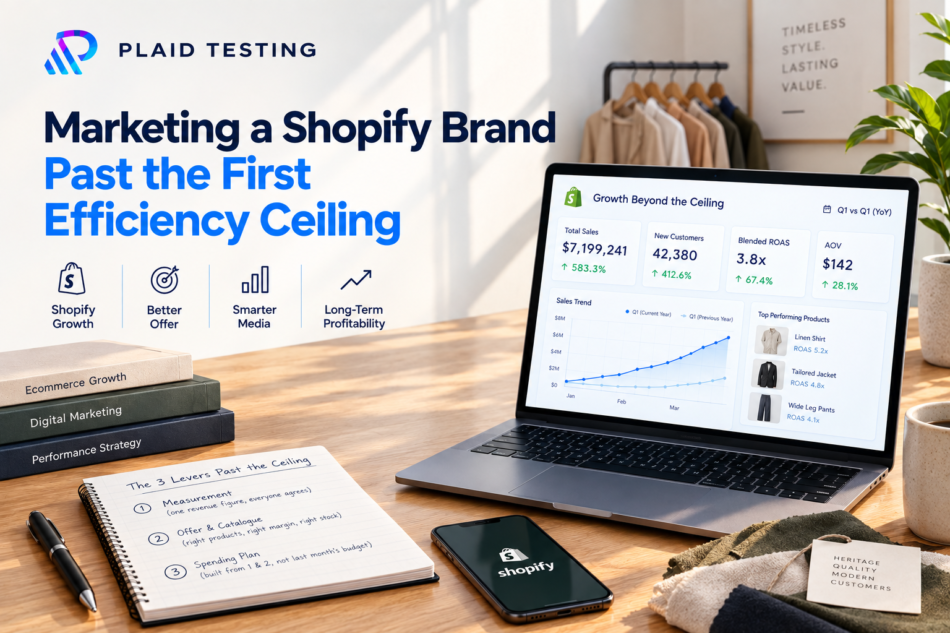
The first efficiency ceiling is rarely a media problem. It arrives when a brand has bought all the cheap demand its current offer, catalogue and measurement can reach. Getting past it means changing one of those three, not buying more of the same traffic through a better bid strategy.
What does the first efficiency ceiling look like on a Shopify store?
It shows up as a flat line that will not respond. Blended efficiency holds while spend creeps up, then slips when you push harder. New customer counts stop climbing even though impressions keep rising. Discount depth increases quietly because somebody needs the week to close. Inside the platform everything still looks acceptable.
The tell is repeatability. A media problem responds to media work within a cycle or two. A ceiling does not. You change the bid strategy and it holds. You rebuild the campaign structure and it holds. A fresh creative batch moves it for a fortnight, then it settles back. When several honest attempts all land in the same place, the constraint sits upstream of the thing you keep adjusting.
Is this a media problem or a merchandising problem?
Look at which products the ads are actually selling. Most Shopify brands find acquisition resting on a narrow band of the catalogue, often a handful of styles carrying most of the first orders. That works until those styles run out of reachable demand, go out of stock, or sit in a size curve that breaks at both ends.
Merchandising then becomes the media constraint. If the hero product cannot be restocked quickly, the account has nothing efficient to sell. If the next best product converts poorly on its own, there is no substitute to rotate in. Media buying cannot manufacture a product people want at a price that leaves margin. It can only reach the people who already want the one you have.
What has to change structurally to get past it?
Measurement first. Settle which revenue figure decisions are made against, so a test result means the same thing to finance and to the buyer. Then the offer and catalogue: what the brand leads acquisition with, at what margin, with what stock behind it. Then the spending plan, built from those two rather than from last month’s budget plus a bit, and capped at what the stock position can actually serve.
That ordering is the substance of marketing support for Shopify brands at scale, and it is why the work often starts away from the ad account. Reversing the order is the common mistake. Brands raise budget, argue about attribution once results disappoint, then reach for merchandising last, when it was the binding constraint the entire time.
Which parts of this does a Shopify marketing agency do well?
A good one helps in places that are easy to underrate. Production capacity, so creative arrives on a schedule rather than when somebody remembers. Platform fluency across Meta, Google and TikTok. Bench depth, so a holiday or a resignation does not stall the account. Documented process, so the same experiment is not run twice by accident.
If your constraint is throughput, that is a real answer and worth paying for. The model reaches its edge at authority. An agency can recommend that you widen the size run, change the offer, or stop discounting, and then it waits. It is not usually in the room where those are decided, and a ceiling only moves when somebody in that room moves it.
How long before the change shows up?
Longer than a media test and sooner than people fear. Measurement changes read almost immediately, because you are re-reading data you already hold. Offer and catalogue changes move on the production and inventory calendar, which is the real clock. Spending changes read last, because they depend on the other two being right.
Working with a heritage fashion brand, I watched Q1 total sales go from $1,053,536 to $7,199,241 year over year, up 583.3%.
None of that came from a smarter bid strategy. It came from a wider set of products the account could sell profitably, a measurement standard everyone accepted, and a budget built to match. Expect a full quarter before the change takes shape, and resist judging it weekly while production catches up.
If your efficiency ceiling has held for two quarters, the fix is usually structural rather than tactical.
Jason Lu runs Plaid Testing, working with ecommerce brands on fractional CMO leadership, paid media, performance creative, and tracking and attribution.


