 WhatsApp Us Now

Pipeline predictability is achieved through narrowing the list of contacted accounts to those who demonstrated buying patterns similar to companies that successfully bought from a business, in combination with a repeatable, month-to-month process of engagement.
The three-step account filtering process helps agencies understand which companies to prioritize, as well as track conversions at every funnel stage to improve conversion rates for future prospects. This approach to lead generation, however, does not rely on a simple increase in outreach volume, but instead focuses on improving the average fit of contacted accounts.
How B2B Lead Generation Addresses the Problem of Predictability
The problem: pipeline predictability is often driven by the quantity of outreach — more outreach equals more meetings and demos scheduled, but it does not necessarily contribute to a higher number of closed deals. Pipeline volume without account fit usually leads to wasted time and effort by sales representatives engaged in low-fit discovery meetings.
Solution: account fit refers to a company’s similarity to ideal customer profile (ICP) or past buyers. It is not strictly defined — as it depends on businesses that a company successfully sold to in the past and what specific combination of traits did they share.
Some of the characteristics may be obvious — such as company size and industry — while others may be less apparent. The fit should become more refined as the company gains more information about what led to closed deals.
Three-step account filtering for high-fit B2B lead generation
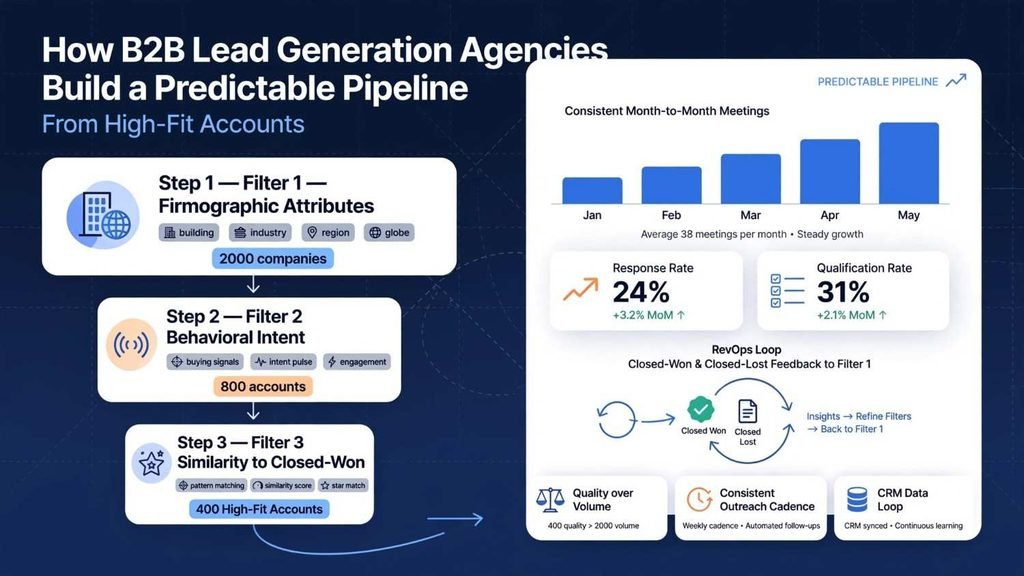
Filter 1: Firmographic attributes
This initial account filter is used to select companies relevant to a business in terms of size, industry, region, and other general attributes. It serves to greatly narrow the initial list of accounts, which may comprise thousands of companies, to a reasonable number.
Filter 2: Behavioral intent
From the list of accounts that matched the firmographic filter, agencies remove companies that did not demonstrate any behavioral intent to purchase, thus reducing the final list to those that showed buying signals.
Filter 3: Similarity to closed-won deals
Finally, agencies apply the third filter to identify accounts similar to those that a business successfully sold to in the past and narrowed the list of prospects to companies that had the greatest similarity to past buyers.
The account fit and lead generation process is not simple, but the final list of prospects should ideally represent a balance between relevance and volume. The fewer companies an agency adds to the prospect list, the more resources it has to research and engage with each account.
While a prospect list with 2,000 companies will allow a lead generation agency to schedule more meetings than a list of 400, the latter will yield better results because the same amount of effort would enable much more personalized outreach to each account.
Key Performance Indicators That Help Determine Predictability
The absolute number of meetings booked is not an indicator of a predictable pipeline. Instead, agencies should monitor response rates, qualification rates after the first discovery call, and other metrics that represent how well prospects moved down the sales funnel. In a similar vein, meeting volumes for a predictable pipeline should be consistent from month to month.
Agencies that implement the right lead generation process should see a stable pipeline of meetings that can be scheduled consistently over the course of several months. It is also worth noting that each step of the funnel will have its own set of metrics — in addition to meetings booked and response rates, agencies should track how many prospects get past the discovery call and move on to the next, more serious stages of the sales process.
How Predictability Helps Maintain a Steady Flow of Sales Opportunities
Every closed deal, whether won or lost, provides agencies with additional information about which accounts were the best fit and which accounted for wasted effort. Agencies that want to build a predictable pipeline incorporate this information into the lead generation process to ensure that their account filtering becomes more effective with each new closed deal. As a result, they update the list of prospects as frequently as possible.
This is where Revenue Operations often intersects with B2B lead generation, as it is responsible for using CRM data to update the lead generation process. This way, companies can constantly refine their understanding of which leads to prioritize.
Factors That Negatively Affect Predictability
Holding off on tightening account fit to boost monthly metrics: if an agency wants to increase the number of meetings it schedules at a faster rate, it can do so by relaxing account fit requirements and allowing more low-fit prospects into the outreach process. However, this approach will have little impact on the company’s long-term pipeline.
Focusing exclusively on won deals: the analysis of closed-deal data should include both won and lost deals, as they both provide valuable information about the efficacy of the lead generation process.
Updating response generation messaging but not targeting criteria: if an agency updates its messaging to get more responses but does not change which accounts it targets, this is unlikely to have a significant impact on the lead generation process.
Having inconsistent outreach cadence: if an agency does not maintain a steady volume of outreach, it will be unable to sustain a predictable pipeline of meetings.
Realistic Expectations About Timeline to Achieve Predictability
A lead generation agency should see an improvement in early response rates and volumes during the first several weeks of launching a new outbound campaign. After about one or two full sales cycles, the agency should see a much higher degree of predictability that will allow it to schedule meetings at a consistent rate each month.
This is because the initial volume and response rates will provide the necessary data to determine the account fit for future prospects. It is important to remember that any agency would have difficulty delivering consistent results in the early stages of a campaign before it has sufficient information about which accounts to target.
Who Can Benefit From This Type of Lead Generation
This approach to outbound lead generation, which relies on refining account fit, is best utilized by companies that already have some sales experience and can benefit from a more focused prospect list. It may not be as useful to startups and other organizations with little sales experience, which have a much broader ideal customer profile (ICP).
How This Type of Lead Generation Works Over the Course of Several Months
A company launches the process of outbound lead generation and begins researching companies that could be potential buyers. First, it filters out accounts that do not match its general criteria, such as company size and industry. Then, the company narrows the prospect list to accounts that have shown some indication to buying interest.
Finally, the firm uses the information about its past buyers to create the list of high-fit prospects and begins contacting them. After several months, the company continues to update this prospect list based on the data about closed deals.
This is a typical process for any B2B lead generation agency that wants to refine its account filtering to achieve a predictable pipeline of meetings. The timeline may vary depending on the company’s sales cycle, but the steps are similar in most cases.
The Global Associates Implements Same Account Filter Steps for Predictable Outbound Pipeline Creation
The Global Associates utilizes the same principles of account fit to create a predictable B2B outbound pipeline for its clients. The company offers its TGA Outreach™ Engine which combines account filtering, extensive research, and data insights about closed deals to help agencies achieve a more predictable pipeline of meetings.
Some frequently asked questions about predictable pipeline and B2B lead generation
What does a predictable pipeline mean for B2B sales?
A predictable pipeline means that a company can consistently expect a certain number of qualified meetings and sales opportunities every month.
How do agencies identify high-fit accounts for B2B lead generation?
Agencies identify high-fit accounts by analyzing account characteristics as well as patterns among past buyers. This process should be ongoing in order to incorporate data about each new closed deal.
Does a smaller prospect list always lead to better results in B2B lead generation?
Not necessarily, but a smaller number of prospects usually enables more resources to be invested in each account, which should lead to a better conversion rate.
How long does it take to build a predictable pipeline in B2B lead generation?
It usually takes around a few months to build a truly predictable pipeline in B2B lead generation. This primarily depends on how long it takes for a company to accumulate enough data to refine its account fit.
How does the role of Revenue Operations fit into B2B lead generation?
Revenue operations often plays a part in B2B lead generation by utilizing CRM data and insights about closed deals to inform the lead generation process.
Can a lead generation agency guarantee a predictable pipeline from the beginning?
No, no reputable lead generation agency should be able to guarantee a predictable pipeline from the beginning, since it requires data from closed deals to be adjusted.
What is the biggest mistake that companies make when trying to build predictable pipeline?
The biggest mistake that companies make when trying to build predictable pipeline is not adjusting account fit because it would reduce the number of meetings scheduled each month.
Is a predictable pipeline only concerned with the volume of leads?
Not entirely. While more leads usually equal more meetings, a predictable pipeline is more concerned with consistency. In this regard, it is more useful to focus on the percentage of meetings that get booked rather than the sheer number of outreach attempts.
Should companies that utilize B2B lead generation analyze lost deals?
Yes, companies that utilize B2B lead generation should analyze lost deals since they provide useful information about the lead generation process.
Is this process suitable for early-stage companies?
This largely depends on the company’s ideal customer profile (ICP). If a company has a broad ICP, it can benefit from a more generalized approach to lead generation. On the other hand, if a company knows exactly what type of buyer it wants to target, it can utilize this process to achieve a predictable pipeline.


