 WhatsApp Us Now
No AI humanizer replaces this one five-minute habit. Here’s why reading your writing aloud catches what every tool — and every silent read-through — misses.
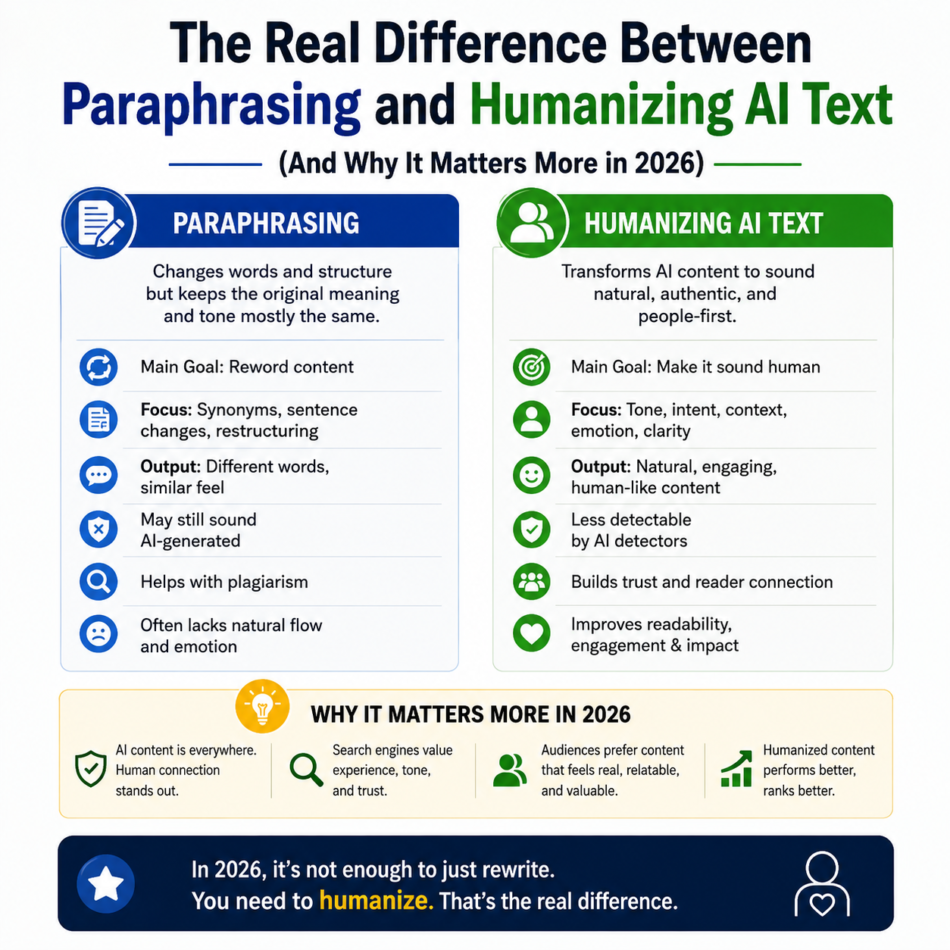
Ask ten people what an “AI humanizer” does, and most will say some version of “it rewrites text so it doesn’t sound AI.” That’s not wrong, but it hides an important distinction that determines whether a tool actually helps or just wastes your time. Paraphrasing and humanizing are not the same process, and confusing them is one of the most common reasons people end up disappointed with a tool that technically did what it claimed.
What Paraphrasing Actually Does
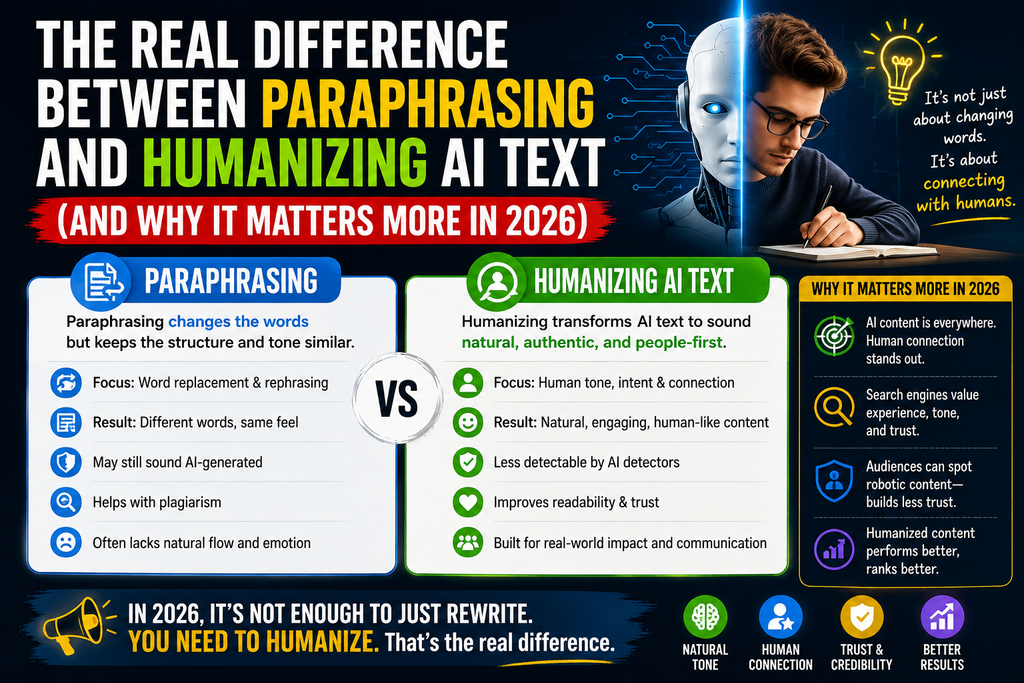
A paraphrasing tool works at the word and phrase level. It swaps synonyms, rearranges clause order, and adjusts a few word choices while leaving the underlying sentence structure largely intact. This is genuinely useful for certain tasks — avoiding repeated phrasing across similar pieces of content, or lightly adjusting tone for a different audience. An ai paraphrasing tool free to use can handle these lighter jobs perfectly well.
What it doesn’t do is fix the deeper pattern that makes AI writing feel mechanical. That pattern isn’t really about word choice — it’s about rhythm. AI-generated text tends to default to fairly uniform sentence length, predictable transition phrases, and an oddly even pacing that holds steady no matter what the actual content is about. Swapping “utilize” for “use” doesn’t touch any of that.
paraphrasing vs humanizing AI textWhat Humanizing Actually Does Differently
A true humanizer operates at the sentence and paragraph level instead. It varies sentence length deliberately, adjusts how ideas connect between paragraphs, and breaks up the overly consistent cadence that both readers and detection systems have learned to recognize. This is a structurally different task than paraphrasing, even though the two get marketed almost interchangeably.
This distinction is exactly why some tools work better than others for the same complaint. If you’ve tried a basic paraphrase and found it left your text feeling “different but still robotic,” that’s not a failed attempt at humanizing — it’s a paraphrase doing exactly what paraphrasers do, applied to a problem it was never built to solve.
Why “No Login” Matters More Than People Realize
A genuinely useful AI humanizer free no login option removes a real point of friction: you don’t have to hand over an email address or create an account just to test whether a tool’s output quality is worth your time. This matters because testing before committing is the only reliable way to tell a real humanizer from a synonym-swapper — reading a tool’s marketing copy won’t tell you which one you’re dealing with, but pasting in one of your own paragraphs will. Trickmenot’s free text humanizer works this way specifically — paste, rewrite, no account required — which makes it easy to run the two-question test below without any commitment.
The practical test is simple: take a paragraph you’ve already written yourself (so you have a clear baseline), run it through the tool, and check two things — does the sentence rhythm actually feel different, not just reworded, and does the core meaning survive intact. If both hold up, you’re looking at a genuine humanizer. If only the words changed and the pacing still feels the same, you’re looking at a paraphrase with better marketing.
The Bigger Goal: Make AI Text Sound Human, Not Just “Different”
This is really the heart of what people are after when they search for how to make AI text sound human free — not a trick, just writing that reads the way a person would naturally write it. That’s a genuinely achievable goal, and it doesn’t require paying for anything to start. It does require understanding that “sounding human” is a rhythm and structure problem, not a vocabulary problem, which is exactly where a lot of free tools under deliver without users realizing why.
A useful habit here: after humanizing a paragraph, read it out loud. Awkward phrasing and oddly even pacing are far easier to catch by ear than by eye, and it takes seconds per paragraph.
Why This Distinction Matters Even More for Academic Work
For students specifically, this distinction has real consequences beyond just readability. Detection systems increasingly key in on structural patterns — sentence-length distribution, transition predictability, and similar statistical signatures — rather than just flagging specific “AI-sounding” words. A paraphrase that only changes vocabulary leaves those structural patterns largely intact, which is part of why some AI-assisted drafts still get flagged even after a rewrite pass that felt thorough to the person doing it.
This is exactly why the habit of learning to check turnitin score before submitting matters more than trusting any single rewrite to have solved the problem. An early check tells you concretely whether the structural patterns are still present, giving you time to revise with actual information instead of guessing based on how the text reads to you personally — which, after staring at your own writing for hours, is genuinely hard to judge objectively.
Finding a Tool That Checks What You Actually Need
Not every checker measures the same thing, which is worth knowing before you trust a single score. Some tools focus purely on similarity to existing text (plagiarism-style checking); others focus on statistical patterns associated with AI generation. If you want something closer to what your institution’s actual system evaluates, look specifically for an ai content checker like turnitin rather than a generic originality scanner, since the underlying methodology genuinely differs between the two categories. A free Turnitin score estimator is a reasonable starting point for that early check before you rely on anything more formal.
A Workflow That Actually Reflects This Distinction
Given all of this, the sequence that produces the best results looks a little different than “run it through one tool and submit”:
Draft your content, whether with AI assistance or from scratch. Identify whether your draft needs light paraphrasing (avoiding repeated phrasing) or genuine humanizing (fixing mechanical rhythm) — they’re different jobs, and using the wrong tool for the wrong problem wastes a step. Run the appropriate tool, then read the result aloud to catch anything that still feels off. Check your originality score before submitting or publishing, using a checker that actually measures what you’re worried about. Finish with a manual pass adding your own specific details and voice — the step no tool replaces, regardless of how good the rewrite was.
The Bottom Line
Paraphrasing and humanizing solve different problems, and knowing which one you actually need saves you from blaming a tool for failing at a job it was never designed to do. If your goal is genuinely natural-sounding writing rather than just differently-worded writing, look specifically for tools built around sentence rhythm and structure — and test them yourself before trusting any label a tool puts on itself.
Frequently Asked Questions
Is a paraphrasing tool the same as a humanizer?
No. Paraphrasers primarily change word choice and sentence order; humanizers restructure rhythm and pacing at the sentence and paragraph level, which is a deeper and more effective fix for mechanical-sounding AI text.
Why does a “no login” free tool matter?
It lets you test actual output quality on your own writing before committing time or money, which is the only reliable way to tell a genuine humanizer from a simple synonym-swapper.
Should I check my originality score even after humanizing?
Yes — checking early gives you time to revise with real information rather than guessing based on how the text reads to you, especially since structural patterns matter as much as word choice to modern detection systems.


