 WhatsApp Us Now
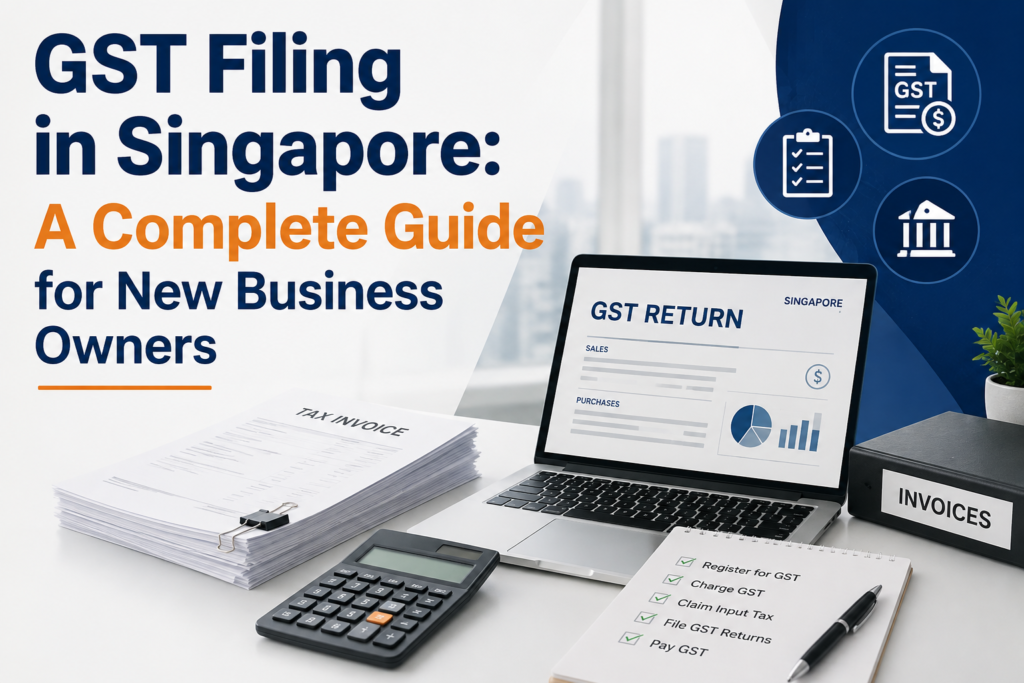
GST (Goods and Services Tax) in Singapore is a broad-based consumption tax levied at 9% on most goods and services. Businesses must register once their taxable turnover exceeds S$1 million annually. After registration, they file quarterly GST returns, charge GST on sales, and claim back GST paid on business expenses. The entire cycle runs on a calendar determined by IRAS.
If you’re launching a startup or running a growing SME, understanding GST compliance services early can save you from costly penalties and administrative headaches later. This guide walks you through every stage — from knowing when to register to submitting accurate quarterly returns.
What Is GST and How Does It Work in Singapore?
GST is collected by businesses on behalf of the Singapore government and remitted to the Inland Revenue Authority of Singapore (IRAS). As a GST-registered business, you charge GST on your taxable supplies (output tax) and claim GST on your business purchases (input tax). The difference is what you pay to IRAS — or claim as a refund.
Singapore’s GST rate increased from 7% to 8% on 1 January 2023, and then from 8% to 9% on 1 January 2024. The 9% rate continues to apply in both 2025 and 2026.
When Does Your Business Need to Register for GST?
GST registration in Singapore is either mandatory or voluntary, depending on your revenue threshold and business strategy.
Mandatory Registration
You must register for GST if your taxable turnover exceeds S$1 million in the past 12 months, or if you expect it to exceed S$1 million in the next 12 months. Once triggered, you have 30 days to apply for registration with IRAS.
Voluntary Registration
Businesses below the S$1 million threshold can still register voluntarily. This is especially useful if your customers are mainly GST-registered businesses, as they can claim back the GST you charge. However, voluntary registrants must stay registered for at least two years.
Exemptions to Know
- Financial services (e.g., lending, insurance)
- Sale and lease of residential properties
- Imported low-value goods under certain thresholds (with exceptions)
Always verify your supply type against IRAS guidelines before assuming exemption status.
Step-by-Step: How to Register for GST in Singapore
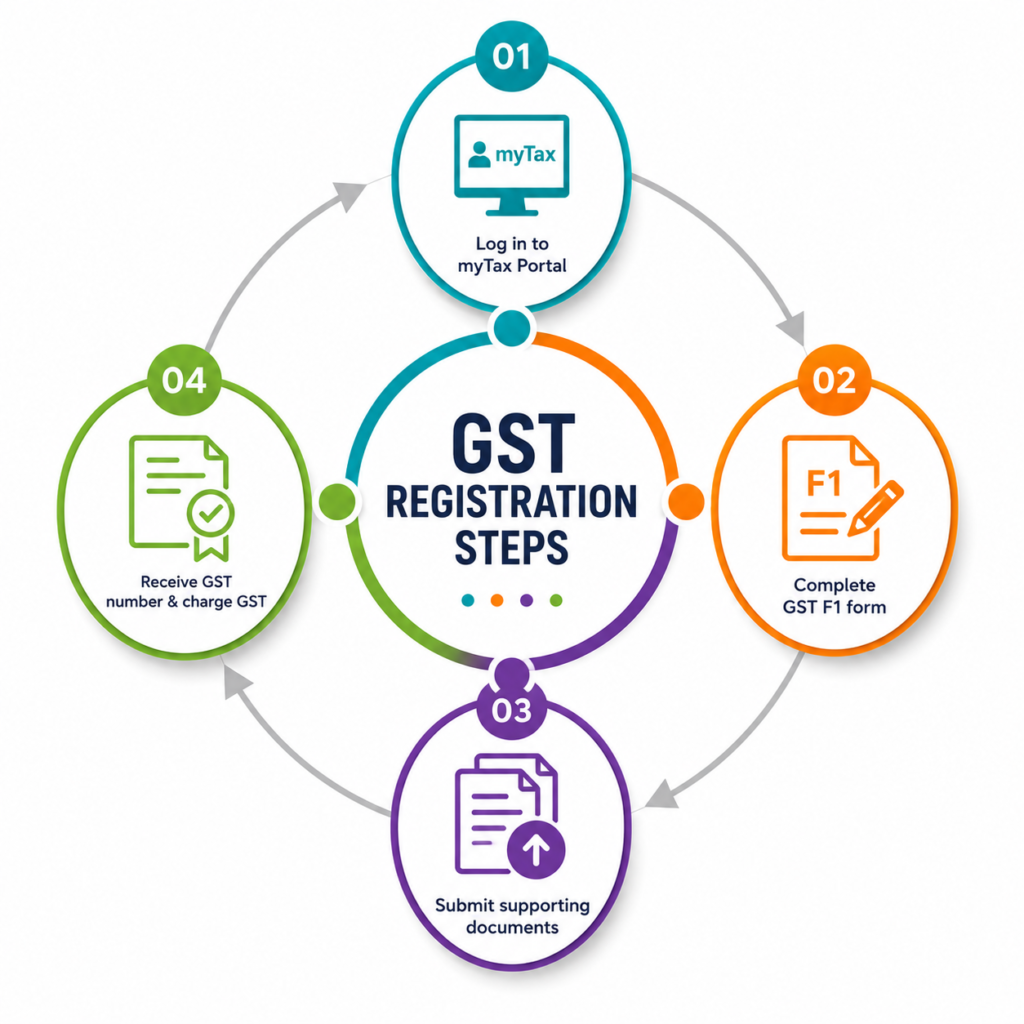
- Log in to myTax Portal using your CorpPass credentials.
- Complete GST F1 form — provide business details, projected turnover, and nature of supplies.
- Submit supporting documents such as financial statements or contracts showing expected revenue.
- Receive your GST registration number — IRAS typically processes applications within 10 business days.
- Begin charging GST from your effective registration date and issue tax invoices to customers.
Once registered, your GST number must appear on all tax invoices issued to customers. Failing to do so is a compliance breach.
Related Post: Accounting Services Singapore: The Complete Business Guide for SMEs (2026)
Understanding the GST Filing Process: Quarterly Returns Explained
Most GST-registered businesses in Singapore file returns every quarter. Your accounting period is assigned by IRAS and does not always align with the calendar quarter.
What You File: GST F5 Return
The GST F5 is the standard return form. It requires you to report:
- Total value of standard-rated supplies (Box 1)
- Total value of zero-rated supplies (Box 2)
- Total exempt supplies (Box 3)
- Total taxable purchases (Box 5)
- Output tax due (Box 6)
- Input tax claimed (Box 7)
The net difference between output and input tax is what you either pay to IRAS or receive as a refund.
Filing Deadlines You Cannot Miss
GST returns must be submitted and payment made within one month after the end of each accounting period. For example, if your quarter ends 31 March, your return is due by 30 April.
Late filing attracts a penalty of S$200 per day, up to a maximum of S$10,000. IRAS can also issue an estimated assessment — which may be higher than your actual liability.
GST Compliance: Common Mistakes SMEs Make
Business tax services is not just about filing on time. Errors in categorising supplies or overclaiming input tax are among the most frequent audit triggers for Singapore SMEs.
| Common Mistake | Risk | How to Avoid |
|---|---|---|
| Claiming input tax on non-business expenses | Audit and penalties | Separate personal and business purchases |
| Issuing incorrect tax invoices | Non-compliance under GST Act | Use compliant invoice templates |
| Missing the registration deadline | Back-dated GST liability | Monitor turnover monthly |
| Wrong tax rate applied post rate-change | Under-collection of GST | Update systems promptly after any rate revision |
Input Tax Claims: What You Can and Cannot Claim
Input tax recovery is one of the key benefits of GST registration — but it comes with strict conditions.
You can claim input tax on:
- Purchases directly used to make taxable supplies
- Import GST paid to Singapore Customs
- Business expenses like office rent, equipment, and professional fees
You cannot claim input tax on:
- Medical expenses for staff (unless obligatory under work injury compensation)
- Family benefits for employees’ family members
- Club membership fees
- Motor car costs (unless in the business of selling or hiring cars)
How GST Compliance Services Can Help Your Business
GST in-house management is possible for you when your transactions are straightforward. However, as your business grows, the number of returns becomes more voluminous and complex. Even just missing one deadline or making one mistake could cause an IRAS audit to happen, which will waste a lot of your time and money.
GST compliance services provide you with assistance in registering for GST, preparing the returns, filing them, and communicating with IRAS regarding your GST returns. These services will even check your input tax to make sure that there are no mistakes. This makes GST services much more cost-effective for SMEs who do not have a dedicated finance department.
At Tan, Chan & Partners , their team of chartered public accountants helps startups and SMEs in Singapore manage their GST from start to finish.
FAQ: GST Filing in Singapore
What is the GST registration threshold in Singapore?
Once the taxable turnover of a business exceeds S$1 million per annum, then it must register itself for GST. If you are likely to exceed this figure next year, then you will have to register yourself for GST in 30 days from now.
How often do I need to file GST returns in Singapore?
The filing of GST returns is generally done quarterly for most organizations. The accounting period is determined by IRAS when you register your business.
Can I claim GST on all my business purchases?
False. Just expenses that relate to producing taxable supplies would qualify. Expenses such as club subscriptions, private motor vehicles, and the health care of employees are not allowable for input tax purposes under Singapore’s GST Act.
What happens if I file my GST return late?
A late submission fee is charged by IRAS at S200perdayuntilS10,000. If you continue to fail to submit your GST returns, IRAS will impose an assessment on your business and begin taking enforcement action against it.
Is voluntary GST registration worth it for small businesses?
That is subject to your customers. In case your customers are mostly GST-registered businesses, being voluntarily registered enables them to claim the GST charged by you, which makes you more competitive. But you have to remain registered for two years at the very least.


