 WhatsApp Us Now

Home automation in Singapore refers to the use of smart devices and interconnected systems to control lighting, security, air conditioning, and other home functions — either remotely or automatically. First-time homeowners can start with a few essential devices and expand over time. A well-planned system improves comfort, energy efficiency, and security without requiring full renovation.
Setting up a home automation Singapore system might feel overwhelming at first. What devices do you actually need? How do they connect? And is it worth the investment for a new HDB flat or condo? This guide breaks it all down — clearly, practically, and without the tech jargon.
What Is Home Automation and How Does It Work?
Home automation connects your home’s devices and appliances through a central system — usually controlled via a smartphone app, voice assistant, or smart hub. These devices communicate using wireless protocols like Wi-Fi, Zigbee, Z-Wave, or Bluetooth.
Think of it this way: your smart lights, air conditioner, door lock, and security camera all “talk” to each other. When you leave for work, one tap on your phone — or a pre-set schedule — can turn off all the lights, lower the aircon, and lock the front door simultaneously.
In Singapore, most smart home setups are built around three layers:
- Input devices — sensors, motion detectors, door/window contacts
- Control devices — smart hubs, voice assistants (Google Home, Amazon Alexa)
- Output devices — smart lights, smart locks, automated curtains, smart ACs
Why Home Automation Makes Sense for Singapore Homeowners
A modern urban setting like that of Singapore would find smart home technology most relevant. Long working hours, expensive energy bills, and smaller living space only indicate how automation could be the next best step rather than luxury.
Smart living has always been an integral part of the Singaporean vision of developing its society into a Smart Nation according to the Infocomm Media Development Authority (IMDA). This has led to more accessibility and acceptance of smart homes.
Here’s why first-time homeowners in Singapore are making the switch:
- Energy savings: Smart Energy Meter and lighting schedules can reduce electricity bills meaningfully over time
- Security: Remote monitoring via smart cameras and video doorbells gives peace of mind, especially for those living alone
- Convenience: Automate repetitive tasks like turning off lights or adjusting temperature based on time of day
- Resale value: Smart home features are increasingly attractive to property buyers in Singapore’s competitive market
Essential Smart Home Devices Every First-Time Homeowner Needs
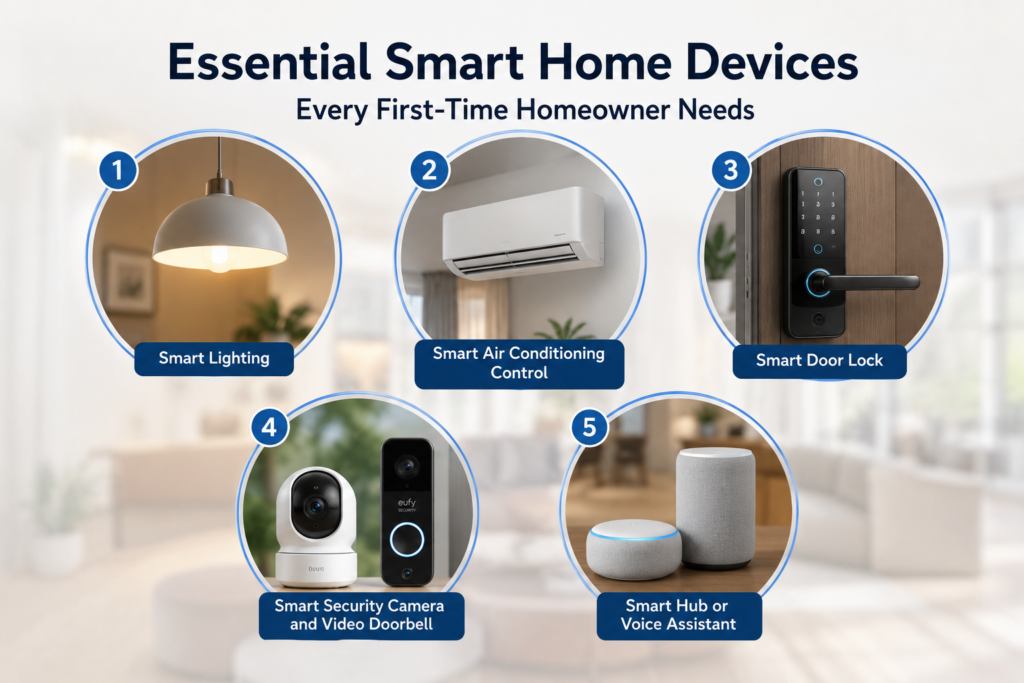
You don’t need to automate everything at once. Start with the devices that deliver the most daily value, then expand your system as your budget and comfort level grows.
1. Smart Lighting
Smart bulbs and switches let you control brightness, colour temperature, and schedules from your phone. They can also be triggered by motion sensors — ideal for corridors and bathrooms. Brands like Philips Hue and Xiaomi are widely available in Singapore.
2. Smart Air Conditioning Control
Given Singapore’s tropical climate, the aircon runs almost year-round. A smart IR blaster or smart aircon controller lets you schedule cooling times, set temperature limits, and turn off the unit remotely if you forgot before leaving. This alone can lead to noticeable savings on your SP Group electricity bill.
3. Smart Door Lock
One of the most popular upgrades in Singapore homes. Smart locks replace traditional keys with PIN codes, fingerprint access, or mobile unlock. They’re especially useful for families with young children or for granting access to cleaners or guests without being home.
4. Smart Security Camera and Video Doorbell
A basic IP camera placed at the entrance or living area lets you monitor your home remotely. Video doorbells add a layer of convenience — see who’s at the door before you open it, even when you’re at the office in Raffles Place.
5. Smart Hub or Voice Assistant
A smart hub ties all your devices together into one unified system. Devices like Google Nest Hub or Amazon Echo also serve as voice control centres. If you’re building a more complex setup, a dedicated hub ensures all your devices work together reliably.
Home Automation System: Choosing the Right Ecosystem
This is where many first-time buyers get stuck. The key is choosing an ecosystem — a platform all your devices communicate through — before purchasing individual products.
| Ecosystem | Best For | Popular Devices |
|---|---|---|
| Google Home | Android users, beginners | Nest Hub, smart displays |
| Amazon Alexa | Wide device compatibility | Echo devices, smart plugs |
| Apple HomeKit | iPhone users, privacy-focused | HomePod, HomeKit-certified locks |
| Matter (universal) | Cross-platform compatibility | New-generation smart devices |
Matter — a newer universal smart home standard supported by Apple, Google, and Amazon — is worth paying attention to. Devices with Matter certification work across all major ecosystems, which future-proofs your investment significantly.
Related Post: Best Smart Home System for HDB vs Condo vs Landed Property in Singapore
How to Plan Your Smart Home Setup Step by Step
A bit of planning before you buy anything saves money and headaches later. Here’s a practical sequence for new homeowners in Singapore:
- Identify your priorities — security, energy savings, convenience, or all three
- Choose your ecosystem — based on the devices you already own (iPhone vs Android)
- Start with high-impact devices — smart lock, aircon controller, and smart lighting as a starter pack
- Ensure strong Wi-Fi coverage — a mesh Wi-Fi system eliminates dead zones in larger flats or condos
- Use a professional for wiring-intensive installations — smart switches may require neutral wire connections, which need an electrician
- Expand gradually — add sensors, cameras, and automated blinds as your needs and budget grow
Common Mistakes First-Time Homeowners Make
Avoid these pitfalls before investing in your smart home system:
- Mixing incompatible ecosystems — buying devices from different platforms that don’t communicate with each other
- Underestimating Wi-Fi requirements — every smart device needs a stable connection; a weak router creates frustrating drop-outs
- Skipping professional installation for electrical work — DIY wiring without proper knowledge can be dangerous and void warranties
- Over-automating too quickly — a cluttered app with 30 devices you barely use is harder to manage than a focused, functional setup
The smartest approach is always to start simple. Get comfortable with two or three devices before expanding your system into a full smart home Singapore setup.
When you’re ready to move beyond basic gadgets and want a professionally integrated system tailored to your home — whether it’s an HDB, EC, or private condo — L3 Homeation specialises in custom smart home solutions in Singapore, designed to work seamlessly from day one.
Frequently Asked Questions
What is the best smart home system for Singapore HDB flats?
The most commonly used systems are those based on Google Home and Amazon Alexa because of the compatibility and convenience that comes along with them. However, for those wanting an integrated approach, a properly programmed system that uses protocols such as Zigbee or Z-Wave is more reliable.
How much does home automation cost in Singapore?
A simple home automation system for a house in Singapore, which includes smart lighting, smart lock, and aircon automation will cost somewhere between SGD 500 and SGD 1,500. An advanced and fully automated system that includes security cameras, automatic curtains, and even a smart hub will cost anywhere between SGD 3,000 and SGD 10,000 or even more, based on the size of your property.
Do I need a professional to set up home automation in Singapore?
Plug-and-play smart devices, such as smart lightbulbs or IR transmitters, do not need any expert assistance. However, if the device is a smart switch that requires neutral wire connections or a whole house installation, it needs to be installed only by an electrician or smart home installation technician.
Is home automation worth it for a new BTO flat?
Absolutely, the time when you are renovating your home is the best for setting up your smart home system. Everything will be easier to incorporate into your house because you have the possibility to lay out cables and set up switches right from the start.


