 WhatsApp Us Now
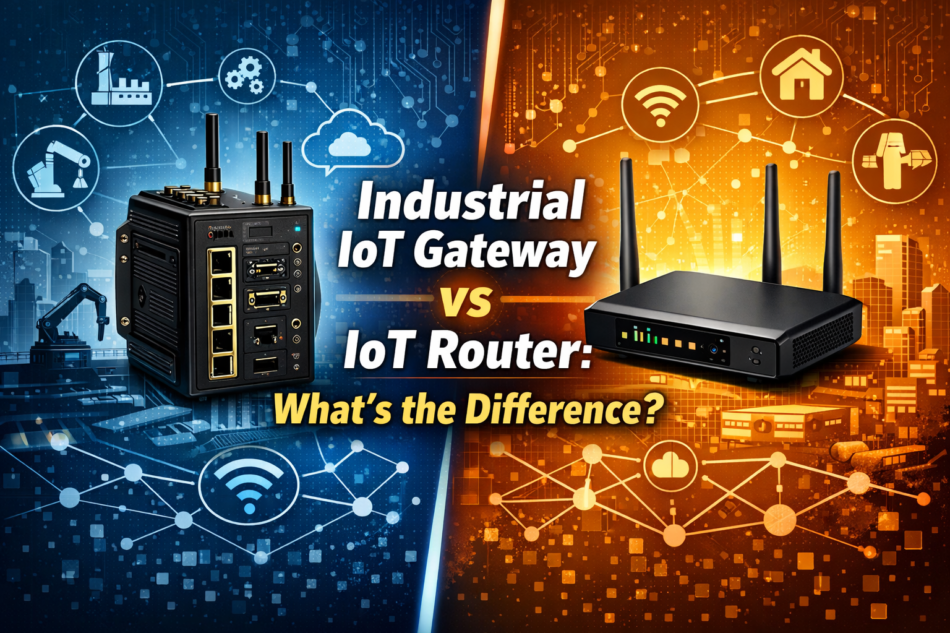
As industries embrace Industry 4.0, the need for seamless communication between machines, sensors, and cloud platforms has become critical. Two key components that enable this connectivity are Industrial IoT Gateways and IoT Routers.
Although they are often confused or used interchangeably, they serve distinct roles in an Industrial IoT (IIoT) ecosystem. Choosing the wrong one—or misunderstanding their purpose—can lead to inefficient systems, data loss, or increased operational costs.
What is an Industrial IoT Gateway?
An Industrial IoT Gateway is an intelligent device that acts as a translator, processor, and bridge between industrial equipment (OT layer) and IT/cloud systems.
Industrial environments typically use legacy communication protocols such as Modbus, CAN, Profibus, or OPC-UA, which are not directly compatible with modern cloud platforms. This is where the gateway comes in.
Core Capabilities
1. Protocol Conversion
Industrial IoT gateways convert machine-level protocols into cloud-friendly protocols like MQTT, HTTP, or HTTPS.
Example:
- Modbus RTU → MQTT → Cloud Dashboard
This ensures interoperability between old and new systems.
2. Edge Computing (Local Data Processing)
Gateways can process data locally before sending it to the cloud.
Functions include:
- Data filtering (removing unnecessary data)
- Aggregation (combining multiple data points)
- Real-time decision-making
Benefit: Reduces bandwidth usage and enables faster response times.
3. Device Integration
Gateways connect multiple devices such as:
- PLCs (Programmable Logic Controllers)
- Sensors
- SCADA systems
- Industrial machines
They act as a central hub for data collection.
4. Data Security
Industrial gateways often include:
- Encryption (TLS/SSL)
- Device authentication
- Secure firmware updates
5. Offline Functionality
Even if internet connectivity is lost, gateways can:
- Store data locally
- Sync data once the connection is restored
Real-World Use Case
In a manufacturing plant:
- Machines generate data using Modbus
- Gateway converts and processes data
- Sends only meaningful insights to the cloud
What is an IoT Router?
An IoT Router is a networking device that provides reliable and secure internet connectivity to IoT systems.
Unlike gateways, routers do not process or interpret data—they simply transmit it efficiently and securely.
Core Capabilities
1. Network Connectivity
IoT routers provide connectivity through:
- 4G LTE / 5G
- Ethernet
- Wi-Fi
They ensure devices stay connected even in remote locations.
2. Traffic Routing
Routers manage how data packets travel between:
- Local devices
- External networks (cloud servers)
3. Security Features
Industrial IoT routers offer:
- VPN (OpenVPN, IPsec, GRE)
- Firewall protection
- Access control
4. Failover & Redundancy
Advanced routers support:
- Dual SIM failover
- Automatic network switching
Benefit: Ensures uninterrupted connectivity in mission-critical applications.
5. Remote Management
Routers allow:
- Remote monitoring
- Firmware updates
- Network diagnostics
Real-World Use Case
In a remote solar plant:
- Router provides 4G connectivity
- Sends data from the gateway to cloud servers
- Maintains uptime with dual SIM backup
Key Differences Explained
| Feature | Industrial IoT Gateway | IoT Router |
| Primary Purpose | Data translation & processing | Data transmission |
| Position in Architecture | Between devices and router/cloud | Between local network and internet |
| Protocol Handling | Industrial + Cloud protocols | Only IP-based networking |
| Edge Intelligence | Yes (analytics, filtering) | No |
| Connectivity Role | Depends on external network | Provides connectivity |
| Complexity | High (intelligent device) | Medium (network device) |
Architecture: How They Work Together
A typical Industrial IoT system uses both devices in a layered architecture:
Step-by-Step Flow:
- Sensors & Machines
Generate raw data using industrial protocols - Industrial IoT Gateway
- Converts protocols
- Filters & processes data
- Prepares it for cloud transmission
- IoT Router
- Connects system to internet
- Securely transmits data
- Cloud Platform
- Stores, analyzes, visualizes data
When Should You Use an Industrial IoT Gateway?
Use a gateway when:
- You are dealing with legacy industrial equipment
- Multiple communication protocols need integration
- You require real-time processing (edge computing)
- Bandwidth optimization is important
- Data needs to be cleaned and structured
When Should You Use an IoT Router?
Use a router when:
- You need reliable internet connectivity
- Deployment is in remote or mobile environments
- Security (VPN/firewall) is a priority
- Continuous uptime is required (failover support)
Can a Gateway Replace a Router (or Vice Versa)?
No — they are not interchangeable.
- A gateway cannot replace a router because it may not provide robust connectivity.
- A router cannot replace a gateway because it lacks protocol conversion and intelligence.
However, modern industrial devices sometimes combine both functionalities.
Hybrid Devices: Gateway + Router
Some advanced solutions integrate:
- Protocol conversion
- Edge computing
- 4G/5G connectivity
- VPN security
Advantages:
- Lower hardware cost
- Easier deployment
- Compact design
Limitations:
- Less flexibility in large-scale deployments
- Performance constraints under heavy loads
Benefits of Using Both Together
Using both devices creates a powerful IIoT ecosystem:
Efficient Data Handling
Only relevant data is transmitted
Reduced Bandwidth Costs
Edge processing minimizes cloud load
High Reliability
Router ensures continuous connectivity
Enhanced Security
Multi-layer protection (gateway + router)
Scalability
Easy to expand across multiple locations
Common Mistakes to Avoid
- Using only a router for industrial data integration
- Ignoring protocol compatibility
- Skipping edge processing (leads to high cloud costs)
- Underestimating security requirements
Future Trends (2026 & Beyond)
- AI-enabled IoT Gateways for predictive analytics
- 5G-powered IoT Routers for ultra-low latency
- Edge-to-Cloud integration becoming standard
- Cybersecurity-focused architectures
Conclusion
The difference between an Industrial IoT Gateway and an IoT Router comes down to their core roles:
- Industrial IoT Gateway → Intelligence (data processing, protocol conversion, edge computing)
- IoT Router → Connectivity (network access, secure data transmission)
For a successful Industrial IoT deployment, both are essential and work best in combination, not as alternatives.


