 WhatsApp Us Now
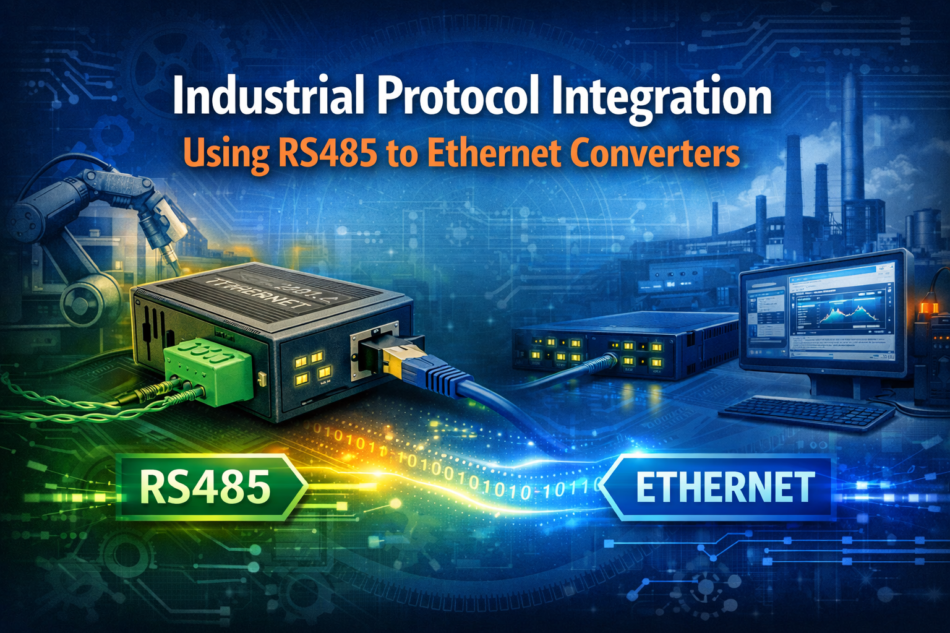
Industrial environments are evolving rapidly with the adoption of Industrial IoT (IIoT), cloud computing, and smart automation systems. However, a major challenge still persists—how to integrate legacy RS485-based devices with modern Ethernet and cloud-based protocols.
This is where RS485 to Ethernet converters become indispensable. They not only bridge physical communication gaps but also enable protocol-level integration, allowing industrial systems to communicate seamlessly across different technologies.
This in-depth guide explores how RS485 to Ethernet converters enable integration with key industrial protocols like Modbus, MQTT, OPC-UA, and HTTP, along with architecture, use cases, and best practices.
Understanding RS485 and Ethernet Communication
RS485 Communication (Legacy but Reliable)
RS485 is a widely used serial communication standard in industrial environments due to:
- Long-distance communication (up to 1200 meters)
- High noise immunity
- Multi-drop capability (multiple devices on the same bus)
It is commonly used by:
- PLCs
- Energy meters
- Sensors and actuators
- Industrial controllers
However, RS485 is limited to serial communication and cannot directly connect to modern IP networks.
Ethernet Communication (Modern Networking)
Ethernet enables:
- High-speed data transfer
- IP-based communication
- Integration with cloud and enterprise systems
Protocols like Modbus TCP, MQTT, and HTTP operate over Ethernet, making it essential for modern industrial infrastructure.
Role of RS485 to Ethernet Converters
An RS485 to Ethernet converter acts as a bridge and protocol translator between serial and IP-based networks.
Core Functions:
- Serial-to-IP data conversion
- Protocol encapsulation (e.g., Modbus RTU → Modbus TCP)
- Device networking over LAN/WAN/Internet
- Remote access and monitoring
Industrial Protocol Integration
1. Modbus Integration (RTU to TCP)
Modbus is the most widely used industrial protocol:
- Modbus RTU → Runs on RS485
- Modbus TCP → Runs on Ethernet
How Integration Works:
- RS485 devices send Modbus RTU data
- Converter encapsulates it into Modbus TCP packets
- SCADA/PLC systems read data over Ethernet
Advantages:
- No need to replace legacy devices
- Seamless SCADA integration
- Standardized communication
Example:
A factory uses RS485-based energy meters. With a converter:
- Data is transmitted to a central SCADA system via Ethernet
- Real-time monitoring and analytics become possible
2. MQTT Integration (IIoT & Cloud Connectivity)
MQTT (Message Queuing Telemetry Transport) is a lightweight publish/subscribe protocol ideal for IoT.
Integration Process:
- RS485 devices send raw data
- Converter reads and formats the data
- Publishes it to an MQTT broker (cloud or local server)
Benefits:
- Low bandwidth usage
- Real-time data streaming
- Easy cloud integration (AWS, Azure, etc.)
Use Case:
A remote water treatment plant:
- Sensors send RS485 data
- Converter pushes data to cloud via MQTT
- Operators monitor systems remotely
3. OPC-UA Integration (Secure Industrial Interoperability)
OPC-UA is a platform-independent protocol designed for secure and reliable industrial communication.
Integration Workflow:
- RS485 devices send data
- Converter maps data to OPC-UA nodes
- Industrial systems access structured data securely
Advantages:
- Vendor-neutral communication
- Built-in security (encryption, authentication)
- Scalable architecture
Example:
A manufacturing unit integrates machines from different vendors into a unified OPC-UA-based system.
4. HTTP/REST Integration (Web & Dashboard Connectivity)
Modern applications use HTTP/REST APIs for:
- Web dashboards
- Mobile apps
- Enterprise systems
Integration:
- Converter translates RS485 data into JSON/XML
- Data is accessible via REST APIs
- Applications fetch and display data
Benefits:
- Easy integration with web platforms
- Real-time visualization
- Cross-platform compatibility
System Architecture: How It All Works
Typical Architecture:
RS485 Devices → RS485 to Ethernet Converter → Network (LAN/WAN/Cloud) → Applications
Data Flow:
- Field devices generate data
- RS485 transmits serial data
- Converter translates protocols
- Ethernet network carries data
- SCADA/Cloud processes and visualizes data
Real-World Applications
Industrial Automation
- PLC communication over Ethernet
- Centralized control systems
Energy Monitoring
- Smart metering systems
- Power consumption analytics
Building Management Systems (BMS)
- HVAC, lighting, and security integration
Water & Wastewater Management
- Pump control and monitoring
- Remote diagnostics
Smart Transportation
- Traffic systems
- Fleet monitoring
Advanced Features in Modern Converters
Modern RS485 to Ethernet converters are more than just protocol bridges.
Key Capabilities:
- Multi-protocol support (Modbus, MQTT, OPC-UA)
- Edge computing and data preprocessing
- Data logging and buffering
- Secure communication (SSL/TLS, VPN)
- Remote configuration via web interface
- Dual Ethernet ports for redundancy
Benefits of Protocol Integration
Operational Efficiency
Centralized monitoring reduces manual intervention
Cost Savings
No need to replace legacy RS485 devices
Scalability
Easily expand networks with Ethernet
Data-Driven Decisions
Real-time analytics improves productivity
Remote Access
Monitor systems from anywhere
Challenges & Solutions
| Challenge | Solution |
| Protocol mismatch | Use multi-protocol converters |
| Network complexity | Use plug-and-play devices |
| Security risks | Implement encryption & firewalls |
| Latency issues | Optimize network and bandwidth |
Best Practices for Deployment
- Choose converters with multi-protocol support
- Ensure proper network configuration (IP, ports)
- Use secure communication protocols (TLS, VPN)
- Test compatibility with existing systems
- Plan for scalability and future upgrades
Future Trends in Protocol Integration
- Edge computing integration
- AI-based predictive maintenance
- Increased adoption of MQTT & cloud platforms
- Stronger cybersecurity frameworks
- Unified industrial communication standards
Conclusion
RS485 to Ethernet converters are a key enabler of industrial digital transformation. By integrating protocols like Modbus, MQTT, OPC-UA, and HTTP, they allow legacy systems to seamlessly connect with modern networks and cloud platforms.
This not only extends the life of existing equipment but also unlocks powerful capabilities such as real-time monitoring, remote access, and data analytics—all essential for Industry 4.0.


