 WhatsApp Us Now
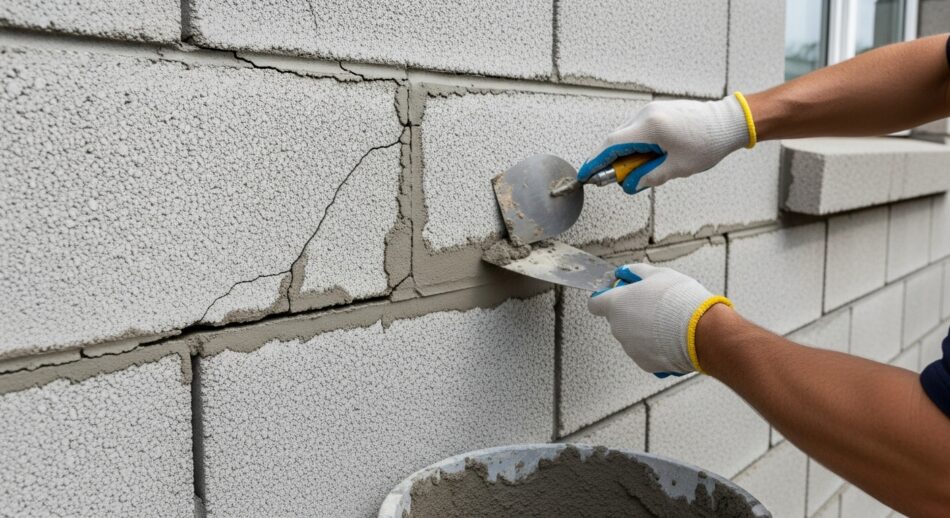
Repairing cracks in concrete block walls requires knowing the nature of the crack and filling it with the appropriate filler or mortar. The initial one is to clean up the crack and scrap off the loose mortar. The crack is then gummed over, and the surface brought to a smooth.
This is a procedure, which is required due to the fact that block walls may have cracks that can enable water to creep in and moisture to get in. I believe that with time the mortar joints weaken. Not all cracks are structural movement and some are cosmetic cracks.
A proper approach is essential to ensure the durability and safety of the wall. This process is especially valuable for construction cost estimation, as it supports accurate assessment and material takeoff. By identifying different types of cracks, preparing the surface correctly, and applying long-lasting, sustainable sealing methods, estimating services can generate reliable quantities and costs, helping prevent future damage and unnecessary repair expenses.
Causes Of Cracks In Concrete Block Walls
Any block wall made of concrete may have cracks, and the knowledge of their origin is the initial step towards the repair.
Structural Movement
The cracks in the walls are usually due to the changes in the building foundations or soil. In case the foundation settles, the blocks pick up the stress.
Thermal Expansion And Contraction
Expansion and Contraction of Thermal has a wide range of clients in this region. Along with the temperature variations, concrete and masonry contract and expand. This movement may cause fine cracks in the hairlines or bigger ones.
Moisture And Water Damage
Block walls are weakened by the seepage of water. After some time moisture may lead to cracks and efflorescence.
Ineffective Construction Practices
Wall cracks are caused by weakness of the concrete mix or mortar, lack of proper alignment of blocks.
Natural Aging
Through the years, the walls do sink and shrink. These are small cracks that are normal and in most cases superficial.
Types Of Cracks In Concrete Block Walls
The type of crack dictates the form of repair. Typically, there are three types of cracks;
1. Hairline Cracks
These finer cracks are nothing more than surface ones. They are not structural integrity compromising, only cosmetic repair is necessary.
2. Structural Cracks
These extended cracks are normally caused by either foundation movement or massive loads. Assessment should be done properly.
3. Stair-Step And Horizontal Cracks.
The horizontal cracks frequently take place as a result of lateral force on the wall.
Elevated block joints are seen to have stair-step cracks, which show settlement.
Step-By-Step Instructions For Repairing Concrete Block Wall Cracks
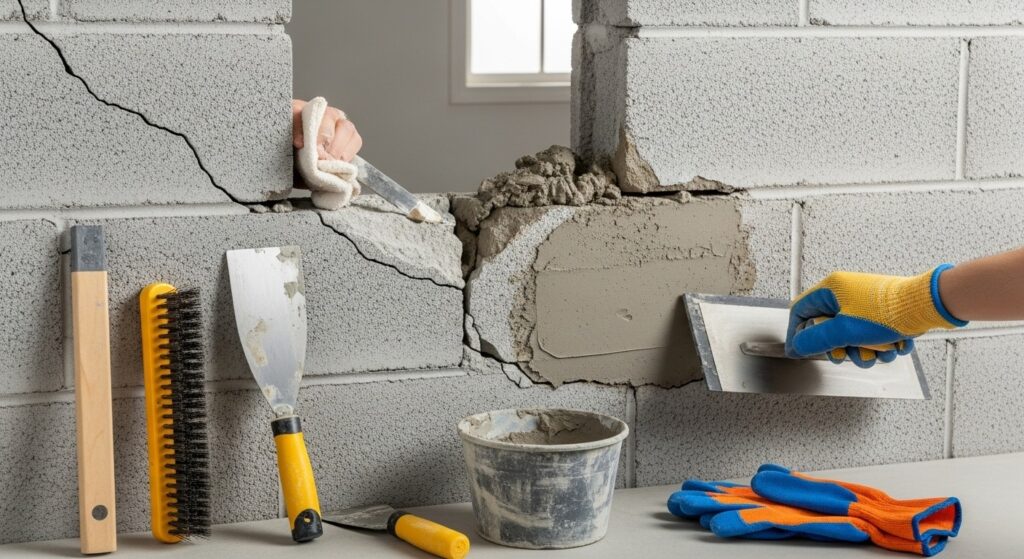
During the process of crack repair, safety and durability should be considered. Here are detailed steps.
Step 1: Inspect The Wall
The initial step is to conduct an inspection of the wall. Record the width, length and the location of the crack. The fillings of hairline cracks are not a difficult task, whereas a structural crack needs specific attention.
Step 2: Prepare The Crack Area
Wash the surrounding crack. It is imperative to eradicate loose debris, dust and old mortar. Once this has been done, the repair material will be held in place.
Undercutting Or Widening The Crack:
This step involves enlarging the crack and undercutting it with the goal of increasing the crack length, thus initiating the crack propagation phase that involves crack enlargement.
Step 3: Widen And Undercut The Crack
To deeper cracks, form little cavities. This form of undercut enhances the wall repair. Small grooves are sufficient to be in narrow cracks.
Step 4: Apply Repair Material
Fill the crack evenly. The gap is filled with the help of a layering technique. This should not be overfilled because it will lead to trouble with surface finish in the future.
Step 5: Leveling And Finishing The Surface
Fill and flatten the surface using a trowel or putty knife. This ensures a smooth wall finish and it is ready to be painted or plastered.
Step 6: Cure The Repair
To cure concrete and mortar is important. Preservation of moisture is essential to the appropriate bonding. In most cases 24-48 hours of light curing will be adequate, depending on the size of cracks.
Step 7: Monitor And Maintain
Monitor the wall after repair. In case the cracks reoccur, examine foundation issues or load problems.
Wall Crack Repair Recommendations
- Deep cracks should always be filled with a layer of filling so that they do not shrink.
- Horizontal cracks can be stabilized by means of further reinforcement.
- Hairline cracks may be filled using a small amount of material but they ought to be maintained.
- During the curing stage ensure that the area where the repair is done is dry to guarantee good bonding.
Preventive Measures For Future Wall Cracks
- Correct foundation checking prior to the building of the walls.
- Barricade water and drainage systems.
- Conducting load and wall stress inspection regularly.
- The use of heavy vibration around block walls should be avoided during construction or renovation.
When to Consult a Structural Engineer
Structural assessment is advised in case cracks exceed 6 mm, or the wall is leaning or bulging. A load distribution check, foundation stability, and long-term repair recommendations will be done by an engineer.
Real-Life Example
Horizontal cracks had formed in a 10 year old residential wall. Settlement and lateral soil pressure were found to be the most important after examination. The crack was enlarged and undermined, filled up in layers and curing was assured. Outcome: the wall was made stable and the cracks were permanently fixed. This situation goes to explain the chronological order in which how to fix cracks in the walls is carried out.
Conclusion
The mending of cracks in concrete block walls is crucial for maintaining building stability and preventing water infiltration, with proper planning supported by concrete cost estimating.
The process of repairing cracks within the concrete block walls entails inspection, cleaning, effective filling, finishing the surface as well as curing. Determining crack types and causes will result in successful repair.
I believe that frequent follow-up and preventive measures minimize the repeat. Well-judged and systematized methods of repair of the walls ensure that they are durable, safe, and structurally solid.
FAQs
What Is The Time Required To Mend The Cracks Of The Concrete Block Walls?
The time of repair is determined by the size and type of cracks. Cracks in hairlines take a typical duration of 1-2 hours. The filling and curing of structural cracks and deep cavities can take up to 24-48 hours.
Can The Cracks In The Walls Be Repaired Repeatedly To Produce A Permanent Repair?
The cracks may reoccur in the event the cause, such as foundation settlement or wetness, is not corrected. The only solution is a lasting one which involves a solution to the problem.
Which Cracks Can Be Ignored?
Minor cracks on the hairline that do not influence structural stability can be treated by cosmetic repair. Big or transverse cracks cannot be neglected.



