 WhatsApp Us Now

Dubai runs on more languages than almost any city its size. A single board meeting can have an Emirati chair, a Chinese supplier, a German engineer and a legal team working in Arabic and English side by side. When everyone in the room does not share a language, the interpreter becomes the most important person nobody notices.
The trouble is that “we need an interpreter” is not really a brief. The right answer depends on the setting, the number of listeners, how fast the conversation moves and whether the meeting has legal weight. Get the format wrong and you end up with a delegate straining to hear through a whisper, or a ten-person negotiation paying for booths it never needed.
Here is how to match the service to the situation.
Start with the setting, not the language
Most people book interpretation by asking “do you have someone for Mandarin?” first. Language matters, but the format decides almost everything else, including the price.
Three questions narrow it down quickly:
- How many people need the interpretation? One or two listeners is a very different job from a hall of 400.
- Does the conversation need to flow in real time? A keynote cannot pause every two sentences. A deposition can, and often should.
- Is anyone in the room remotely? Hybrid meetings change the equipment and the platform you need.
Answer those, and the choice of mode usually makes itself.
Which interpretation mode fits your meeting?
Each mode was built for a particular kind of room. The table below is a simple starting point.
| Mode | How it works | Best for |
|---|---|---|
| Simultaneous | Interpreters work from a soundproof booth while the speaker talks; listeners hear them through headsets | Conferences, summits, multi-language events |
| Consecutive | The speaker pauses and the interpreter renders each segment afterwards | Negotiations, interviews, depositions, small meetings |
| Whispered (chuchotage) | The interpreter sits beside one or two listeners and speaks quietly | Site visits, factory tours, observers at a meeting |
| Escort | An interpreter stays with a visitor through the day | Airport arrivals, business trips, delegation tours |
| Video remote (VRI) | A live interpreter joins through Zoom, Teams or Google Meet | Hybrid meetings, remote consultations |
| Over-the-phone | On-demand interpretation by phone call | Urgent calls, support lines, quick consultations |
| Sign language | A qualified interpreter on site or by video | Press conferences, education, public events |
A useful rule of thumb: if the event has a stage, think simultaneous. If it has a table, think consecutive. If it has a walking route, think whispered or escort.
Simultaneous interpretation is demanding work, so professional teams send interpreters in pairs who rotate during long sessions. If a quote for a full-day conference lists a single simultaneous interpreter per language, ask why.
Don’t forget the equipment
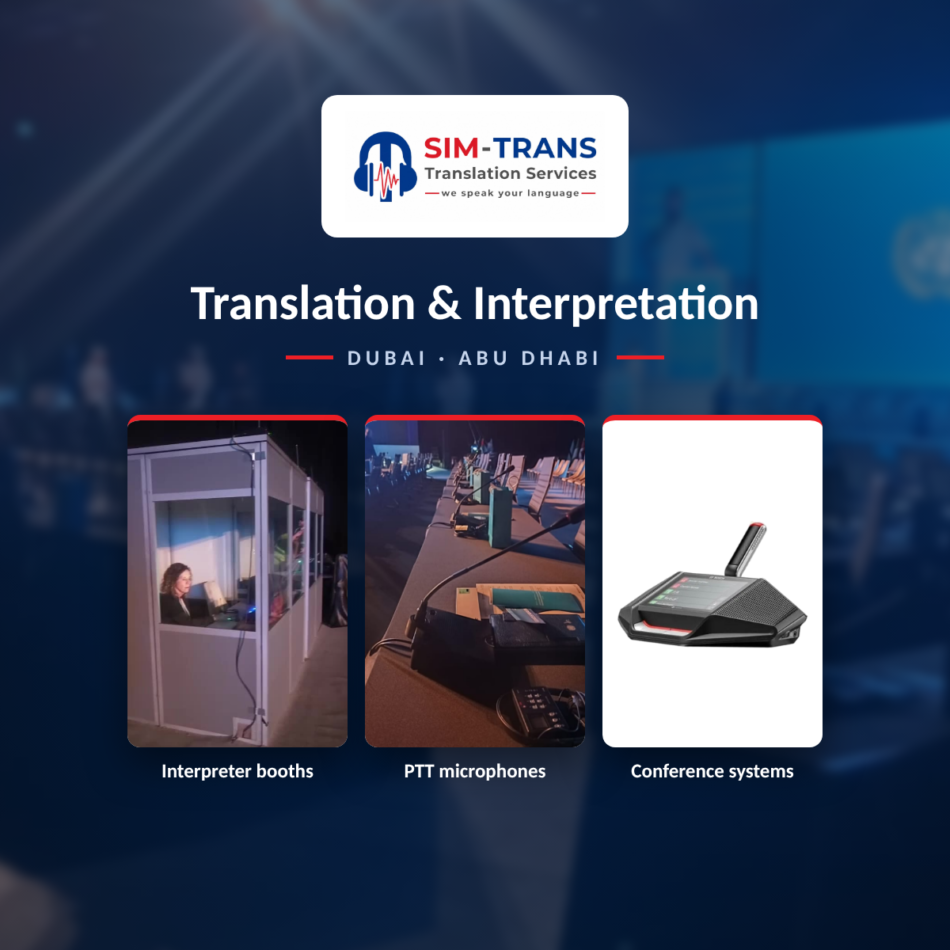
For simultaneous interpretation, the interpreter is only half the service. The other half is the booth, the transmitters, the receivers and the technician who keeps it all working.
This is where events quietly go wrong. Receivers that drop out at the back of the hall, a booth placed where the interpreter cannot see the speaker’s slides, or a system that cannot carry enough language channels. A good provider will handle soundproof booths, wireless receivers and headsets, and will install and test everything before the first guest arrives. In Dubai, specialist providers such as Sim-Trans can scale a setup from a small boardroom to a conference of more than 1,000 delegates, with receivers carrying up to 32 language channels.
Two practical tips:
- Book equipment and interpreters together where you can. One coordinator for both means one person to call when something changes on the day.
- Ask who is on site. A technician in the room during the event is worth far more than a phone number.
Legal and official settings play by different rules
Interpretation for a court hearing, a police statement, a notary appointment or an arbitration is not the same as interpretation for a product launch. Accuracy carries legal consequences, and the authorities involved will usually expect interpreters with recognised credentials.
In the UAE, that typically means interpreters recognised by the UAE Ministry of Justice. Before you book for anything official, confirm the interpreter’s accreditation and check with the court, prosecution office or notary what they will accept. Consecutive interpretation is the usual format here, because it lets every statement be rendered in full and checked.
Confidentiality matters too. For legal, medical or commercially sensitive work, it is reasonable to ask for an NDA before you share any case files or briefing material.
What should you ask before booking an interpreter in Dubai?
A short checklist saves a lot of trouble later:
- Subject matter. Will the interpreter have experience in your field, whether that is legal, medical, technical or financial?
- Briefing. Will they receive your agenda, slides and terminology in advance? Interpreters who are briefed perform noticeably better.
- Backup. What happens if the interpreter falls ill on the morning of a critical meeting?
- Pricing. Is the quote fixed, and does it include equipment, technicians and setup time? Prices usually depend on the language pair, the mode, the duration and the equipment.
- Lead time. Can they cover short-notice requests? Some Dubai providers can deploy an interpreter on the same day for urgent court, hospital or business needs, but rare language pairs need more notice.
An agency usually answers these questions more easily than a single freelancer, simply because it has more people and equipment to draw on. For a one-off informal meeting, a trusted freelancer can work well. For a multi-language conference, an agency is the safer bet.
Are remote and AI interpretation worth considering?
Yes, for the right job. Video remote interpreting has become a normal part of business in the UAE, and it removes travel costs for short meetings or calls with partners abroad. Phone interpretation suits urgent, short conversations where video is not practical.
AI simultaneous interpretation is the newer option. It offers live translation at a lower cost and can work well for webinars, internal training and product launches where the stakes are moderate. For a court hearing, a medical consultation or a tense negotiation, a human interpreter is still the right call. Tone, intent and the occasional deliberately vague sentence are exactly what machines miss.
Many organisations now mix both: AI for routine sessions, human interpreters for the moments that matter.
Frequently asked questions
What is the difference between interpretation and translation? Interpretation deals with spoken language in real time. Translation deals with written documents. The skills overlap, but they are different professions.
How far in advance should I book interpreters for a conference in Dubai? As early as you can, ideally several weeks ahead for large events, especially during peak exhibition season. Short-notice bookings are possible for common language pairs, but equipment and specialist interpreters fill up fast.
Can one event run in several languages at once? Yes. With simultaneous interpretation, each language gets its own booth team and channel, and delegates simply choose their language on the receiver.
Is consecutive interpretation slower? It roughly doubles the time each statement takes, since everything is said twice. That makes it ideal for small, precise discussions and impractical for packed conference agendas.
The bottom line
The best interpretation is the kind nobody talks about after the event. Choose the mode that fits the room, make sure the equipment is handled by people who will be there on the day, and for anything with legal weight, check credentials before you sign. Do that, and your multilingual meeting in Dubai will feel like everyone was speaking the same language all along.
About the author: Esraa Elhaddad writes about language services and cross-border business in the Gulf for Sim-Trans, a UAE Ministry of Justice-recognised translation and interpretation company with offices in Dubai and Abu Dhabi, operating since 2006.


