 WhatsApp Us Now
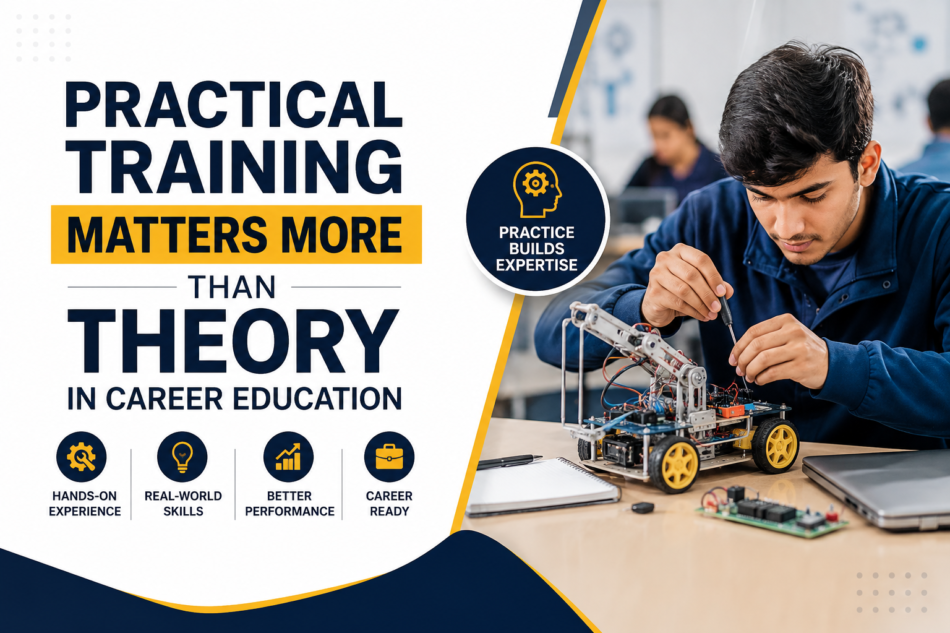
Knowing something from a textbook is useful. Knowing how to use it is even more useful.
That is the basic idea behind practical training.
Students spend years learning formulas, definitions, concepts, and theories. These create the foundation for higher education. But once you move into college, competitive exams, internships, or a job, you are often expected to apply what you know.
Think about a student preparing for JEE.
Memorising every physics formula does not automatically mean they can solve a difficult question. They need to understand the concept, identify what the question is asking, choose the right approach, and solve it within a limited time.
That is where theory and practice come together.
Quick Answer
Practical training helps students turn theoretical knowledge into usable skills. It gives them opportunities to solve problems, practise concepts, learn from mistakes, and handle situations that may not look exactly like textbook examples. Theory builds knowledge, while practical work teaches students how to use that knowledge.
What Is Practical Training in Education?
Practical training means learning through application.
It can involve:
- Solving real-world problems
- Laboratory experiments
- Projects
- Mock tests
- Case studies
- Presentations
- Group activities
- Simulations
- Hands-on assignments
- Problem-solving exercises
The exact method depends on the subject.
For a science student, practical learning might mean experimenting.
For a computer science student, it could mean writing and testing code.
For a JEE aspirant, it may involve solving different types of problems and analysing mistakes after a mock test.
The common thread is simple.
You do not just read about something.
You practise using it.
Why Is Theory Still Important?
Before we compare theory and practice, there is one thing worth making clear.
Theory is not useless.
Far from it.
You need concepts before you can apply them properly.
Imagine trying to solve a physics problem without understanding the basic laws involved. More practice alone will not fix that gap.
Theory gives you:
- Basic concepts
- Definitions
- Principles
- Formulas
- Background knowledge
- Subject vocabulary
Practical training builds on this foundation.
A good learning system should not force students to choose between theory and practice. It should connect the two.
What Happens When Students Learn Only Through Theory?
Students who mainly memorise information can perform well in familiar situations.
The trouble often starts when the question changes.
For example, a student may know a mathematical formula perfectly. When they see the exact example from their notes, they solve it quickly.
Now change the wording.
Change the numbers.
Add another concept.
Suddenly the question feels difficult.
This is not always because the student is weak at mathematics. They may simply need more practice applying the concept in different situations.
That distinction is important.
How Does Practical Training Improve Problem-Solving?
Problem-solving is a skill.
It gets better with practice.
When students work through different problems, they start noticing patterns.
They learn to ask:
- What information has been given?
- What is the question asking?
- Which concept applies?
- Are there multiple ways to solve it?
- Does my answer make sense?
- Where did I make a mistake?
These questions become part of the thinking process.
Over time, students may become more comfortable with unfamiliar questions.
This is especially useful in competitive examinations where not every question will look exactly like a classroom example.
How Does Practical Training Help JEE Students?
For students preparing for JEE, practical application can be particularly useful.
JEE preparation involves a strong understanding of subjects such as Physics, Chemistry, and Mathematics. Students also need to manage time and solve questions accurately.
Consider a Physics chapter.
Reading the theory gives you the laws and concepts.
Solving basic questions helps you understand how those laws work.
More difficult problems then require you to connect multiple ideas.
Mock tests add another layer.
Now you need to make decisions under time pressure.
A student might know the material but spend too long on one difficult question.
That is also something practice can reveal.
Practical Training vs Theory: What Is the Difference?
| Theory-based learning | Practical learning |
| Builds subject knowledge | Applies subject knowledge |
| Focuses on concepts and principles | Focuses on using concepts |
| Often uses textbooks and notes. | Uses problems, projects, tests and activities |
| Helps explain “what” and “why” | Helps practise “how” |
| Creates a foundation | Builds application skills |
| Can be easier to study passively | Requires more active participation |
Neither side should be ignored.
A student who practises without understanding may develop incorrect habits.
A student who only reads may struggle to apply what they know.
The combination is stronger.
What Are the Benefits of Practical Training?
1. Better Concept Understanding
When you use a concept, you often notice details that are easy to miss while reading.
A physics formula can look simple in your notebook.
Try applying it to a new problem.
You may suddenly realise that you misunderstood one of the conditions.
That is useful learning.
2. Learning From Mistakes
This is one of the biggest benefits of practice.
Suppose you take a mock test and score less than expected.
It can feel disappointing.
But the score itself is not the most useful part.
Look at the mistakes.
Were they caused by:
- Lack of knowledge?
- Misreading the question?
- Calculation errors?
- Poor time management?
- Guessing?
- Confusion between concepts?
Once you know the reason, you know what to work on.
3. Better Time Management
Many students know how to study.
Fewer people know how to manage their time during an exam.
Practical tests help students experience time pressure before the actual examination.
You can learn when to move on from a difficult question and when to spend more time solving it.
That experience cannot come from reading theory alone.
4. More Confidence With Unfamiliar Questions
Confidence should come from preparation, not from simply being told that you are capable.
When you have solved different types of problems, unfamiliar questions may feel less intimidating.
You have already experienced situations where the answer was not immediately obvious.
That matters.
Practical training is not only about competitive examinations.
Consider a student interested in engineering.
Learning mathematics and physics is important.
But they can also develop skills through:
- Building small projects
- Learning basic programming
- Participating in science competitions
- Working with simple electronics
- Using design or simulation tools
- Explaining projects to others
These activities can help students understand what their future field actually involves.
A student interested in computer science, for example, may discover that they enjoy coding much more than they expected.
Another student may discover the opposite.
That is useful information too.
Common Mistakes Students Make
Mistake 1: Treating practice as something to do later
Some students spend weeks studying theory and tell themselves they will start solving questions once the chapter is complete.
Try not to wait too long.
Mix learning and practice.
Mistake 2: Solving only easy questions
Easy questions feel comfortable.
They also make you feel like you are progressing.
But you need different levels of difficulty to test real understanding.
Mistake 3: Looking at the answer too quickly
Getting stuck is part of problem-solving.
Give yourself some time before checking the solution.
Then compare your approach with the correct one.
Mistake 4: Ignoring wrong answers
A wrong answer can teach you more than an easy correct answer.
Keep track of repeated mistakes.
Mistake 5: Chasing study hours
Five focused hours of learning and practice can be more useful than sitting with books for ten hours while constantly checking your phone.
The number of hours is not the only thing that matters.
How Can Students Add More Practical Training to Their Routine?
You do not need to completely change your study plan.
Try this simple approach.
Step 1: Learn the concept
Read the topic carefully.
Understand the basic idea before trying difficult questions.
Step 2: Solve basic problems
Start with questions that check whether you understood the concept.
Step 3: Move to application-based questions
Try questions that require you to think rather than simply recall.
Step 4: Mix old and new topics
This prevents you from relying only on chapter-specific patterns.
Step 5: Take regular tests
Use timed tests to practise under exam-like conditions.
Step 6: Analyse your mistakes
Spend time understanding why you got something wrong.
Step 7: Repeat
Return to weak areas after a few days.
This cycle is much more useful than simply completing a chapter and never revisiting it.
How Can Parents Support Practical Learning?
Parents sometimes focus heavily on marks.
That is understandable.
But you can also ask different questions.
Instead of only asking:
“What did you score today?”
try:
- What did you learn today?
- Which topic was difficult?
- What mistake did you make?
- Can you explain this concept to me?
- What will you practise tomorrow?
These questions encourage students to think about the learning process.
They also make it easier to identify problems before exam time.
What Should You Look for in Coaching Classes?
If you are comparing coaching options in Nagpur, do not look only at the fee, batch size, or number of classes.
Ask how much active practice students receive.
For example, if you are considering IIT JEE Classes in Nagpur, ask:
- Are regular problem-solving sessions conducted?
- Are students given questions of different difficulty levels?
- How often are mock tests held?
- Are test results discussed?
- Can students ask questions when they get stuck?
- Are common mistakes explained?
- Is there enough revision?
- Does the teaching approach suit the student’s current level?
A good coaching environment should give students opportunities to practise what they learn.
How Can Teachers Make Theory More Practical?
Teachers do not need expensive equipment for every lesson.
Small changes can help.
For example:
- Ask students to explain their reasoning.
- Give a real-world example.
- Change the numbers in a familiar problem.
- Ask students to find more than one solution.
- Discuss why a wrong answer is wrong.
- Use short quizzes after teaching a concept.
- Give students unfamiliar problems.
Even a five-minute activity can make a lesson more active.
Does Practical Training Matter for Future Careers?
Yes, especially as students move into higher education and employment.
College courses often require students to work on projects, assignments, presentations, labs, research, or practical tasks.
Workplaces go even further.
A manager does not usually ask an employee to repeat a textbook definition. They may ask them to solve a problem, analyse information, communicate with a team, or complete a task.
This is why students benefit from learning how to apply knowledge early.
Frequently Asked Questions
Why is practical training important in education?
Practical training helps students apply what they learn instead of only remembering information. It can improve problem-solving, concept understanding, time management, and confidence with unfamiliar tasks. Practice also gives students a chance to make mistakes, understand them, and improve before facing important exams or real-world situations.
Is practical learning better than theoretical learning?
Practical learning is not a replacement for theory. Students need theoretical knowledge to understand concepts, principles, and methods. Practical training then helps them apply that knowledge. The most useful approach combines both. Theory provides the foundation, while practice helps students understand how to use what they have learned.
How does practical training help JEE preparation?
Practical training can support JEE preparation through problem-solving, timed tests, mixed-difficulty questions, revision, and mistake analysis. These activities help students practise applying Physics, Chemistry, and Mathematics concepts. Regular testing can also reveal problems with time management, calculation accuracy, or understanding.
How can students develop practical skills at home?
Students can practise through problem-solving, small projects, presentations, coding exercises, experiments where appropriate, mock tests, and teaching concepts to someone else. You do not need expensive equipment. Even analysing mistakes after a practice test is a practical learning activity.
What should I check before choosing IIT JEE Classes in Nagpur?
Look at the teaching method, subject coverage, practice schedule, mock tests, doubt-solving support, revision system, and how student performance is reviewed. Ask how much time students spend applying concepts rather than only listening to lectures. The right choice depends on the student’s learning needs and preparation level.
Can practical training help students outside competitive exams?
Yes. Practical learning can help students develop problem-solving, communication, teamwork, research, digital skills, and decision-making. These abilities can be useful in college and later at work. Students can start developing them through projects, presentations, activities, experiments, and independent learning.
Final Thoughts
Theory gives students knowledge.
Practice gives them a chance to use it.
You need both.
If a student spends all their time memorising, they may struggle when the question looks unfamiliar. If they practise without understanding the basic concept, they may repeat the same mistakes.
The better approach is simple.
Learn the concept. Practise it. Make mistakes. Understand them. Try again.
That cycle can make learning more active and useful.
And when you are choosing coaching, an IIT JEE Classes in Nagpur program should not be judged only by how much content it covers.
Ask a more useful question:
“How much opportunity will the student get to apply what they learn?”
That is often where real learning begins.


