 WhatsApp Us Now
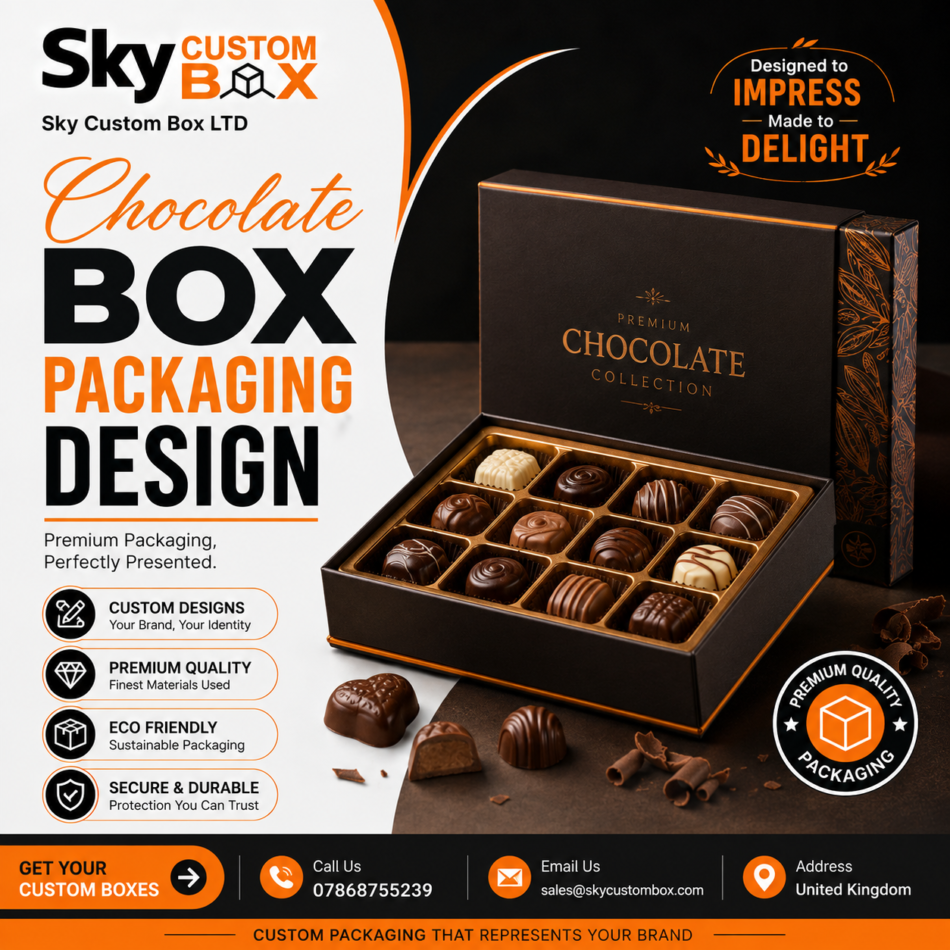
Chocolate is more than a food product. For many customers, it represents celebration, appreciation, luxury, and gifting. Because of this, packaging plays an important role in how chocolate is presented and perceived. A well-designed box can protect delicate products while also communicating quality, brand identity, and the occasion behind the purchase.
For retailers, chocolatiers, confectionery brands, and gift businesses, choosing the right chocolate box packaging design requires more than selecting an attractive colour or printed pattern. Packaging needs to balance appearance, functionality, product protection, sustainability, production requirements, and customer expectations.
Whether a business needs empty chocolate box packaging for handmade products or is researching wholesale chocolate packaging for larger production runs, understanding the fundamentals of effective packaging design can make the decision much easier.
Why Chocolate Packaging Matters for Retail and Gifting
Chocolate packaging has two major responsibilities: protecting the product and creating a positive customer experience.
Chocolate can be sensitive to heat, moisture, pressure, odours, and rough handling. A poorly constructed package may result in broken pieces, damaged finishes, or an unappealing presentation. In retail environments, packaging also needs to withstand transportation, shelf handling, and storage.
At the same time, consumers often make purchasing decisions based partly on presentation. A carefully designed box can help communicate whether a product is positioned as premium, traditional, playful, seasonal, or environmentally responsible.
Effective chocolate packaging should therefore consider:
- Product protection and structural strength
- Attractive visual presentation
- Appropriate internal compartments or inserts
- Brand colours, typography, and graphics
- Easy opening and closing
- Storage and transportation requirements
- Sustainability and material selection
- Retail shelf appeal
- Gift-giving convenience
The best solution is one that combines these elements rather than prioritising appearance alone.
Choosing the Right Chocolate Box Packaging Design
A successful chocolate box packaging design starts with the product itself. Different chocolates require different packaging structures.
For example, individual pralines may benefit from trays or moulded inserts that prevent movement, while chocolate bars may require a slimmer folding carton. Assorted chocolates often need compartments so that individual pieces remain separated during transportation.
The box format should also reflect the intended market. A luxury gift collection may use a rigid box with a magnetic closure, while everyday confectionery products may be better suited to lightweight folding cartons.
Important design considerations include:
Box Structure
Rigid boxes provide a sturdy and premium feel and are commonly associated with luxury gifting. Folding cartons can be lighter and easier to store, making them suitable for retail products with higher volumes.
Internal Protection
Inserts, trays, dividers, and fitted compartments can reduce movement and help prevent chocolates from rubbing against each other. The interior should be designed around the product dimensions rather than treated as an afterthought.
Printing and Finishing
Packaging can be enhanced through finishes such as foil details, embossing, debossing, spot effects, textured papers, or high-quality printing. These techniques can create visual and tactile differences without requiring complicated box structures.
Opening Experience
The unboxing experience has become increasingly important, particularly for gift products. A box that opens smoothly and reveals the chocolates attractively can contribute to customer satisfaction and encourage social sharing.
Trends Shaping Modern Chocolate Packaging
The packaging sector continues to evolve as consumers become more conscious of sustainability, convenience, and product presentation.
One major trend is the increasing use of recyclable and responsibly sourced materials. Businesses are exploring paperboard, kraft materials, recyclable card, and reduced-plastic solutions where these materials are appropriate for the product.
Another trend is minimalist design. Rather than covering packaging with excessive graphics, some brands are choosing simple typography, restrained colour palettes, and carefully positioned logos. This approach can create a sophisticated appearance while making important information easier to read.
Personalisation is also becoming more common. Seasonal chocolate collections, wedding favours, corporate gifts, and special events can benefit from customised packaging featuring specific messages, colours, or artwork.
Other notable trends include:
- Sustainable paper-based packaging
- Plastic reduction
- Minimalist luxury designs
- Custom inserts and compartments
- Seasonal and limited-edition packaging
- Personalised gift boxes
- QR codes linking customers to digital information
- Reusable or repurposable packaging
- Small-batch packaging for independent chocolatiers
These trends demonstrate that packaging is increasingly viewed as part of the complete product experience rather than simply a protective container.
Empty Chocolate Box Packaging: What Businesses Should Consider
Businesses producing chocolates themselves may look for empty chocolate box packaging that can be filled, labelled, and distributed according to their own requirements.
This approach can be particularly useful for independent chocolatiers, bakeries, gift businesses, event suppliers, and seasonal confectionery producers. However, selecting an empty box requires careful consideration of dimensions and construction.
Before ordering, businesses should determine:
- The number and size of chocolates per box.
- Whether inserts or dividers are required.
- The expected product weight.
- Whether the box will be transported individually or inside larger cartons.
- How the package will be stored before filling.
- Whether branding will be printed directly onto the box.
- Whether additional food-safe inner packaging is required.
It is also important to distinguish between the decorative outer box and any material that comes into direct contact with food. Chocolate packaging should be selected with appropriate food-contact requirements and supplier specifications in mind.
Wholesale Chocolate Packaging for Growing Businesses
For businesses producing hundreds or thousands of units, purchasing packaging at wholesale quantities can help create consistency across product ranges.
When evaluating wholesale chocolate packaging, price should not be the only consideration. Packaging quality, minimum order quantities, lead times, storage requirements, print consistency, and production tolerances can have a significant effect on overall costs.
A useful evaluation checklist includes:
- Minimum order quantity
- Box dimensions and material thickness
- Printing capabilities
- Available finishes
- Insert options
- Assembly requirements
- Production lead time
- Delivery arrangements
- Packaging storage requirements
- Quality-control procedures
Businesses searching for “chocolate boxes packaging wholesale near me” may also benefit from considering suppliers based on production capability rather than distance alone. A nearby supplier can be convenient, but reliability, material quality, communication, and consistency remain important factors.
For UK businesses, packaging providers such as Sky Custom Box can be considered when researching customised box formats and packaging options for retail and gifting applications.
Common Chocolate Packaging Challenges and Practical Solutions
One common problem is choosing a box that looks attractive but does not adequately protect the product. This can be addressed by testing the packaging with the actual chocolate assortment before committing to a large production run.
Another challenge is excessive packaging. Additional layers may create a premium appearance, but unnecessary materials can increase costs, storage requirements, and environmental impact. A more efficient structure can often achieve similar protection with fewer components.
Colour consistency can also become challenging when packaging is printed across different production batches. Establishing approved artwork, colour specifications, and production samples can help reduce variations.
Storage is another overlooked issue. Rigid boxes can occupy considerable warehouse space before assembly or filling. Businesses should calculate how many cartons can realistically be stored and how packaging will move through the production process.
Finally, packaging should be tested under realistic conditions. A box that performs well on a design table may behave differently during shipping. Drop testing, stacking tests, and practical handling assessments can identify weaknesses before products reach customers.
How to Choose Packaging for Different Chocolate Products
Different applications require different packaging approaches.
Luxury chocolates: Rigid boxes, premium papers, foil details, magnetic closures, and carefully designed inserts can reinforce a high-end positioning.
Everyday retail chocolates: Lightweight folding cartons may provide an efficient balance between presentation, protection, and storage.
Corporate gifts: Larger presentation boxes with custom branding can be suitable for client gifts, employee rewards, and business events.
Wedding and event chocolates: Small personalised boxes can provide both packaging and a keepsake element.
Seasonal collections: Custom colours, graphics, sleeves, or limited-edition structures can help distinguish Christmas, Valentine’s Day, Easter, and other seasonal products.
Artisan chocolates: Handmade products often benefit from packaging that highlights craftsmanship through natural materials, understated graphics, and tactile finishes.
The packaging should always be selected according to the product, customer, sales channel, and intended experience.
Final Thoughts
Effective chocolate packaging brings together protection, design, usability, branding, and responsible material selection. For retailers and gift businesses, the right packaging can help preserve product quality while creating a stronger first impression.
From empty chocolate box packaging for small-batch producers to wholesale chocolate packaging for established confectionery businesses, the most effective approach is to begin with practical requirements and then build the visual design around them.


