 WhatsApp Us Now
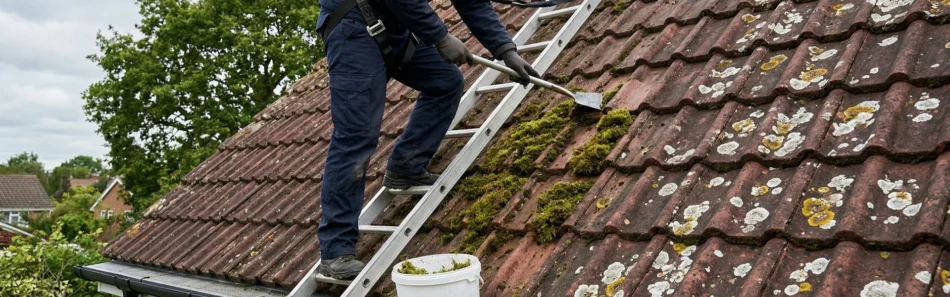
Most seasonal roof maintenance guides mention, in a single passing line, that “shaded areas” are more prone to moss. What they rarely explain is why that happens, how much of a difference orientation actually makes, or, most usefully, how your maintenance schedule should change depending on which way your roof faces. If you’ve cleaned your whole roof on the same schedule for years and found moss creeping back within months on one side while the rest stays clear, orientation is very likely the reason. This guide breaks down the science behind it and what to do differently on the sections of your roof that are working against you.
The Science: Why North-Facing Roofs Grow Moss Faster
Moss and algae need three things to establish: moisture, organic material to feed on, and enough shade to avoid drying out between rainfall. A north-facing roof (in the northern hemisphere, which includes the whole of the UK) receives little to no direct sunlight for most of the year, particularly through autumn and winter when the sun sits low in the sky.
The practical effect is straightforward: after rain, dew, or overnight condensation, a south-facing slope will typically dry out within a few hours of morning sun. A north-facing slope, by contrast, can stay damp for a day or more, especially in cooler months. That extended damp window is exactly the condition moss spores need to germinate and spread, which is why north-facing roofs consistently develop moss faster and more densely than sun-exposed slopes on the same building.
It’s Not Just North-Facing, Other Shade Factors That Compound the Problem
Orientation is the biggest single factor, but it rarely acts alone. A few other conditions make the moss problem worse, regardless of which way a roof technically faces:
- Overhanging trees, which block direct sunlight and drop leaves, pollen, and organic debris that feed moss and algae growth
- Neighbouring buildings or garden walls that cast shadow over part of the roof for large portions of the day
- Valleys and gulleys between roof sections, which trap moisture and debris regardless of aspect
- Low-pitch roof sections, which drain more slowly than steeper slopes and stay wetter for longer
A south-facing roof shaded by a mature tree can, in practice, behave more like a north-facing roof in terms of moss risk. This is why a purely seasonal cleaning calendar, applied evenly across the whole roof, tends to undertreat the genuinely high-risk sections while over-servicing the ones that were never much of a problem.
How Orientation Should Change Your Moss Removal Schedule
Rather than treating the whole roof as a single unit, it’s more effective to set inspection and treatment frequency by aspect. As a general guide for UK properties:
| Roof Aspect | Typical Sun Exposure | Moss Risk Level | Recommended Inspection Frequency |
| North-facing | Little to no direct sun for most of the year | High, stays damp longest | Every 6 months |
| East-facing | Morning sun only, shaded by afternoon | Moderate to high | Every 6–9 months |
| West-facing | Afternoon sun, dries out later in the day | Moderate | Annually |
| South-facing | Direct sun for most of the day | Low, dries quickly | Annually |
| Any aspect under tree cover | Reduced regardless of orientation | High, compounded by debris and shade | Every 4–6 months |
In practice, this usually means north-facing and tree-shaded sections get checked and treated roughly twice as often as south-facing slopes on the same roof, not because the roof material is different, but because the conditions driving regrowth are.
Don’t wait for visible moss on shaded slopes
By the time moss is clearly visible on a north-facing or heavily shaded roof section, it has usually had a significant head start compared to a sunnier slope showing the same amount of growth. Because regrowth is faster in these conditions, catching it early, ideally during a routine inspection rather than after it’s spread, makes a real difference to how invasive the eventual clean needs to be.
Moss Removal from Roof Tiles: Method Considerations for Shaded Areas
The cleaning method itself doesn’t necessarily change by orientation, but shaded, damp sections do need a bit more care. Roofs that stay wet for longer are often more slippery and more fragile underfoot, so safe access and a gentle approach matter even more on north-facing slopes than on a dry, sun-baked south face.
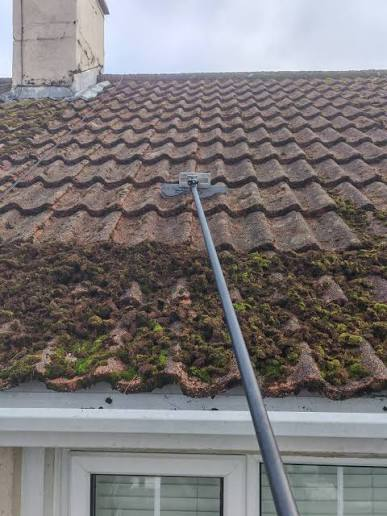
For most established growth, low-pressure soft washing combined with an appropriate biocide remains the safest and most effective option for moss removal from roof tiles, since it avoids the mechanical force that can crack tiles or strip protective coatings. On sections where moss has had longer to establish, typically the shaded slopes, a preliminary manual scrape is sometimes used ahead of the biocide treatment to speed up the process without resorting to high pressure.
It’s also worth considering preventative measures specifically on the sections most prone to regrowth. Zinc or copper strips fitted near the ridge of a persistently shaded slope release trace ions when it rains, which helps inhibit future moss and algae growth on that section without needing to treat the whole roof preventatively.
Choosing the Right Moss Roof Cleaner for Orientation-Specific Problems
If one side of your roof keeps growing moss back faster than the rest, it’s worth raising this directly with whoever quotes the job, rather than accepting a single flat treatment plan for the entire roof. A good moss roof cleaner should be willing to assess each slope individually, factoring in aspect, tree cover, and pitch, rather than pricing and scheduling the whole roof as one uniform surface.
A few questions worth asking before booking general roof cleaning moss removal work:
- Will treatment frequency be adjusted for shaded or north-facing sections, or is it a single whole-roof schedule?
- Is preventative treatment (such as zinc or copper strips) being considered for the worst-affected slopes?
- Does the quote account for any additional care needed on damp, slippery sections during access?
A contractor who asks about your roof’s orientation and shade pattern before quoting is generally a good sign that the job will be approached properly rather than as a one-size-fits-all clean.
Why a One-Size-Fits-All Clean Rarely Solves the Problem Long-Term
A single annual moss cleaning roof visit, applied evenly across the whole property, often looks like it’s worked for the first few months. But on the shaded or north-facing sections, moss algae removal from a single treatment simply doesn’t last as long as it does on sun-exposed slopes, because the underlying conditions that caused the growth haven’t changed. Within a matter of months, the same section can be visibly regrowing while the rest of the roof still looks clean.


