 WhatsApp Us Now
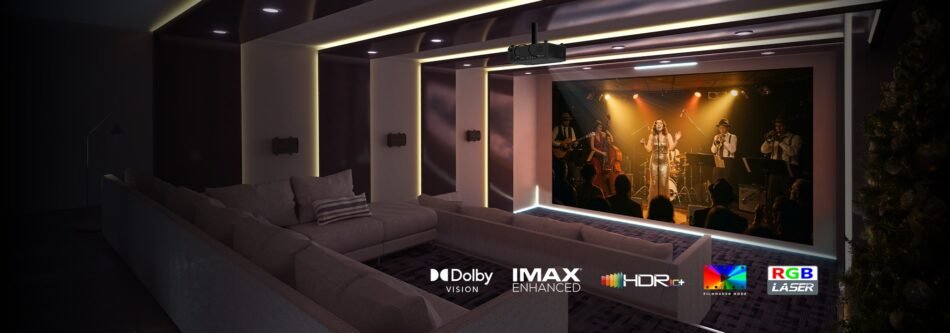
There’s a specific kind of silence that falls over a room right before a movie starts in a theater — the lights dim, the screen fills your entire field of vision, and for the next two hours nothing else exists. Recreating that feeling at home has become a real, achievable goal for a growing number of households, but it takes more thought than simply buying an expensive TV. It starts with understanding how actual theaters create that experience in the first place — and it isn’t the screen size alone.
Why Home Setups Often Fall Short of “Theater-Like”
Most people chasing a cinema experience at home focus entirely on screen size, assuming bigger automatically means better. But anyone who’s sat too close to an oversized TV knows that size without the right picture quality just means a bigger, blurrier disappointment. A genuine theater feel comes from a combination of resolution, contrast, room darkness, and screen surface — not size in isolation.
This is where a 4K movie projector changes the equation. Unlike traditional TVs, projectors are built to scale a sharp, detailed image across a much larger surface without the drop-off in clarity that oversized televisions often suffer from. The resolution holds up because the image is designed to be projected large from the start, not stretched digitally.
The Overlooked Half of the Equation: The Screen
Here’s what surprises a lot of first-time buyers: projecting onto a wall doesn’t just look “slightly worse” than a proper screen — it noticeably undercuts everything a good projector is capable of. A home movie projector screen is engineered to reflect light evenly and preserve contrast and color accuracy in a way no painted wall can replicate, no matter how smooth or white it looks.
This becomes especially obvious once you’re using a 4K source. Fine detail — texture, subtle color gradients, sharp edges — is exactly what gets lost when the reflecting surface isn’t built for it. Pairing high-resolution projection with a low-quality surface is a bit like buying great speakers and playing them through a phone’s tiny built-in speaker instead — the source quality simply isn’t the bottleneck anymore.
How Real Theaters Actually Get It Right
It’s worth understanding what commercial cinemas do differently, because the principles scale down surprisingly well to a living room. In 4K projector movie theaters, several elements work together deliberately:
- Controlled ambient lighting to maximize contrast
- Screens specifically engineered for even light reflection and minimal glare
- Projector placement and throw distance calculated precisely for the room
Home setups that borrow even a few of these principles — dimming ambient light, choosing the right screen material, and positioning the projector correctly — get dramatically closer to that theatrical feel than most people expect.
Building a System, Not Just Buying a Projector
The households that end up genuinely happy with their home theater setup tend to treat it as a system rather than a single purchase. Room lighting, screen size relative to seating distance, wall color, and screen surface all interact with the projector’s output, and getting one piece wrong can undercut the rest.
Optoma has built its home entertainment lineup around this kind of system-level thinking, offering projectors and complementary display solutions designed to work together rather than as isolated components. For anyone serious about building a proper home theater setup, that cohesive approach tends to matter more in the long run than chasing individual spec sheets.
Is It Really Worth the Extra Effort?
For occasional, casual viewing, a decent TV and a dark room might feel like enough. But for anyone who watches regularly, hosts movie nights, or simply wants that unmistakable big-screen feeling, the difference a properly matched projector and screen setup makes is immediate and obvious — usually within the first five minutes of the first movie.
Getting closer to an actual theater experience at home isn’t about spending endlessly — it’s about understanding which pieces genuinely matter and making sure they work together.
FAQs
1. Is a 4K projector really necessary, or does 1080p look fine at home?
For larger screen sizes especially, 4K makes a noticeable difference in sharpness and detail compared to 1080p.
2. Do I need a special screen, or can I project onto a wall?
A dedicated screen significantly improves contrast and color accuracy compared to a wall, even one that looks smooth and white.
3. How much room darkness do I actually need for a good picture?
A fully dark room isn’t mandatory, but reducing ambient light substantially improves contrast and overall image quality.


