 WhatsApp Us Now
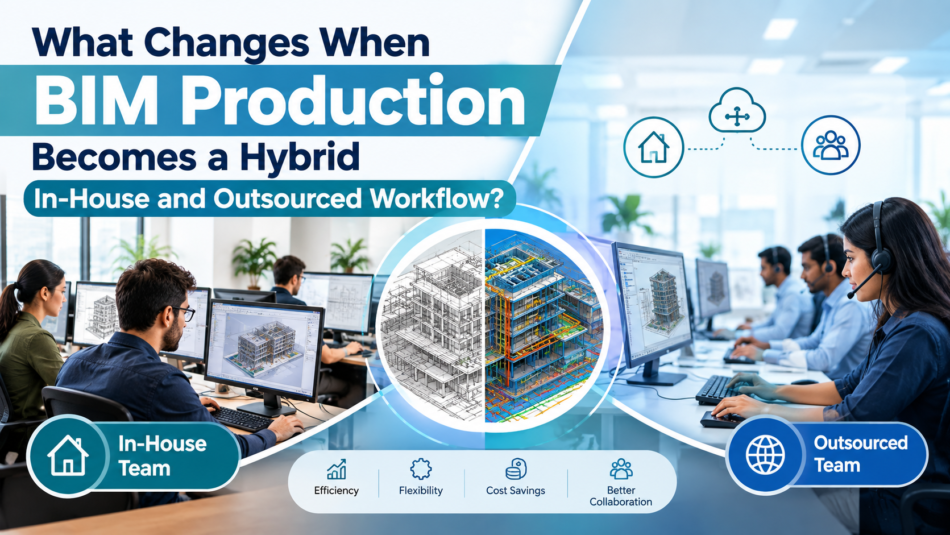
A hybrid BIM workflow blends in-house and outsourced production, changing how teams are structured, how quality is controlled, and how data is secured. Companies gain flexibility and cost savings, but only when they invest in clear standards, collaboration tools, and strong coordination between internal and external teams.
More architecture, engineering, and construction (AEC) firms are rethinking how they produce Building Information Modeling (BIM) deliverables. Instead of keeping every task in-house, they’re splitting the work—handling core design internally while sending specialized or high-volume modeling to external partners. This is the hybrid BIM model, and it’s reshaping how teams operate.
Why the shift? Firms want to scale up quickly during busy periods, tap into specialized skills they don’t have on staff, and control costs without sacrificing quality. Revit BIM outsourcing services make it possible to expand capacity on demand, while in-house teams stay focused on the work that needs their direct attention.
But moving to a hybrid model isn’t as simple as sending files to a vendor. It touches nearly every part of your operation—from team structure to security protocols. Here’s what actually changes when BIM production becomes a hybrid workflow, and how to manage the transition well.
How does a hybrid model change team structure?
The biggest shift is organizational. A traditional BIM team sits together, shares one office, and follows a single chain of command. A hybrid model spreads production across internal staff and external partners, sometimes in different time zones.
That distribution creates new coordination needs. You can no longer rely on a quick desk-side conversation to resolve a modeling question. Instead, teams need defined handoff points, shared task boards, and clear ownership for each deliverable.
Project management also evolves. Managers move from supervising a single team to orchestrating several groups at once. Communication protocols become formal—scheduled check-ins, written briefs, and documented feedback loops replace casual updates. Firms that skip this step often see confusion, duplicated work, and missed deadlines.
How do you keep quality consistent across teams?
Quality control gets more complex when multiple teams touch the same project. Everyone must follow the same rules, or the model quickly becomes a patchwork of styles.
Start with a unified BIM standard. This means a shared set of naming conventions, modeling protocols, level of development (LOD) requirements, and template files that every team uses—internal and external alike. A well-documented BIM Execution Plan (BEP) is essential here.
Review processes matter just as much. Outsourced work should pass through a structured quality check before it enters your master model. Many firms use a two-stage review: the external partner performs an internal audit, then the in-house team runs a final coordination check. Reliable partners like Archdraw Outsourcing typically build these review layers into their delivery process.
Version control ties it all together. With several teams editing models, you need a single source of truth. Cloud-based platforms with clear check-in and check-out rules prevent people from overwriting each other’s work and keep documentation accurate.
What are the cost and resource implications?
Hybrid BIM workflows can lower costs, but there’s an upfront investment to plan for.
- Initial spend: You’ll need collaboration tools, cloud licenses, and time to train both teams on shared standards. This isn’t free, but it’s a one-time foundation.
- Long-term savings: Outsourcing specialized or repetitive tasks—like family creation, sheet setup, or high-volume modeling—usually costs less than expanding your permanent payroll. You pay for capacity only when you need it.
- Smarter resource allocation: With routine production handled externally, your in-house experts can focus on high-value work: design intent, client coordination, and complex problem-solving.
The result is a leaner, more flexible operation. You scale up for large projects without carrying the fixed overhead during slower periods.
What technology do hybrid BIM workflows require?
Technology is the backbone of any hybrid setup. Without the right tools, distributed teams can’t work together effectively.
Collaboration platforms connect in-house and remote staff, letting them share models, mark up drawings, and track tasks in real time. Cloud-based BIM tools such as Autodesk Construction Cloud or BIM 360 allow multiple parties to access a live model from anywhere. Data management systems keep files organized and traceable.
Integration is the tricky part. Different teams may use different software versions or plugins, which can break a workflow. The fix is standardization: agree on software versions, file formats, and exchange protocols before the project starts. A short technology onboarding for external partners prevents most compatibility headaches down the line.
How do you manage risk and data security?
Sharing project data with outside parties raises real security questions. Sensitive drawings, client information, and proprietary details now travel beyond your firewall.
Protecting that data starts with access controls—give each partner only the files and permissions they need. Use secure, encrypted platforms for file transfer rather than email attachments. Non-disclosure agreements (NDAs) and clear contract terms protect your intellectual property and set expectations for data handling.
Dependencies also need attention. When an outsourced deliverable feeds directly into your in-house work, a delay on their end stalls your team. Build buffer time into schedules, define clear deadlines, and keep backup plans ready so one bottleneck doesn’t derail the whole project.
Best practices for a successful hybrid BIM workflow
Firms that thrive with hybrid production tend to follow the same core habits:
- Document everything. Standardize your BIM processes, templates, and expectations in writing so nothing depends on memory or verbal instructions.
- Set regular checkpoints. Schedule consistent progress reviews and status updates to catch issues early.
- Invest in training. Make sure both in-house and external teams understand your standards, tools, and communication norms.
- Transition gradually. Start with a pilot project or a single task type before shifting large portions of production. A phased approach limits disruption and helps you refine the process.
These practices turn a loose collection of teams into a coordinated production engine.
Making hybrid BIM work for your firm
A hybrid BIM workflow offers a compelling mix of flexibility and cost efficiency—but the benefits only appear when the model is managed with care. Success depends on three things: the right tools, well-documented processes, and strong coordination between your internal and external teams.
Firms that get this right position themselves ahead of competitors. They scale faster, access specialized skills on demand, and free their in-house experts to focus on what matters most. If you’re considering the move, start small, standardize early, and choose experienced partners who understand hybrid delivery.
Frequently asked questions
What is a hybrid BIM workflow?
A hybrid BIM workflow combines in-house and outsourced BIM production. Internal teams handle core design and coordination, while external partners take on specialized or high-volume modeling tasks. This gives firms scalable capacity without expanding permanent staff.
Why do companies outsource part of their BIM production?
Companies outsource to scale quickly during busy periods, access specialized skills, and control costs. Outsourcing routine or repetitive modeling lets in-house experts focus on high-value work like design intent and client coordination.
How do you maintain quality when outsourcing BIM work?
Maintain quality by setting a unified BIM standard, documenting a BIM Execution Plan, and using structured review processes. A two-stage review—an external audit followed by an in-house coordination check—helps keep outsourced work consistent with your master model.
Is outsourcing BIM production secure?
It can be, with the right safeguards. Use encrypted collaboration platforms, limit file access to what each partner needs, and put NDAs and clear contracts in place to protect intellectual property and sensitive project data.
How should a firm start transitioning to a hybrid BIM model?
Start with a pilot project or a single task type rather than shifting everything at once. Standardize your processes early, invest in collaboration tools, and choose experienced outsourcing partners to minimize disruption during the transition.


