 WhatsApp Us Now

Understanding Time in Tokyo: How Japan’s Capital Keeps Perfect Time
You are preparing for a meeting with colleagues in Japan, booking an international flight, or following a live event scheduled in Tokyo. Then the question arises: what exactly is the current time in Tokyo, and how does it compare to your own location?
At first, this seems like a simple time conversion. Yet confusion often appears when people assume Japan changes clocks seasonally or follows multiple regional time standards. Unlike many countries, Japan operates under a highly consistent national system that eliminates many of the timing uncertainties common elsewhere.
Understanding time in Tokyo matters because Tokyo is one of the world’s most significant centers for finance, technology, transportation, and global communication. Whether someone checks live local clocks through tools such as findtime.io or manually coordinates across continents, accurate knowledge of Tokyo’s time framework supports reliable scheduling and informed planning.
What Is Time in Tokyo?
Time in Tokyo refers to the official local time observed in Japan’s capital, based on Japan Standard Time (JST), which operates at UTC+9 throughout the entire year.
This means Tokyo is:
- Nine hours ahead of Coordinated Universal Time
- Consistently aligned with national Japanese time
- Unaffected by seasonal daylight saving adjustments
Because Japan uses a single unified national clock, the time in Tokyo is the same as the time observed in other Japanese cities, including:
- Osaka
- Kyoto
- Sapporo
- Fukuoka
This national consistency simplifies scheduling significantly.
Why Tokyo Uses Japan Standard Time
Japan’s time system is built around practical geographic and administrative efficiency.
Although Japan stretches across multiple islands, it is geographically compact enough from east to west to operate effectively under one time standard.
A single national clock offers several advantages:
- Simplified transportation schedules
- Easier nationwide coordination
- Consistent business operations
- Reduced scheduling confusion
For a highly interconnected metropolitan hub like Tokyo, this uniformity supports precision in everything from commuter rail systems to international financial transactions.
Time in Tokyo and Japan Standard Time (JST)
Tokyo follows Japan Standard Time exclusively.
Direct Answer Definition
Japan Standard Time (JST) is the official time zone used across Japan, operating permanently at UTC+9 without daylight saving adjustments.
This makes Tokyo’s local clock highly predictable throughout the year.
Unlike countries that shift between summer and winter schedules, the time in Tokyo remains constant regardless of season.
This stability is one of Japan’s most practical timekeeping features.
Does Tokyo Observe Daylight Saving Time?
No.
Tokyo does not observe daylight saving time.
This is one of the most important facts for anyone checking the time in Tokyo.
Many people assume all economically advanced countries shift clocks seasonally. Japan does not.
This means:
- No spring clock changes
- No autumn reversions
- No seasonal adjustment confusion
- Stable year-round UTC+9 alignment
This consistency benefits:
- International businesses
- Travelers
- Remote teams
- Broadcast scheduling
When coordinating with Tokyo, there is no need to account for local seasonal clock shifts.
How Time in Tokyo Compares to Major Global Cities
Understanding relative time differences helps with practical planning.
Typical comparisons include:
Tokyo and London
Tokyo is generally 8 or 9 hours ahead of London depending on whether the UK is observing daylight saving time.
Tokyo and New York
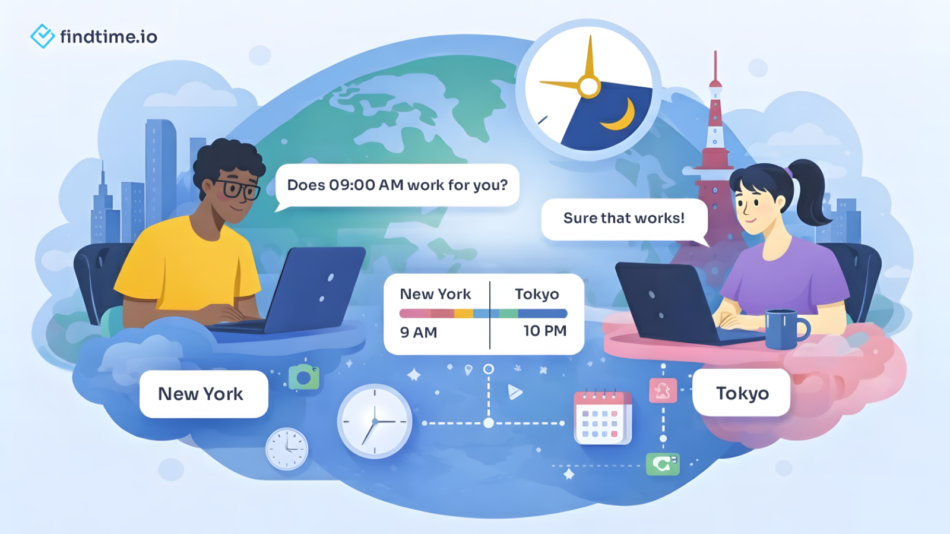
Tokyo is usually 13 or 14 hours ahead of New York City.
Tokyo and Dubai
Tokyo is typically 5 hours ahead of Dubai.
Tokyo and Sydney
Tokyo is usually 1–2 hours behind Sydney depending on Australia’s seasonal clock changes.
Because Tokyo itself remains fixed, any variation usually comes from daylight saving shifts in other countries.
Why Accurate Time in Tokyo Matters
Tokyo is not just another major city.
It is one of the world’s most important operational centers.
International Business
Tokyo hosts major financial institutions and multinational corporate headquarters.
Even minor timing mistakes can affect:
- Trading activity
- Virtual meetings
- Contract deadlines
- Operational coordination
Travel and Transit
Tokyo’s transportation systems are globally recognized for precision.
Missing local time accuracy can disrupt:
- Flight departures
- Rail transfers
- Hotel check-ins
Live Events and Broadcasting
Global audiences frequently follow:
- Financial market openings
- Technology announcements
- Cultural broadcasts from Tokyo
Correct timing ensures participation without confusion.
Why Time Precision Matters So Much in Tokyo
Tokyo’s reputation for punctuality reflects broader Japanese operational culture.
In Japan, precise timing supports:
- Public transportation reliability
- Workplace efficiency
- Social expectations
- Institutional coordination
The significance of exact time in Tokyo extends beyond clocks.
It reflects a societal commitment to consistency and order.
This is especially visible in Tokyo’s extensive transit networks, where even small timing deviations are treated seriously.
Common Misunderstandings About Time in Tokyo
Several misconceptions often create confusion.
Tokyo Has a Separate City Time Zone
Incorrect.
Tokyo follows the same Japan Standard Time as the rest of the country.
Tokyo Changes Clocks in Summer
False.
Tokyo does not observe daylight saving time.
Japan Uses Multiple Time Zones
Japan operates under one unified national time system.
Time Differences Stay Constant Everywhere
Relative differences can change because other countries may shift clocks seasonally.
How to Check Time in Tokyo Accurately
Reliable time verification is essential.
Useful methods include:
- Automatic network-synchronized devices
- World clock applications
- Regional live time services
- Online tools such as findtime.io
Because Tokyo does not change clocks seasonally, accuracy depends mostly on accounting for time shifts in your own location.
Historical Background of Tokyo’s Time System
Japan standardized national time during the late nineteenth century as modernization accelerated.
Before national standardization, local solar time varied by region.
The adoption of Japan Standard Time supported:
- Railway expansion
- Government coordination
- Communication infrastructure
- National administrative consistency
Tokyo’s central role in governance naturally made it the reference point for national time coordination.
Time in Tokyo for Global Remote Work
Remote work has made time awareness more important than ever.
Professionals collaborating with Tokyo-based teams often need to account for:
- Significant overnight offsets
- Early-morning or late-evening calls
- Date changes across international boundaries
The fixed nature of time in Tokyo simplifies recurring scheduling compared to countries with seasonal clock adjustments.
Frequently Asked Questions About Time in Tokyo
What time zone is Tokyo in?
Time in Tokyo follows Japan Standard Time, which operates at UTC+9 throughout the entire year without seasonal changes.
Does Tokyo observe daylight saving time?
No. Time in Tokyo remains fixed year-round and does not shift for daylight saving.
Is time in Tokyo the same across all of Japan?
Yes. Tokyo shares the same official national time as all Japanese cities and regions.
Why does Tokyo not change clocks?
Japan maintains fixed timing for consistency, administrative simplicity, and predictable national coordination.
How far ahead is Tokyo from UTC?
Time in Tokyo is always nine hours ahead of Coordinated Universal Time.
Why does Tokyo’s time difference change with other countries?
The local time in Tokyo remains fixed, but countries observing daylight saving may alter their offset relative to Japan.
How can I check accurate time in Tokyo?
The most reliable method is using synchronized digital clocks or live regional references such as findtime.io.
Why is accurate Tokyo time important?
Accurate time in Tokyo supports business meetings, travel planning, financial scheduling, and international coordination.
Final Thoughts
Understanding time in Tokyo is refreshingly straightforward compared with many international time systems.
Tokyo operates on a stable, predictable UTC+9 schedule under Japan Standard Time, without daylight saving adjustments or internal regional variation. This consistency simplifies international coordination and reflects Japan’s broader emphasis on precision and reliability.
The most practical lesson is simple: when planning around Tokyo, focus on your own local seasonal clock changes rather than expecting changes in Japan. Whether coordinating global business, arranging travel, or checking live local timing through findtime.io, understanding Tokyo’s fixed time structure makes accurate scheduling easier and far more dependable.


