 WhatsApp Us Now
Global Seamless Pipe Market demand for seamless pipes is increasing as industrial users prioritize strength, reliability, pressure resistance, and long operating life. Oil and gas infrastructure remains a major demand center, while power generation, construction, automotive, and process industries are expanding opportunities for specialized seamless tubular products.
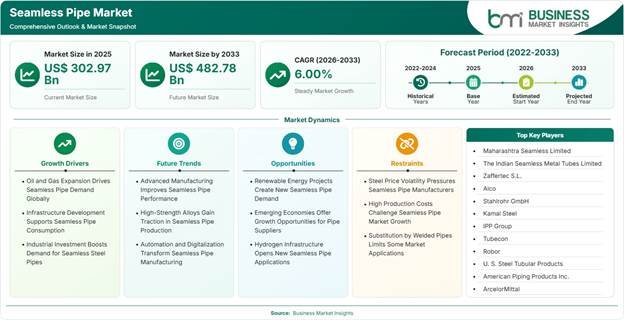
According to Business Market Insights, the global Seamless Pipe Market Sizestood at US$ 302.97 Billion in 2025 and is expected to reach US$ 482.78 Billion by 2033, registering a CAGR of 6.00% from 2026 to 2033. Increasing investments in transmission networks, refineries, manufacturing facilities, offshore projects, and industrial infrastructure are expected to support market expansion.
Download Sample Report: https://www.businessmarketinsights.com/sample/BMIPUB00038771
Seamless Pipe Strategic Framework
The strategic landscape of the Seamless Pipe Market is being shaped by increasing demand for reliable tubular products capable of operating under high pressure, elevated temperatures, and corrosive conditions. Producers are strengthening their capabilities through advanced metallurgy, manufacturing automation, quality monitoring, heat treatment, and specialized alloy development.
Energy transportation remains a core demand center, while emerging applications in hydrogen transportation, carbon capture, offshore energy, and advanced industrial processing are creating opportunities for premium-grade seamless pipes. Supply-chain integration among producers, mills, distributors, and contractors is also becoming increasingly important for improving availability and shortening delivery times.
Market Growth Projections
The Seamless Pipe Market is expected to maintain steady expansion throughout the forecast period as energy companies, industrial manufacturers, infrastructure developers, and construction organizations continue investing in high-performance piping systems.
The market is projected to increase from US$ 302.97 Billion in 2025 to US$ 482.78 Billion by 2033, representing a 6.00% CAGR from 2026 to 2033. Energy infrastructure expansion, industrial modernization, pipeline replacement, and large-scale infrastructure projects are expected to remain important contributors to demand.
Steel & Alloys held the largest material share in 2025, supported by their strength, durability, pressure resistance, and broad applicability across energy and industrial systems. Specialty alloys are gaining importance where corrosion resistance, elevated-temperature performance, and demanding mechanical properties are required.
Oil and Gas remains a major end-user industry, accounting for approximately 31%–35% of the market in 2025 and expected to register a 6.8%–7.3% CAGR through 2033. Offshore exploration, LNG infrastructure, transmission network expansion, and refinery investment are supporting demand for durable tubular products.
Asia Pacific is expected to provide particularly strong growth opportunities. The region is projected to record a 7.0%–7.5% CAGR through 2033, supported by industrialization, infrastructure development, refinery expansion, manufacturing investment, and energy transportation projects.
Market Drivers
Expansion of Global Energy Transportation Infrastructure
Investment in energy transportation systems remains one of the strongest demand drivers for seamless pipes. Oil and gas operators require tubular products capable of handling high pressures, temperature variations, corrosive fluids, and long operating cycles across exploration, production, processing, and transportation infrastructure.
Pipeline upgrades, LNG infrastructure, refinery modernization, and energy security initiatives are increasing procurement requirements for high-quality tubular products. The expansion of transmission networks and offshore energy projects is also supporting demand for specialized seamless pipe solutions.
Industrial Modernization and Manufacturing Expansion
Industrialization across emerging economies is creating demand for new manufacturing facilities, petrochemical plants, utilities, processing infrastructure, and energy systems. These facilities require piping products capable of supporting high-pressure and high-temperature operations.
Manufacturing automation and modern quality-control systems are also encouraging seamless pipe producers to improve dimensional consistency, mechanical properties, production efficiency, and compliance with demanding customer specifications.
Growing Demand for High-Performance Engineering Materials
Industrial users increasingly require materials that deliver strength, corrosion resistance, dimensional stability, and extended service life. Advanced metallurgy and alloy development are enabling manufacturers to produce seamless pipes for increasingly challenging operating environments.
Demand for premium materials is also being supported by applications such as hydrogen transportation, carbon capture, offshore energy, and advanced industrial processing. These applications require materials capable of maintaining structural integrity under specialized conditions.
Market Opportunities
Hydrogen Transportation and Clean Energy Networks
Hydrogen infrastructure represents an emerging opportunity for seamless pipe manufacturers. Governments and private companies are investing in hydrogen production, storage, and transportation networks, increasing the need for materials capable of addressing hydrogen-related performance challenges.
Hydrogen embrittlement and material compatibility requirements are encouraging research into advanced alloys and specialized tubular products. Manufacturers with expertise in high-performance materials can position themselves for emerging clean-energy infrastructure opportunities.
Offshore Energy and Deepwater Exploration Projects
Offshore and deepwater projects require high-performance tubular products capable of withstanding high pressures, elevated temperatures, and corrosive marine environments. Exploration and production activities in the Gulf of Mexico, Brazil, West Africa, and Southeast Asia are creating opportunities for specialized seamless pipes.
The capital-intensive nature of offshore projects also increases the importance of product reliability, lifecycle performance, and compliance with stringent engineering requirements.
Infrastructure Development in Emerging Economies
Large-scale infrastructure programs across Asia, Africa, and Latin America are creating opportunities for seamless pipe suppliers. Industrial corridors, energy transportation networks, manufacturing plants, utilities, and construction projects require reliable piping systems for transporting fluids, gases, and chemicals.
The development of local manufacturing and supply-chain infrastructure is further improving accessibility to seamless tubular products in emerging markets.
Market Segmentation
By Type
The type segment comprises Hot Finished Pipes and Cold Finished Pipes. Hot Finished Pipes accounted for approximately 54%–58% of the market in 2025, supported by extensive applications in energy, construction, and industrial sectors. Cold Finished Pipes are gaining importance in applications requiring precision dimensions, tighter tolerances, and superior surface finish.
- Hot Finished Pipes: Used extensively in oil and gas, power, construction, and industrial applications where strength and pressure resistance are important.
- Cold Finished Pipes: Preferred for automotive, aviation, instrumentation, and precision engineering applications requiring dimensional accuracy and improved surface quality.
By Material
The material segment includes Steel & Alloys, Copper & Alloys, Aluminum & Magnesium Alloys, and Nickel & Alloys. Steel & Alloys dominated the market in 2025 with approximately 58%–62% share, supported by strength, durability, pressure resistance, and broad industrial applicability.
- Steel & Alloys: Widely used across oil and gas, construction, power generation, and industrial applications.
- Copper & Alloys: Suitable for heat transfer, refrigeration, and process applications requiring thermal conductivity and corrosion resistance.
- Aluminum & Magnesium Alloys: Increasingly used in lightweight transportation and aerospace applications.
- Nickel & Alloys: Used in high-temperature and corrosive environments, including petrochemical and offshore applications.
By Manufacturing Process
The manufacturing-process segment comprises Mandrel Rolling, Multi-Stand Plug Mill, and Cross-Roll Piercing & Pilger Rolling. Mandrel Rolling accounted for approximately 41%–45% share in 2025, supported by its ability to deliver consistent wall thickness, dimensional accuracy, and mechanical performance.
- Mandrel Rolling: Supports consistent wall thickness and high-quality pipe production.
- Multi-Stand Plug Mill: Enables high-volume production for industrial and energy applications.
- Cross-Roll Piercing & Pilger Rolling: Supports specialized applications requiring precise dimensions and advanced material properties.
By End-user Industry
The end-user industry segment includes Oil and Gas, Power Generation, Automotive, Aviation, Construction, and Process Industry. Oil and Gas represented approximately 31%–35% of the market in 2025 and is expected to record the highest CAGR through 2033.
- Oil and Gas: Major demand center across exploration, production, refining, LNG, and transmission infrastructure.
- Power Generation: Seamless pipes are used in systems operating under high temperatures and pressures.
- Automotive: Precision tubular products support vehicle manufacturing and lightweight engineering.
- Aviation: Advanced tubular materials support high-performance aerospace applications.
- Construction: Pipes are used across infrastructure and structural applications.
- Process Industry: Chemical and industrial processing facilities require durable piping for demanding operating environments.
Top Players in the Seamless Pipe Market
The competitive landscape includes major tubular manufacturers, steel producers, distributors, and specialized industrial suppliers. Key companies profiled by Business Market Insights include:
- Maharashtra Seamless Limited
- The Indian Seamless Metal Tubes Limited
- Zaffertec S.L.
- Alco
- Stahlrohr GmbH
- Kamal Steel
- IPP Group
- Tubecon
- Robor
- U. S. Steel Tubular Products
- American Piping Products Inc.
- ArcelorMittal
- Nippon Steel Corporation
- Sumitomo Corporation
- Tianjin Pipe (Group) Corporation
- Salzgitter Mannesmann Stainless Tubes GmbH
- United Metallurgical Company
- Jindal SAW Ltd.
Competition is increasingly shaped by advanced manufacturing capabilities, product quality, alloy development, capacity expansion, regional distribution networks, strategic partnerships, and the ability to supply specialized products for energy and industrial applications.
Technological Innovations
Technological development in the Seamless Pipe Market is increasingly focused on advanced metallurgy, digital manufacturing, automated quality control, predictive monitoring, and improved heat-treatment processes. These technologies help manufacturers improve dimensional consistency, mechanical performance, production efficiency, and product reliability.
Advanced alloy development is becoming particularly important as end users require pipes capable of operating in corrosive, high-pressure, and high-temperature environments. Hydrogen transportation and carbon capture applications are also encouraging research into materials capable of maintaining performance under emerging operating conditions.
Manufacturers are also strengthening supply-chain integration and production automation. Digital quality monitoring and advanced process controls can help reduce manufacturing variability while supporting stringent certification and customer requirements.
Market Restraints and Challenges
Volatility in Raw Material Pricing and Supply
Steel, nickel, alloying elements, and specialty metals can experience significant price fluctuations due to energy costs, trade policies, geopolitical developments, and supply-chain disruptions. These fluctuations can increase manufacturing costs and complicate pricing and long-term project planning.
Large producers may have greater procurement flexibility, while smaller manufacturers can face stronger margin pressure when input costs rise rapidly. Supply diversification and long-term sourcing arrangements can help mitigate these risks.
Competition from Alternative Pipe Technologies
Advances in welded pipe technologies and alternative material systems are increasing competitive pressure in selected applications. Where project specifications permit substitution, customers may compare seamless pipes with alternatives based on price, performance, availability, and application requirements.
Manufacturers therefore need to maintain product quality while improving manufacturing efficiency, developing specialized products, and demonstrating lifecycle performance to remain competitive.
Get Industry Snippets: https://www.businessmarketinsights.com/industry-overview/seamless-pipe-market
Future Market Outlook
The Seamless Pipe Market is projected to grow from US$ 302.97 Billion in 2025 to US$ 482.78 Billion by 2033, registering a 6.00% CAGR during 2026–2033. The long-term outlook remains positive as energy infrastructure, industrial modernization, pipeline replacement, and large-scale infrastructure projects continue generating demand.
Oil and gas will remain a major demand center, particularly across LNG, offshore exploration, refining, and transmission infrastructure. At the same time, hydrogen transportation, carbon capture, and other energy-transition applications are expected to create new demand for advanced materials and premium-grade tubular products.
Frequently Asked Questions (FAQs)
What is driving the Seamless Pipe Market?
The major drivers include energy infrastructure expansion, pipeline modernization, industrial development, manufacturing expansion, offshore energy projects, and demand for high-performance engineering materials.
Which material segment leads the Seamless Pipe Market?
Steel & Alloys is the leading material segment, accounting for approximately 58%–62% of the market in 2025, supported by strength, durability, pressure resistance, and broad industrial applicability.
Which end-user industry represents the largest segment?
Oil and Gas is the leading end-user industry, accounting for approximately 31%–35% of the market in 2025 and supported by exploration, refining, LNG, offshore development, and pipeline infrastructure.
Which region is expected to grow fastest?
Asia Pacific is expected to be the fastest-growing major region, with a projected 7.0%–7.5% CAGR from 2026 to 2033, supported by industrialization, infrastructure development, refinery expansion, and energy investments.
What are the major technology trends in the Seamless Pipe Market?
Key technology trends include advanced metallurgy, specialty alloy development, digital manufacturing, predictive quality monitoring, automated production systems, and advanced heat treatment.
What opportunities are emerging for seamless pipe manufacturers?
Hydrogen transportation, carbon capture, offshore energy, deepwater exploration, infrastructure modernization, and advanced industrial processing represent important emerging opportunities.
What is the historic period, base year, and forecast period?
The market report uses 2022–2024 as the historical period, 2025 as the base year, and 2026–2033 as the forecast period.
Browse More Reports
Metal Forming Tools Market Outlook
Hydraulic Equipment Market Size, Share Outlook
Metal Cutting Tools Market Outlook
Forestry Equipment Market Outlook


