 WhatsApp Us Now
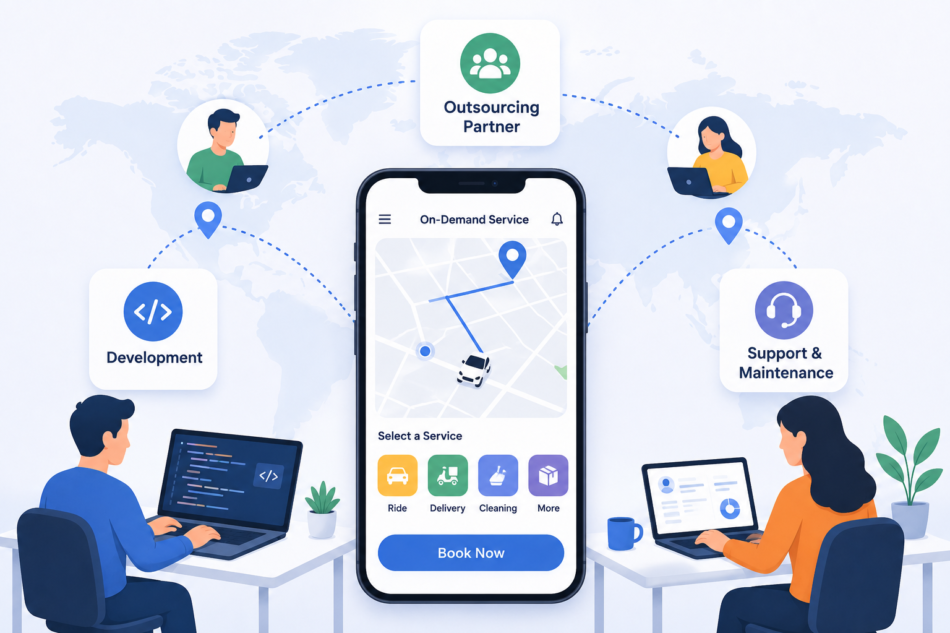
If you’re thinking about building an Uber-style platform, here’s the thing nobody tells you upfront: you’re not building one app. You’re building three: a customer app, a driver or provider app, and an admin dashboard, all talking to each other in real time. That single fact changes everything about how you should approach outsourcing, and it’s the reason so many founders end up with a half-working platform and a vendor who owns half their codebase.
The good news is that the cost savings are real. Businesses that outsource this kind of work typically save 40–60% compared to hiring an in-house team, and they get to market 30–50% faster. The catch is that those savings only show up when you pick the right engagement model and structure the contract properly. Get either of those wrong, and the “savings” evaporate into rework, delays, and disputes over who owns the code.
This is exactly the gap that a detailed, well-researched approach to on-demand app development outsourcing is meant to close — walking founders through the real cost ranges, the engagement models that actually work for fast-moving products, and the contract structures that protect both the budget and the IP. Below is a breakdown of the core ideas worth understanding before you sign anything.
Why Outsourcing Makes Sense for Most Early-Stage Platforms
For a startup trying to ship an on-demand MVP, building an in-house team from scratch usually takes three to five months just to hire a mobile developer, backend engineer, designer, and QA tester — and that’s before anyone writes a line of production code. Senior engineers with real-time architecture experience (WebSockets, live GPS tracking, payment integrations) also command premium rates, often $130–$190 an hour in the US market.
Outsourcing solves both problems at once. You get a full-stack team assembled in weeks instead of months, and you’re paying for output rather than absorbing the overhead of salaries, benefits, and slow ramp-up time. It’s not a compromise founders settle for — for most early-stage on-demand businesses, it’s simply the more rational way to build.
When In-House Still Makes Sense
In-house teams make more sense once a company has existing technical leadership in place and a clear roadmap stretching 12 months or further out. Most on-demand founders actually start outsourced and shift to a hybrid model later — in-house product leadership paired with an outsourced engineering team for ongoing development. That transition is normal, not a sign the outsourcing model failed.
Choosing the Right Engagement Model
Not all outsourcing arrangements are created equal, and the differences matter more for on-demand apps than for most other software categories, simply because these products need constant iteration.
- Offshore teams (South Asia, Eastern Europe) offer the lowest hourly rates, roughly $25–$60/hour, but a 10–12 hour time zone gap can turn a same-day bug fix into a two-day cycle. That’s a real problem when your real-time tracking or checkout flow is still being tested against live behavior.
- Nearshore teams close that gap. Overlapping working hours mean daily standups and sprint reviews happen in real time, and nearshore engagements typically cost 40–55% less than US onshore development — often cheaper than offshore once you factor in the revision cycles offshore delays create.
- Dedicated teams are assigned specifically to your project and function like an extension of your own company rather than a vendor working through a scope document. This model fits on-demand platforms particularly well, since these products never really “finish” — surge pricing, new service categories, and UX refinements keep coming after launch.
- Staff augmentation fills a specific skills gap, like a WebSocket specialist or a Stripe integration engineer, when you already have an in-house team but need targeted expertise.
For most on-demand builds, nearshore or dedicated-team arrangements outperform pure offshore, precisely because tight feedback loops matter more here than in a typical software project.
The Risks That Actually Sink These Projects
The upside of outsourcing is well documented, but so are the failure patterns, and they tend to repeat:
- Scope mismanagement. Skipping discovery and jumping straight to a fixed-price quote is one of the most common and most expensive mistakes founders make.
- Communication overhead. It’s cited as the top challenge by 42% of outsourcing clients, and it compounds badly on projects where requirements shift from sprint to sprint.
- Technical debt. Poorly architected real-time systems — GPS broadcasting, notification queues, WebSocket handling — become expensive to fix once your user base grows past the point where a rewrite is easy.
- IP exposure and vendor lock-in. Without an NDA and IP assignment clauses signed before development starts, founders can end up not fully owning their own codebase. Proprietary frameworks with no documentation, or a vendor holding your App Store and hosting credentials, are classic lock-in signals.
- Hidden costs. Maintenance (15–20% of build cost annually), Google Maps API fees at scale, payment processing charges, and App Store commissions rarely show up in the initial quote but absolutely show up in your budget later.
Getting the Contract Structure Right
This is where a lot of founders unknowingly set themselves up for pain. Fixed-price contracts work fine for a tightly locked scope, but on-demand apps evolve constantly as real drivers and real transactions reveal what actually needs to change, which makes rigid fixed pricing a source of conflict rather than protection.
Time-and-materials contracts are more honest for a product category built around iteration, but they require active project management on your end and make budgeting harder to predict.
The middle ground, and the structure most experienced outsourcing teams recommend — is milestone-based payment: releasing payment only after discovery, design approval, MVP completion, QA sign-off, and launch are each independently verified. It gives you real leverage. If the tracking feature is broken at milestone four, you simply don’t release that payment until it’s fixed.
A Practical Vetting Checklist
Before signing with any vendor, a few red flags are worth checking for immediately:
- No comparable on-demand app in their portfolio (customer app + provider app + admin panel, all three)
- No discovery phase offered before quoting a price
- Reluctance to sign an NDA or discuss IP ownership
- Vague answers about who specifically will work on your project
- No post-launch support plan
- A fixed-price quote handed over for a scope that was never properly defined
Any one of these is worth pausing on. Two or more, and it’s probably time to look elsewhere.
The Bottom Line
Outsourcing on-demand app development isn’t the risky move, treating it like a generic software contract is.
The founders who get this right start with real discovery, choose an engagement model that matches how fast their product needs to move, lock in IP protection and milestone-based payments before development begins, and budget for the operating costs that show up after launch, not just the ones in the initial quote.
Get those pieces in place, and the 40–60% cost savings outsourcing promises actually materialize — instead of quietly disappearing into rework six months down the line.


