 WhatsApp Us Now

Key Takeaways
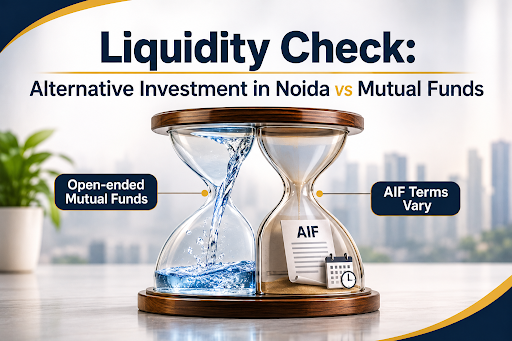
Different exits: Open-ended mutual funds allow redemptions on business days, while closed-ended AIFs lock money for years.
Entry ticket: Mutual funds have no mandatory minimum, but an AIF commitment generally starts at ₹1 crore per scheme.
Clear terms: Reading terms is easier with AIF investment services in Delhi from Niveshology Wealth, explaining each clause.
Timing first: Check when you may need the money before you consider any option with a lock-in.
You have heard the pitch.
The talk around alternative investment in Noida sounds exclusive, and the numbers look interesting.
But one question matters before returns: when can you get your money out?
Mutual funds and AIFs answer that very differently.
This blog compares them on liquidity, so you can ask sharper questions.
How an AIF Locks Your Money
An AIF is a privately pooled fund registered with SEBI.
Category I and II AIFs are closed-ended. Their minimum tenure is three years. That can be extended by up to two years if two-thirds of investors, by value, approve. Many AIFs also call capital in parts, not all at once.
Money comes back when investments are sold. The date isn’t fixed.
Category III funds can be open-ended, but redemptions follow each fund’s own terms.
That’s why the placement memorandum matters, and AIF investment services in Delhi, such as those from Niveshology Wealth, can explain it in plain words.
Mutual Funds vs AIFs, Side by Side
Here is the liquidity picture at a glance:
Exit: Open-ended mutual funds redeem on business days at NAV. Closed-ended AIFs run for a fixed tenure.
Speed: Mutual fund proceeds usually arrive within a few working days. AIF payouts depend on when investments exit.
Minimum: Mutual funds need no mandatory minimum. Most AIFs need ₹1 crore per scheme.
Lock-ins: Some mutual funds, like ELSS, carry a three-year lock-in. Most AIFs hold money for three years or more.
Even mutual funds aren’t friction-free. An exit load may apply on early redemption.
Questions to Ask Before You Commit
When Will I Need This Money?
List near-term needs first: school fees, a home, medical costs. A lock-in can clash with them.
How Much Can I Lock Away?
Decide how large a slice of your total money you’re comfortable locking away. Do it before you see any pitch.
What Do the Documents Say?
AIFs share their terms in a placement memorandum. Check the tenure, extension rules, fees, and how and when money is returned.
Where a Distributor Fits
A distributor explains products, shares documents, and supports paperwork.
It doesn’t manage the fund or promise outcomes.
An AMFI-registered distributor works within these limits.
The decision stays with you.
Conclusion
So, which is more liquid? Open-ended mutual funds, by design.
That doesn’t make AIFs right or wrong.
They are different tools with different exits.
Check your timeline, read every document, and remember that neither promises returns.
FAQs
1. Can I invest in an AIF with a smaller amount?
Generally no, since the minimum is ₹1 crore per scheme, and alternative investment in Noida through Niveshology Wealth starts with checking whether that ticket fits your wider finances. Exceptions such as angel funds have their own conditions.
2. What is a drawdown in an AIF?
You commit an amount, like ₹1 crore, but the manager calls the money in installments. Missing a call can carry penalties under the fund’s terms.
3. How fast do I get money from a mutual fund?
Open-ended funds usually credit redemption proceeds within a few working days. Liquid funds can be quicker. Exit loads and lock-ins apply to some schemes.
4. Are AIFs regulated like mutual funds?
Both come under SEBI, but with different rules. AIFs are privately pooled vehicles under SEBI’s AIF Regulations, 2012, and can raise money only through private placement.


