 WhatsApp Us Now
By the T-Series StageWorks Team
Every great Bollywood track you have ever loved is having a guitarist behind it. Not in the spotlight, not in the credits most of the people are reading, but in the studio, in the recording booth, laying down the part which is making the song feel like the song. The instrumentalists you are never seeing are often the musicians who have built the whole thing.
There is a path to that. It is starting earlier than most of the people are thinking, it is requiring less natural talent than most of the people are assuming, and it is more accessible in Delhi and Noida right now than it has ever been. The question is not whether you can learn an instrument. It is whether you are learning it somewhere which is taking you seriously.
The Difference Between Playing and Training
The learning of a few chords at home and the enrolling in a structured instrument course in Noida are two different activities. They are producing two different musicians. The home practice is producing someone who can play the songs they already know. The structured training is producing someone who is understanding why a chord is working, can learn a new song in one listen, can play alongside the other musicians without falling apart, and can eventually step into a professional recording or performance context.
The gap between those two outcomes is not about the practice hours. It is about what is being practised, in what order, and with what feedback. Most of the self-taught guitarists are spending the years on the wrong things. A proper programme is compressing the right things into a fraction of that time.
What Professional Instrument Training Actually Includes
An instrument course worth the enrolling in is covering more than the technique. It is covering the music theory in context, not the theory for its own sake, but the kind which is explaining what you are hearing when Pritam Chakraborty is building a bridge section, or why an A minor chord in a specific position is creating the exact mood it does. The understanding of this is turning a student who is copying into a musician who is creating. It is the difference between the learning to play the songs and the learning to understand the music, and once you can do the second, the first is becoming easy for any song you are encountering, not just the ones you were taught.
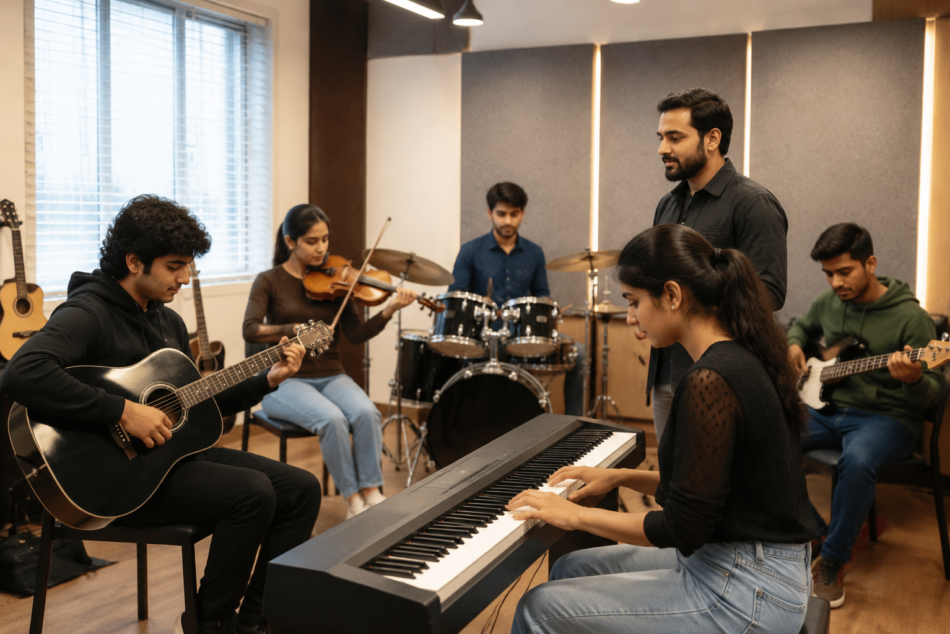
It is covering the ear training alongside the physical playing, so that when a director on a Bollywood playback session is asking for a different feel on a passage, you are hearing it immediately and your fingers are following. It is covering the performance, which is different from the practice in every way which is mattering. And it is covering how to work with the other musicians, which is the skill most of the instrumental students are never developing because they have never had to be in a room with anyone else while playing.
Why the T-Series Connection Changes What’s Possible
T-Series StageWorks Academy is not simply a music school which is happening to share a name with India’s biggest music and film production house. It is a genuine extension of that world. T-Series Acoustics, the acoustic performance platform on YouTube with the tens of millions of subscribers, has featured the students from this very academy. The deserving students at TSA are getting a platform which no independent music school in Delhi or Noida can offer, the real industry, not a simulation of it. That is not a marketing claim. It is a structural fact about what this institution is actually connecting you to the moment you are walking in as a serious student.
This is mattering for an instrumentalist because the music is a relational field. The guitarist who has performed even once in a serious production context is a different professional from one who has only ever played alone. The connections, the experience of the real studio standards, the understanding of what the professional musicians are expecting of each other, these are the things which only are coming from being inside the industry, however briefly, at the right stage.
How to Choose the Right Programme
Before you enrol anywhere, ask the three questions. First, who is teaching it, and have they worked professionally? The faculty credentials should be visible and specific, not “years of teaching experience” but “this is where I have worked and performed.” Second, will I perform at any point during the course, or only practise privately? The answer to this is telling you immediately how seriously the programme is taking your development as a musician rather than just a student. Third, what is happening after the course? Is there a next level, a community, a pathway?
The T-Series StageWorks Academy instrument course in Noida is answering all three clearly. The guitar training at the academy is built around the professional standards from the first session, because the goal is never just to play, but to become the kind of musician which India’s entertainment industry is having the space for.
If the music has been something you have kept at a distance, thinking it was for the people with more time, more talent, or a different background, it is not. Pick up the phone. Book a session. See what a proper course is doing to a student who simply is deciding to take it seriously.
The studio is waiting.


