 WhatsApp Us Now
Cybersecurity has become an essential part of modern business operations. Organizations across Ontario are using cloud platforms, digital applications, connected devices, and online services to improve productivity and serve customers. However, greater digital dependence also creates new security responsibilities. Businesses must protect sensitive information, manage access, monitor risks, and comply with changing regulatory expectations.
Traditional cybersecurity practices alone are often not enough to manage these responsibilities efficiently. Security teams may need to review large amounts of information, track compliance requirements, monitor vulnerabilities, and document security activities. When these tasks are handled manually, they can consume valuable time and increase the possibility of human error.
This is where cybersecurity governance automation ontario is becoming increasingly important. By combining governance principles with automated technologies, organizations can create more consistent, measurable, and efficient security processes.
For students and aspiring technology professionals, understanding these developments can also provide valuable insight into the changing cybersecurity industry. Institutions such as Canadian College for higher studies can help learners explore technology-focused education and develop foundational knowledge for today’s digital workplace.
What Is Cybersecurity Governance?
Cybersecurity governance is the structured approach an organization uses to manage information security. It defines policies, responsibilities, processes, controls, and decision-making procedures that help protect digital assets.
While cybersecurity focuses heavily on preventing and responding to threats, governance provides the framework that determines how security should be managed throughout an organization.
Key Elements of Cybersecurity Governance
A strong governance program can include:
- Security policies and standards
- Risk assessment and management
- Access control
- Data protection
- Compliance monitoring
- Security awareness
- Incident response planning
- Vendor and third-party risk management
- Security audits
- Performance measurement
Governance helps ensure that security is not treated as an isolated technical function. Instead, it becomes part of the organization’s broader business strategy.
Why Automation Is Changing Cybersecurity Governance
Organizations generate enormous amounts of security-related information. Security alerts, vulnerability findings, access records, compliance requirements, audit evidence, and policy documents can quickly become difficult to manage.
Automation can help simplify these processes.
Rather than relying entirely on spreadsheets, emails, and manual reports, organizations can use technology to collect information, assign tasks, monitor controls, and generate reports.
Continuous Monitoring
Automated systems can monitor security controls and organizational environments continuously. When a potential issue is detected, the appropriate team can receive an alert or task.
This approach can help organizations identify problems earlier instead of waiting for periodic manual reviews.
Automated Workflows
Consider an organization discovering a critical vulnerability. A manually managed process might require several emails and follow-ups before the issue reaches the correct team.
An automated workflow can create a task, assign responsibility, establish a deadline, notify relevant employees, and track remediation progress.
This creates a more consistent process and reduces administrative effort.
Improved Compliance Tracking
Compliance management can involve numerous controls and documentation requirements. Automation can help organizations track whether controls are operating effectively and whether required evidence has been collected.
It can also make reporting easier by bringing information together in a centralized system.
The Importance of Cybersecurity Automation in Ontario
Ontario has a large and diverse business environment that includes technology companies, financial organizations, healthcare providers, educational institutions, retailers, manufacturers, and professional services.
Many of these organizations depend on digital systems to operate efficiently. As technology adoption grows, protecting data and managing cybersecurity risks becomes increasingly important.
The growing relevance of cybersecurity governance automation ontario reflects this broader shift toward security programs that use automation to improve visibility, consistency, and efficiency.
Organizations can benefit from governance systems that help connect security policies with practical activities. Instead of treating compliance, risk management, and cybersecurity as separate responsibilities, automation can bring them into a more coordinated framework.
Benefits of Governance Automation for Organizations
Automation does not eliminate cybersecurity risks, but it can help organizations manage them more effectively.
1. Greater Visibility
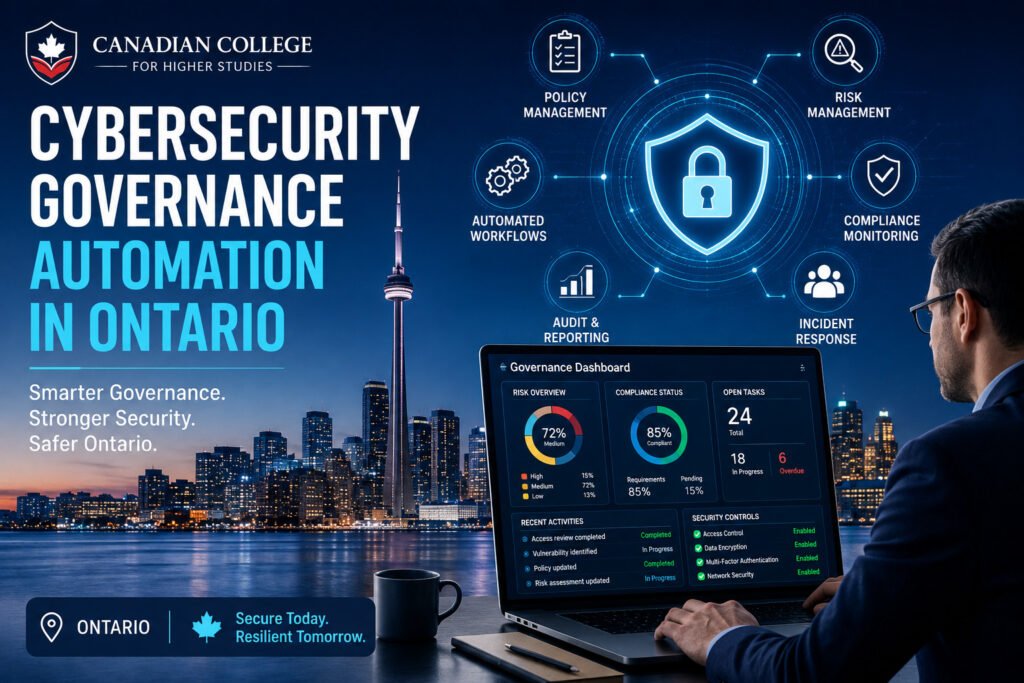
A centralized governance platform can provide security teams and managers with a clearer view of current risks, compliance status, outstanding tasks, and security controls.
Better visibility allows decision-makers to understand where attention is required.
2. Reduced Manual Work
Security professionals often spend significant time performing repetitive administrative tasks. Automation can handle many routine activities, allowing employees to focus on analysis, strategy, and complex security decisions.
3. Consistent Processes
Manual processes can vary depending on who performs a task. Automated workflows can standardize procedures and ensure that important steps are not easily overlooked.
4. Faster Risk Response
When security information is collected and analyzed more efficiently, teams can respond to important findings faster. Automated notifications and task assignments can reduce delays.
5. Better Audit Preparation
Maintaining accurate records is important during internal and external audits. Automated systems can help maintain documentation, activity logs, control information, and remediation records.
This can make audit preparation more organized and less disruptive.
How Cybersecurity Governance Automation Works
Implementing automation usually involves several stages. Organizations should carefully evaluate their needs before selecting technologies.
Step 1: Identify Security Requirements
The first step is understanding what needs to be protected. Organizations can identify important systems, applications, data, users, and business processes.
This creates a foundation for determining which security controls and governance processes require attention.
Step 2: Assess Risks
Security teams can evaluate potential threats and vulnerabilities based on likelihood and business impact.
Not every security issue has the same priority. Risk assessment helps organizations focus resources on the issues that matter most.
Step 3: Define Policies and Controls
Organizations need clear policies that explain security expectations. These policies can cover areas such as password management, access permissions, data handling, device security, and incident response.
Controls should then be mapped to the appropriate policies and requirements.
Step 4: Automate Repetitive Activities
Once processes are clearly defined, suitable activities can be automated.
Examples include:
- Security alerts
- Access reviews
- Compliance reminders
- Risk notifications
- Vulnerability tracking
- Task assignments
- Evidence collection
- Reporting
Automation should be introduced carefully so that workflows remain accurate and useful.
Step 5: Measure and Improve
Cybersecurity governance is not a one-time project. Organizations should regularly evaluate their security performance and improve processes when necessary.
Metrics can help organizations understand whether risks are being addressed effectively and whether security objectives are being achieved.
Skills Needed for Cybersecurity Governance Careers
The development of automated governance systems is creating demand for professionals who understand more than traditional cybersecurity tools.
Technical Knowledge
Students can benefit from learning networking, cloud computing, operating systems, cybersecurity fundamentals, databases, and security technologies.
Understanding how different systems communicate can make it easier to work with security platforms and automation tools.
Risk and Compliance Knowledge
Governance professionals should understand risk management, security policies, audits, and compliance principles.
This knowledge helps bridge the gap between technical security teams and business leadership.
Automation Skills
Basic programming and scripting can be useful for automating repetitive tasks. Knowledge of APIs, security platforms, cloud services, and workflow technologies can also provide an advantage.
Analytical Thinking
Cybersecurity professionals frequently need to examine information, identify patterns, evaluate risks, and determine appropriate actions.
Strong analytical skills can therefore be just as valuable as technical knowledge.
Communication
Security recommendations often need to be explained to people who do not have a technical background. Professionals who can communicate clearly can help organizations understand why a particular security decision matters.
Educational organizations such as Canadian College for higher studies can be a starting point for learners who want to explore technology-related education and develop skills relevant to the evolving digital economy.
Challenges Organizations Should Consider
Although automation provides significant benefits, it should be implemented thoughtfully.
Poor Data Can Create Poor Results
Automated systems depend on accurate information. If the underlying data is incomplete or outdated, automated reports and decisions may also be unreliable.
Integration Can Be Complicated
Organizations often use many different applications and security tools. Connecting these systems may require technical expertise, testing, and ongoing maintenance.
Automation Needs Human Oversight
Not every security decision should be automated. Complex risks may require professional judgment and business context.
The best approach is often a combination of automation and human decision-making. Technology can manage repetitive processes while experienced professionals handle strategic and complex situations.
The Future of Cybersecurity Governance
The future of cybersecurity governance will likely involve greater integration between automation, cloud computing, artificial intelligence, analytics, and security operations.
Organizations may increasingly use automated systems to identify unusual activity, prioritize risks, monitor controls, and provide real-time governance information.
However, technology alone will not create a secure organization. Effective cybersecurity also depends on policies, employee awareness, leadership support, skilled professionals, and a culture of security.
For students, this changing environment creates opportunities to develop a combination of technical and business-oriented skills. Understanding both cybersecurity and governance can help learners adapt to roles that require cross-functional knowledge.
The continued growth of cybersecurity governance automation ontario demonstrates how security management is evolving from manual processes toward more connected and intelligent systems.
Why Education and Continuous Learning Matter
Cybersecurity is a constantly changing field. New technologies, vulnerabilities, regulations, and attack methods can influence how organizations approach security.
Because of this, professionals need to continue developing their knowledge after completing formal education.
Students can strengthen their preparation by combining academic learning with practical projects, technical exercises, industry certifications, and independent research. Learning how security tools work in real-world environments can make theoretical concepts easier to understand.
Canadian College for higher studies can be considered by learners exploring educational opportunities related to technology and professional development. Building a foundation in cybersecurity, networking, cloud technologies, governance, and automation can help students better understand the demands of modern digital organizations.
Conclusion
Cybersecurity governance has become an important part of managing digital risk. As organizations across Ontario adopt more cloud services, connected technologies, and digital business processes, they need efficient ways to monitor security, manage risks, and maintain compliance.
Cybersecurity governance automation ontario represents a modern approach that combines structured governance with automated workflows, continuous monitoring, reporting, and risk management. When implemented correctly, automation can reduce repetitive work, improve visibility, strengthen accountability, and support faster responses to security issues.
At the same time, automation should not replace human expertise. Successful cybersecurity depends on the right combination of technology, skilled professionals, clear policies, reliable data, and informed decision-making.
For aspiring cybersecurity professionals, this changing environment offers opportunities to develop valuable skills across technology, governance, risk management, and automation. Canadian College for higher studies can provide learners with an opportunity to explore relevant educational pathways while preparing for a digital economy where cybersecurity continues to play a central role.


