 WhatsApp Us Now
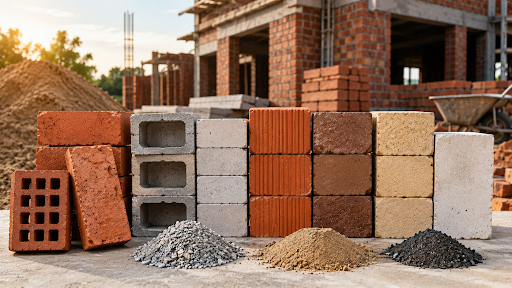
Most people spend three months choosing tiles and about twenty minutes choosing bricks.
That order is backwards. Tiles you can replace in ten years. The brick sits inside your wall for the next sixty, holding up everything above it, and nobody is going to break that wall open to fix a bad decision.
So before your mason places the first order, here is what actually matters.
Start with the wall, not the brick
A load-bearing wall and a filler wall have completely different jobs. One carries the weight of the slab above it. The other just divides two rooms.
If you buy the same brick for both, you are either overpaying on one or underbuilding on the other.
For load-bearing work, compressive strength is the number to ask about. IS 1077 sets the classification for common burnt clay bricks, and anything below 3.5 N/mm² is not meant for structural walls no matter what the seller tells you. For internal partitions, a lighter block often does the job better and reduces dead load on the structure.
Ask the question plainly at the counter. Good brick manufacturers will answer it with a test report. The rest will change the subject.
The water absorption test nobody does
Here is a check that costs you nothing and takes a day.
Take a brick. Weigh it dry. Soak it in water for 24 hours, take it out, wipe the surface, weigh it again. If the weight has gone up by more than about 20 percent, that brick is drinking water — and it will keep drinking it out of your plaster, your paint, and eventually your interior walls.
Damp patches on a two-year-old wall usually trace back to this. Not to the paint. Not to the waterproofing. To the brick.
Shape matters more than people think
Pick up ten bricks from the same lot and stack them. Do the edges line up? Are the faces flat? Is the size the same across all ten?
If they are not, your mason will fix it with mortar. More mortar means thicker joints, thicker joints mean more cement, and more cement means a bill that quietly grows by ten to fifteen percent without anyone noticing where it went.
This is the single biggest practical advantage of machine made bricks. Extruded and cut by machine, the dimensions repeat. Every piece is the same. Walls go up faster because the mason is not adjusting for every fifth brick, and the joint stays thin and clean.
Which also happens to look better if you ever plan to leave the wall exposed.
Sound, colour, and the thumbnail test
Old-school checks still work, and site engineers still use them.
- Tap two bricks together. A well-fired brick rings. A soft one gives a dull thud — that one is underburnt.
- Look at the colour. It should be even and deep, right through the piece, not just on the surface. Break one and check the core.
- Scratch it with your thumbnail. If it marks easily, the firing was incomplete.
- Drop one from about a metre. A properly fired brick should survive it. Most underburnt ones will not.
None of this requires a lab. Ten minutes at the yard tells you most of what you need to know.
Buy from a source that will still exist next year
This part gets ignored constantly.
Construction never runs in one clean order. You will need a top-up lot in month four. If your original supplier has moved on, you now have two different batches in one wall, with two different shades and two different sizes, and it will show.
So look for consistency of supply, not just price. The best brick suppliers keep the same clay source, the same firing process, and the same product range year after year. Mahaluxmi Bricks, for instance, has been producing from its Panchkula unit since 1982 — over four decades of the same operation — and that kind of continuity is exactly what protects you when you need one more truckload halfway through the project.
Ask how long they have been running. Ask if the batch you are buying today will still be available in six months. The answer tells you a lot.
One last thing about price
The cheapest brick is almost never the cheapest wall.
A weak brick needs more mortar, more plaster to hide the unevenness, and sometimes a repair five years later. Add those up and the “savings” disappear, usually with interest.
Buy for the wall you want in 2050, not the invoice you want this Friday.
Take a sample. Soak it. Tap it. Break one open and look inside. Twenty minutes of that will teach you more than any brochure, and it is the one part of the process nobody else can do for you.


