 WhatsApp Us Now

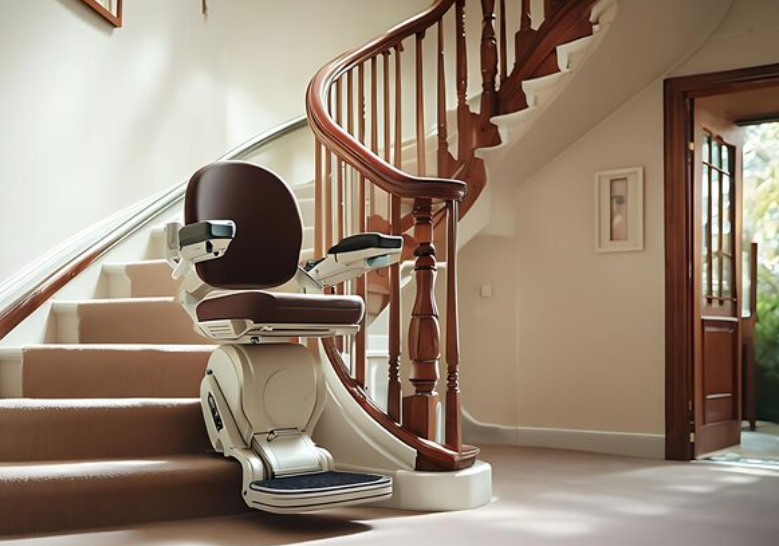
A curved stair lift in a split-level home in Concord NH is a different measuring job than a curved lift on a full flight. Split-levels put short runs, tight landings, and turns at the bottom into one staircase, and each changes the rail. The equipment handles it. What catches households out is the cost and the lead time, both of which track turns rather than steps.
Why Split-Levels Are Harder Than Full Flights
A conventional two-storey staircase gives a rail a long clean run with one turn at most. A split-level gives the opposite.
The flights are short, often five to seven steps between levels. The landings are small, sized for somebody to pivot rather than pause. And the staircase frequently turns at the bottom to fit inside the footprint of the house.
A rail has to follow all of it, climbing the short flight, flattening across the landing, picking up the incline on the far side, and managing any turn without the rider feeling a jolt at each joint. On a long gentle flight the rail has room to transition, and on a split-level it does not.
The Short Flight Problem
This is the part most homeowners find backwards. A short flight is not cheaper to fit a curved rail to, and in several ways it is harder.
A rail needs a certain distance to change angle smoothly. Where a flight is six steps with a turn at one end and a landing at the other, the whole transition happens in a compressed run, which takes more fabrication work rather than less.
It also affects where the carriage parks. The rail needs a short overrun at each end so the carriage sits clear of the steps, and on a split-level those overruns land on small landings that may already have a doorway opening onto them.
Turns at the Bottom & Mid-Landings
Turns at the Foot of the Stairs
A turn at the bottom of a flight is common in split-level and raised-ranch layouts, and it is usually the most expensive single feature on the quote.
Mid-Landings That Look Straight
A mid-landing where the flight pauses and continues in the same direction still needs a curved rail in most cases, since the rail has to flatten across the landing and pick the incline back up. Plenty of households assume a staircase like that counts as straight, and it does not.
Where a door opens onto a landing the rail crosses, the rail has to clear it, which sometimes means a folding section that hinges up out of the doorway.
Intermediate Stops & What They Add
On a split-level the rider often wants to get on or off at a mid-level rather than only at the top and bottom. That is an intermediate stop, and it is a real addition rather than a minor option.
It needs a park position, a charge point at that level, and call controls there, and it changes how the rail is drawn, since the carriage has to stop level with that landing rather than passing it.
Decide this early, because adding an intermediate stop after the rail is fabricated is not a modification but a new rail.
Measuring a Split-Level Properly
Most manufacturers now measure curved staircases with a photographic or laser system. A technician places calibrated markers along the staircase and captures a sequence of images, and software reconstructs the geometry in three dimensions.
On a split-level that matters more than on a simple curve, since there are more angles to capture and more places for a hand measurement to accumulate error.
The takeaway is that a firm price before this step does not exist. Any curved figure quoted from photographs or over the phone is either padded to cover the unknowns or incomplete, and that applies with more force on a split-level than anywhere else.
Modular Rail Against Fully Bespoke
Two fabrication approaches exist and the difference shows up in the lead time.
Fully Bespoke Rail
A fully bespoke rail is bent and welded to the measured geometry. It gives the closest fit on irregular staircases and it is the longer route, with fabrication measured in weeks.
Modular Rail Systems
A modular system builds the curve from pre-manufactured sections joined at calculated angles. Fabrication is faster because the components already exist, and the result suits most standard turn configurations.
For a split-level the answer depends on how irregular the geometry is. A standard 90 degree turn with a landing sits well within what a modular system handles, while two turns at unusual angles with a short run between them may fit better on a bespoke rail. Ask which approach a quote uses, since it explains most of the difference between two lead times.
Where a Platform Lift Beats a Curved Rail
This is worth raising because it saves some households a great deal of money.
A curved stair lift carries a seated rider, which means leaving a mobility device at the bottom and transferring onto the seat. On a split-level with short rises, a vertical platform lift sometimes fits beside the staircase or at an entry and carries the rider in their chair.
Where the rise between two levels is three or four feet and there is floor space beside the stairs, a platform lift can cost less than a multi-turn curved rail and serve a wheelchair user properly rather than partially.
Dealers carrying both categories give a more even read on this than one selling a single product line. Stairlifts & Ramps of New England, a family-run dealer covering Concord and the surrounding Merrimack County towns from its Salem office, installs curved stair lifts, platform lifts, and residential elevators alike, and a firm with that range has less reason to route a split-level household toward whichever product it happens to stock.
Lead Time & Planning Around It
A straight rail comes from stock and installs within a week or two of the assessment. A curved rail does not.
Fabrication runs into weeks, and the figure depends on the manufacturer’s current queue rather than a brochure number. A split-level with several turns sits at the longer end.
Where the lift is going in ahead of a surgery or a discharge date, start the survey early. Fabrication time cannot be compressed by paying more, and the measurement is what begins the clock.


