 WhatsApp Us Now

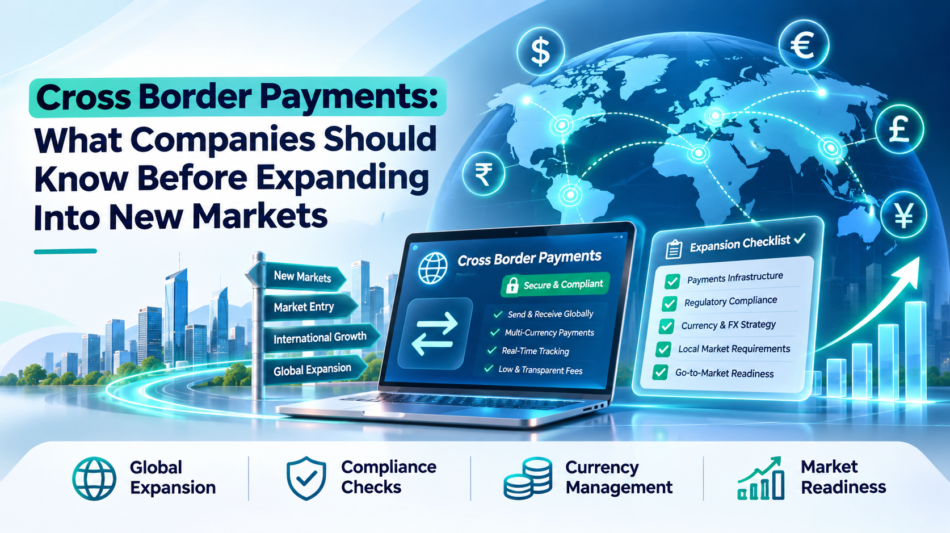
International expansion creates new revenue opportunities, but it also introduces payment, currency, settlement, and regulatory challenges. Businesses should understand how cross-border payments work before entering a new market and choosing payment infrastructure.
Introduction
Expanding into a new country can create major opportunities for a business. Companies can access new customers, establish relationships with international suppliers, and diversify their revenue sources.
However, international expansion also changes how money moves through the organization.
Domestic payment processes may not work effectively when customers, vendors, and partners are located in different countries. Businesses may need to manage different currencies, local payment preferences, financial regulations, transaction fees, and settlement timelines.
This makes cross border payments an important part of international expansion planning.
Before entering a new market, businesses should evaluate whether their existing payment solutions can support the operational and financial requirements of the target region.
Understand the Complete Payment Flow
Businesses should first understand how money will move within the new market.
Will customers make payments directly to the company? Will the business pay local suppliers? Will it work with distributors or international partners?
Answering these questions helps determine the type of business payment solution the company requires.
Businesses should map the complete payment journey, including:
- Customer payment collection
- Transaction processing
- Currency conversion where applicable
- Settlement
- Vendor payments
- Refunds
- Reconciliation
This process can reveal potential operational gaps before expansion begins.
Consider Local Payment Preferences
Customers in different markets may prefer different payment methods.
A payment option that works well in one country may not be the preferred choice elsewhere.
Businesses should research how customers in the target market normally pay for products and services.
Flexible online payment solutions can help businesses provide convenient digital payment experiences across multiple markets.
Offering familiar payment methods can reduce friction and make it easier for customers to complete transactions.
Payment localization should therefore form part of the broader market-entry strategy.
Understand Currency Requirements
International payments frequently involve multiple currencies.
Businesses should understand which currencies they need to accept and how currency conversion may affect transaction costs and settlements.
Currency fluctuations can also affect the final value received from international transactions.
Companies should evaluate how payment providers manage currencies, conversion processes, and settlement options.
A strong international business payment solution should align with the company’s target markets and financial requirements.
Evaluate Settlement Timelines
Transaction completion and settlement are not always the same thing.
A customer may complete a payment, but the business may receive access to those funds later.
Settlement times can affect working capital.
Before entering a new market, companies should understand how long international transactions typically take to settle through their chosen payment infrastructure.
Predictable settlement schedules help finance teams plan expenses and maintain better control over cash flow.
This becomes particularly important when transaction volumes grow.
Review the Cost of Cross Border Payments
International payments can include several types of costs.
Businesses should evaluate the complete pricing structure rather than looking only at a headline transaction fee.
Possible costs may relate to:
- Transaction processing
- Currency conversion
- International settlements
- Platform usage
- Integration
- Refund processing
Understanding these costs helps businesses calculate realistic margins in the target market.
A transparent approach to payment costs can also prevent unexpected financial pressure after expansion.
Plan for B2B Cross Border Payments
Companies expanding internationally may need to pay suppliers, distributors, logistics providers, consultants, and other business partners.
These b2b cross border payments can become a significant part of international operations.
Businesses should develop processes for tracking and reconciling these transactions.
Clear B2B payment records help finance teams manage accounts payable and maintain strong relationships with international partners.
Payment reliability can also influence how suppliers view the business as a commercial partner.
Consider Payment Collection Through Pay-in Services
International expansion often increases the number of incoming transactions a company must manage.
Efficient Pay-in services can help businesses organize customer collections across digital channels.
Businesses should evaluate whether their payment infrastructure provides the visibility needed to monitor incoming payments and identify unsuccessful transactions.
Effective Pay-in services can reduce manual collection work and support more organized reconciliation.
They can also provide finance teams with clearer information about incoming cash flow.
Evaluate Security Requirements
International transactions require strong payment security.
Businesses should understand how their payment provider protects transaction data and manages potential risks.
Security considerations may include authentication, data protection, transaction monitoring, access controls, and regulatory requirements.
The exact requirements may vary depending on the markets in which the business operates.
Companies should evaluate security early instead of treating it as an afterthought.
Strong payment security protects both the organization and its customers.
Understand Regulatory and Compliance Requirements
Payments do not operate in isolation from local regulations.
Different markets may have requirements relating to financial transactions, customer verification, data handling, taxation, or payment processing.
Companies should understand the regulations relevant to their activities and seek professional guidance when necessary.
Payment infrastructure should support the company’s compliance strategy rather than create additional complexity.
This is particularly important for businesses entering several international markets.
Prioritize Transaction Visibility
Finance teams need to know what is happening with every important transaction.
A lack of visibility can make it difficult to determine whether a customer has paid, whether a supplier payment has settled, or why a transaction failed.
Good payment solutions provide organized transaction information.
Businesses should evaluate reporting capabilities before choosing a provider.
Better visibility can improve reconciliation, financial reporting, customer support, and cash flow management.
Prepare Online Payment Solutions for Scale
Entering one new market may eventually lead to expansion into several more.
Businesses should therefore choose online payment solutions that can scale.
Important questions include:
- Can the platform support higher transaction volumes?
- Can it handle additional markets?
- Can the business integrate it with existing systems?
- Is useful transaction reporting available?
- Can it support the required payment methods?
A scalable platform can reduce the need for repeated technology changes.
How Uniteller Can Fit Into International Payment Planning
When evaluating international payment infrastructure, businesses may consider providers such as Uniteller as part of their wider assessment.
The appropriate solution depends on the company’s markets, transaction requirements, customer profile, integration needs, and business model.
Businesses should compare payment providers carefully rather than selecting one solely based on price.
The objective is to find infrastructure that supports reliable business payments and can adapt as international operations expand.
Test Before Scaling
Businesses should avoid assuming that a payment process will work perfectly from the beginning.
Testing can identify potential issues with payment acceptance, customer experience, reconciliation, reporting, or settlement.
A controlled launch provides teams with an opportunity to refine the payment process before transaction volumes increase.
Finance, technology, customer support, and operations teams should collaborate during this stage.
Conclusion
International expansion requires more than a strong product and market-entry strategy. Businesses also need reliable payment infrastructure.
Before entering a new market, companies should evaluate cross border payments, settlement timelines, currencies, transaction costs, security, local payment preferences, and compliance requirements.
Flexible online payment solutions, dependable Pay-in services, and structured b2b cross border payments can help businesses manage international transactions more efficiently.
By choosing the right business payment solution, implementing scalable payment solutions, and evaluating providers such as Uniteller according to their operational needs, companies can create a stronger foundation for international business payments and sustainable global growth.


