 WhatsApp Us Now

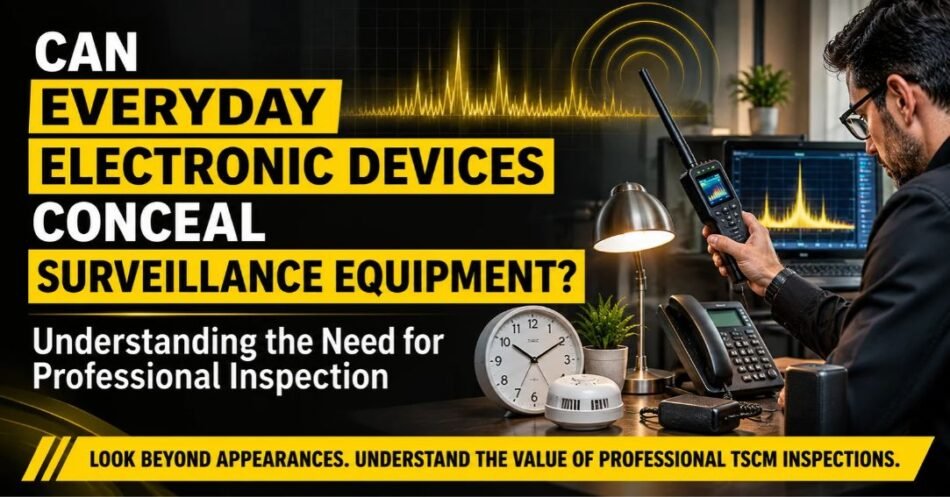
Learn how everyday electronic devices may raise surveillance concerns and how professional bug sweeping and TSCM inspections assess potential risks in Bangalore.
Modern electronic devices are designed to be compact, multifunctional, and increasingly integrated into everyday environments. Cameras, speakers, chargers, smart home equipment, and other electronic accessories are now common in homes, offices, and commercial spaces. While most serve legitimate purposes, their appearance alone may not always reveal every component or function they contain.
This raises an important question: can everyday electronic devices conceal surveillance equipment? Although certain electronic devices can be modified or designed to incorporate monitoring components, an unfamiliar appearance does not establish that a device is being used for surveillance. Identifying potential concerns requires technical assessment, reliable evidence, and an understanding of how electronic equipment operates.
For individuals and organizations in Bangalore, professional bug sweeping and Technical Surveillance Countermeasures (TSCM) inspections can provide a structured approach to evaluating specific electronic surveillance concerns.
Why Everyday Electronic Devices Require Careful Assessment
Modern electronic equipment often combines multiple functions within a relatively small design. Wireless connectivity, microphones, cameras, sensors, and data transmission capabilities are common features of many legitimate products.
Some surveillance-related equipment may also be designed to resemble ordinary household or office accessories. This can make identification through visual examination alone difficult.
However, it is equally important to avoid assuming that every unfamiliar charger, adapter, speaker, or electronic accessory contains a hidden surveillance device. Many unusual-looking components have legitimate technical purposes.
A professional inspection focuses on identifying verifiable anomalies rather than drawing conclusions based on appearance or suspicion.
What Types of Surveillance Equipment May Be Relevant?
Depending on the circumstances, a technical surveillance inspection may consider several categories of electronic equipment.
1. Hidden Cameras
Small camera modules may be incorporated into various electronic products or installed within surrounding fixtures. Professional inspection can help assess specific concerns involving concealed imaging equipment.
2. Hidden Listening Devices
Unauthorized audio-monitoring equipment may use microphones and, depending on its design, wired or wireless transmission methods. Identifying potential hidden listening devices may require physical examination and appropriate electronic detection techniques.
3. Wireless Monitoring Equipment
Some electronic devices communicate through radio-frequency signals. RF-based assessment can help specialists examine relevant wireless activity and investigate signals that require further attention.
4. Unauthorized Tracking Devices
Vehicles and other assets may be assessed for potential GPS tracking or electronic monitoring equipment when specific concerns arise. Such inspections require an approach suited to the asset and the suspected technology.
The presence of ordinary wireless equipment does not, by itself, indicate surveillance. Findings must always be interpreted in context.
Why Visual Inspection Alone May Not Be Sufficient
A visual examination can identify unusual objects, unexplained modifications, or unfamiliar installations. However, compact electronic components may not have obvious external indicators.
Some devices may also remain inactive or transmit only under particular conditions. As a result, a basic visual check may not provide enough information to assess every potential concern.
Professional electronic bug detection uses multiple inspection methods where appropriate, allowing specialists to examine both physical components and relevant electronic activity.
Read More: Personal Bug Sweeping Services: Assessing Electronic Surveillance Risks at Home
How Professional Bug Sweeping and TSCM Inspections Work
A structured TSCM inspection is planned according to the environment, the client’s concerns, and the type of equipment being assessed. Depending on the inspection scope, it may include the following methods.
1. Physical Examination
Specialists examine relevant areas, fixtures, furniture, electrical installations, and electronic equipment for unusual components, modifications, or installation patterns that may warrant further investigation.
2. Radio-Frequency Analysis
Radio-frequency (RF) analysis helps assess wireless signal activity within an inspection environment. Spectral analyzers and other suitable equipment may help identify signals that require technical evaluation.
It is important to understand that Wi-Fi networks, Bluetooth devices, mobile phones, and other legitimate electronics also generate radio-frequency activity. A signal should not automatically be classified as surveillance-related without further assessment.
3. Specialized Electronic Detection
Depending on the circumstances, specialists may use equipment such as Non-Linear Junction Detectors (NLJDs) to examine certain electronic components, including components that may not be actively transmitting.
Different detection tools have different capabilities and limitations. Their use should be determined by the inspection requirements rather than applied indiscriminately.
4. Technical Verification and Reporting
Potential anomalies require careful examination before conclusions are drawn. Professionals assess relevant findings, distinguish ordinary electronic activity from issues requiring further investigation and document observations according to the agreed inspection scope.
This process helps clients understand what was examined, what was identified, and whether additional assessment or action may be appropriate.
When Should You Consider a Professional Technical Surveillance Inspection?
Individuals and organizations may consider professional bug sweeping when:
- Unexplained electronic equipment or unusual installations are identified.
- There are specific concerns about hidden cameras or listening devices.
- Sensitive corporate meetings or confidential discussions require additional technical assessment.
- A recently acquired or renovated property requires an electronic surveillance inspection.
- A vehicle needs assessment for potential unauthorized tracking or monitoring equipment.
An inspection should be based on identifiable concerns and realistic requirements. Professional assessment is intended to establish technical findings, not reinforce assumptions.
Choosing Professional Electronic Bug Detection Services in Bangalore
Selecting an appropriate TSCM service provider involves more than checking the equipment used. Technical experience, inspection methodology, suitable detection tools, and the ability to interpret findings are all important considerations.
Before arranging an inspection, clients should consider:
- Technical expertise: Professionals should understand different electronic surveillance technologies and their limitations.
- Suitable equipment: Detection tools should be selected according to the environment and inspection requirements.
- Structured methodology: The inspection should follow a clearly defined and appropriate process.
- Discreet handling: Sensitive premises and client information should be handled responsibly.
- Clear reporting: Findings should be communicated accurately, without exaggerated claims or unsupported conclusions.
These considerations help clients make informed decisions when evaluating professional TSCM services.
Check this: TSCM Bug Sweeping in Mumbai: A Professional Guide to Electronic Surveillance Detection
Professional TSCM Debugging and Bug Sweeping Services in Bangalore
Electronic surveillance concerns require a balanced approach supported by technical knowledge and appropriate inspection procedures. Whether the requirement involves a corporate office, residential property, vehicle, or aircraft, the inspection process should be tailored to the environment.
Trace Point India provides professional TSCM debugging and bug sweeping services in Bangalore for individuals and organizations seeking technical assessments of potential electronic surveillance concerns. Its services include corporate, residential, vehicle, and aircraft inspections, with an emphasis on specialized detection equipment, tailored inspection requirements, discreet handling, and detailed reporting.
Clients can discuss their specific concerns to understand the appropriate scope and inspection approach.
Conclusion
Everyday electronic devices are becoming smaller and more multifunctional, but their appearance alone cannot establish whether they contain surveillance equipment. Equally, unfamiliar electronics or unusual wireless signals should not automatically be treated as evidence of unauthorized monitoring.
Professional bug sweeping combines physical examination, RF analysis, and specialized detection methods to assess potential concerns more systematically. For individuals and businesses in Bangalore, a structured technical surveillance inspection can provide clearer information and support decisions based on evidence rather than assumptions.
Discuss Your Electronic Surveillance Inspection Requirements
If you have specific concerns about hidden surveillance devices in your office, residence, or vehicle, contact us to discuss professional TSCM debugging and bug sweeping services in Bangalore.


