 WhatsApp Us Now
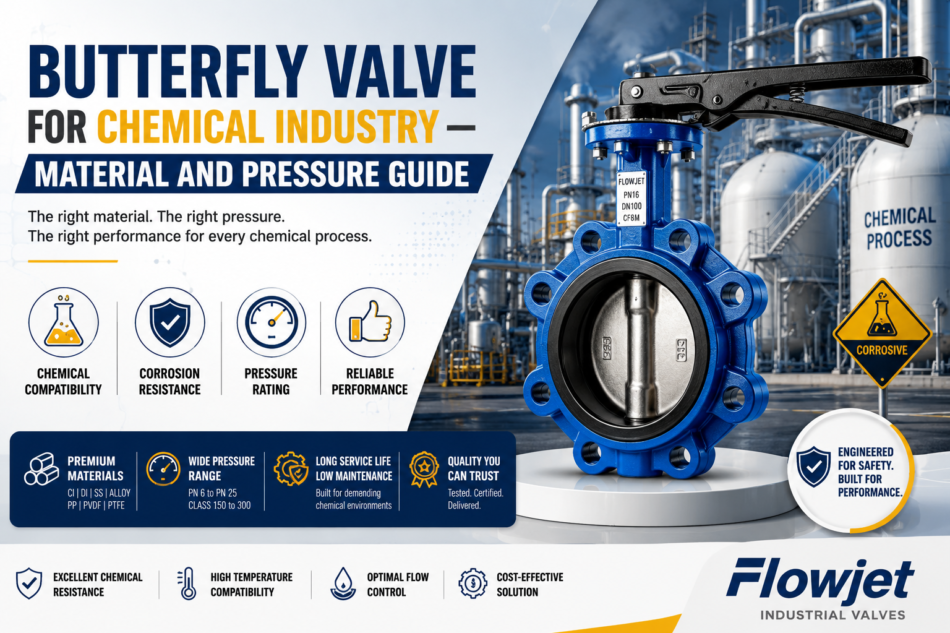
Walk through any chemical plant and you’ll find butterfly valves almost everywhere — on cooling water headers, chemical dosing lines, solvent transfer pipes, effluent treatment systems. They’re compact, they’re cost-effective for larger diameters, and they open and close fast. For most general service applications, they work without much drama.
But the chemical industry isn’t general service. And that’s exactly where buyers run into trouble.
A butterfly valve that works perfectly on a water line can fail within weeks — sometimes days — if it’s put into service handling chlorinated solvents, strong acids, or high-temperature process streams without the right material combination. The valve body might hold. The seat liner might not. Or the disc might hold and the stem seal fails. Or everything seems fine at ambient temperature and then the process heats up during a reaction and the liner softens and leaks.
These failures are almost always predictable. They happen not because butterfly valves are wrong for chemical service — they’re often exactly right — but because the material selection wasn’t matched carefully to the actual chemical environment.
This guide is written to help chemical plant engineers and procurement teams avoid that mistake.
Why Material Selection Is More Critical in Chemical Service
In water or HVAC applications, a standard cast iron body with an EPDM seat covers most situations. You pick it, it works, and you don’t think about it again for years.
Chemical service doesn’t work that way. The body material, disc material, seat liner, and stem seal all need to be evaluated individually against the specific chemical being handled — its concentration, temperature, and whether the valve sees it continuously or intermittently. A material that’s perfectly resistant to dilute sulphuric acid may degrade quickly in concentrated sulphuric acid. EPDM handles many water-based chemicals well but swells in hydrocarbon-based solvents. PTFE is chemically resistant to almost everything but has pressure and temperature limits that matter in high-pressure process lines.
Getting one of these material choices wrong in a chemical plant doesn’t just mean a leaking valve. It can mean a chemical release, a contaminated batch, a forced process shutdown, and — in serious cases — a safety incident. The cost of the right valve upfront is almost always a fraction of any of those outcomes.
Body Material Options — What Each Handles
Cast Iron is the most common and economical body material. It’s suitable for mildly corrosive chemicals, cooling water, and general process fluids where the chemical aggressiveness is low. In stronger acids or alkaline environments, it corrodes relatively quickly and isn’t the right choice.
Ductile Iron offers better mechanical strength than cast iron — relevant in higher pressure applications — but similar chemical resistance. Often used where the mechanical load is higher but the chemical environment is still mild to moderate.
Carbon Steel is widely used in oil, gas, and general petrochemical service. Not ideal for strongly oxidising or reducing chemical environments without appropriate lining.
Stainless Steel (SS 304 / SS 316) is the go-to choice for most corrosive chemical service. SS 316 in particular offers good resistance to chlorides, dilute acids, and a broad range of process chemicals. It costs more than cast iron but earns that cost back quickly in applications where the alternative would be frequent valve replacement. Most serious butterfly valve manufacturers working with chemical industry clients carry both grades as standard.
Exotic Alloys (Hastelloy, Duplex SS, Monel) come into the picture for extremely aggressive environments — concentrated acids, high-temperature chlorine service, and similar applications where stainless steel itself isn’t sufficient. These are higher-cost and typically ordered specifically for the application.
Seat and Liner Material — The Part That Usually Fails First
The seat liner is the most chemically exposed component in a butterfly valve, and it’s the most common failure point in chemical service when the wrong material is specified.
EPDM — Good for water, steam, dilute acids, and alkalis. Not suitable for hydrocarbons, oils, or solvents.
NBR (Nitrile) — Good resistance to oils, fuels, and hydrocarbons. Not suitable for strong acids or ketone-based solvents.
PTFE / Virgin PTFE — Excellent chemical resistance across a very broad range of chemicals including acids, alkalis, and solvents. Temperature range is typically up to 180–200°C depending on configuration. Slightly lower seating tightness compared to elastomeric seats in some designs, but the chemical resistance makes it the default choice for most serious chemical process applications.
Viton (FKM) — Handles high temperatures better than EPDM or NBR, and resists a wide range of aggressive chemicals including chlorinated solvents and aromatic hydrocarbons. Often specified for chemical service where temperature and chemical aggressiveness are both elevated.
PVDF Lining — Used where PTFE isn’t sufficient or where the valve body itself needs lining protection. Common in pharmaceutical and chemical plants handling highly corrosive media.
When speaking with a butterfly valve manufacturer for chemical plant requirements, providing the exact chemical name, concentration, and operating temperature — not just “chemical service” — makes a significant difference in getting the right material recommendation.
Pressure Ratings — What Chemical Plant Buyers Need to Know
Most standard butterfly valves are rated for moderate pressures — typically PN10 to PN16 in metric ratings, or ANSI Class 150 in inch-based specifications. For a large portion of chemical plant service, particularly on larger diameter lines handling bulk transfer or utility fluids, this is adequate.
Where it gets more specific:
High-pressure chemical lines — reactor feed lines, high-pressure solvent transfer, pump discharge headers on high-pressure systems — often require Class 300 or higher rated valves. Standard concentric butterfly valves aren’t always suitable here. Double eccentric or triple offset designs handle higher differential pressures significantly better, and several butterfly valve manufacturers in India now produce these for chemical and power industry applications.
Vacuum service — some chemical processes operate under vacuum, and standard valves aren’t always rated or tested for it. This needs to be specified clearly with the manufacturer.
Temperature-pressure relationship — a valve rated for PN16 at ambient temperature may have a de-rated pressure limit at 150°C. If your process runs hot, check the temperature-pressure chart for the specific valve and seat material combination, not just the ambient pressure rating.
A Practical Checklist Before Specifying Butterfly Valves for Chemical Service
Before sending an enquiry to a butterfly valve manufacturer, having these details ready typically results in faster, more accurate proposals:
- Chemical name and concentration
- Operating temperature (normal and maximum)
- Operating pressure and any vacuum conditions
- Line size and face-to-face dimension standard (EN 558, ASME B16.10)
- End connection type — wafer, lug, or flanged
- Actuation requirement — manual, pneumatic, or electric
- Any specific testing or certification requirements (TA-Luft, fire safe, etc.)
The more specific the enquiry, the more useful the response. A reputable butterfly valve manufacturer — particularly one with chemical industry experience — will often flag a material mismatch before it becomes the buyer’s problem on site.
Why Ahmedabad-Based Manufacturers Are a Practical Choice for Gujarat Chemical Plants
Gujarat is home to one of India’s most concentrated chemical manufacturing corridors — from the petrochemical clusters around Vadodara and Dahej to the chemical processing units across Ankleshwar, Vapi, and Ahmedabad’s own GIDC estates. For chemical plants in this belt, sourcing butterfly valves from a manufacturer based in Ahmedabad or nearby GIDC areas carries practical advantages beyond just price.
Lead times are shorter for standard sizes. Factory visits are feasible before qualifying a new supplier. Replacement seats, discs, and other wear parts arrive in days rather than weeks. And when a valve needs to be discussed technically — right material, right pressure class, right trim for a specific chemical — that conversation is easier with a manufacturer who knows the local process industry, speaks the same operational language, and has probably already supplied similar service in a nearby plant.
Manufacturers like Flowjet, operating from Ahmedabad and serving chemical plants across Gujarat and beyond, have built their product range specifically around this kind of chemical service reality — not just standard water and HVAC applications, but the more demanding, material-specific requirements that chemical plant engineers actually deal with.
Final Thought
Butterfly valves are an excellent fit for a wide range of chemical plant applications — provided the materials match the service. The combination of the right body, the right seat liner, and the right pressure rating for the specific chemical environment isn’t complicated to get right if it’s thought through at the specification stage. Getting it wrong, on the other hand, tends to be expensive and occasionally dangerous.
When in doubt, work with a butterfly valve manufacturer who asks the right questions before confirming a product — not one who quotes the cheapest standard valve and leaves the material compatibility question unanswered.


