 WhatsApp Us Now
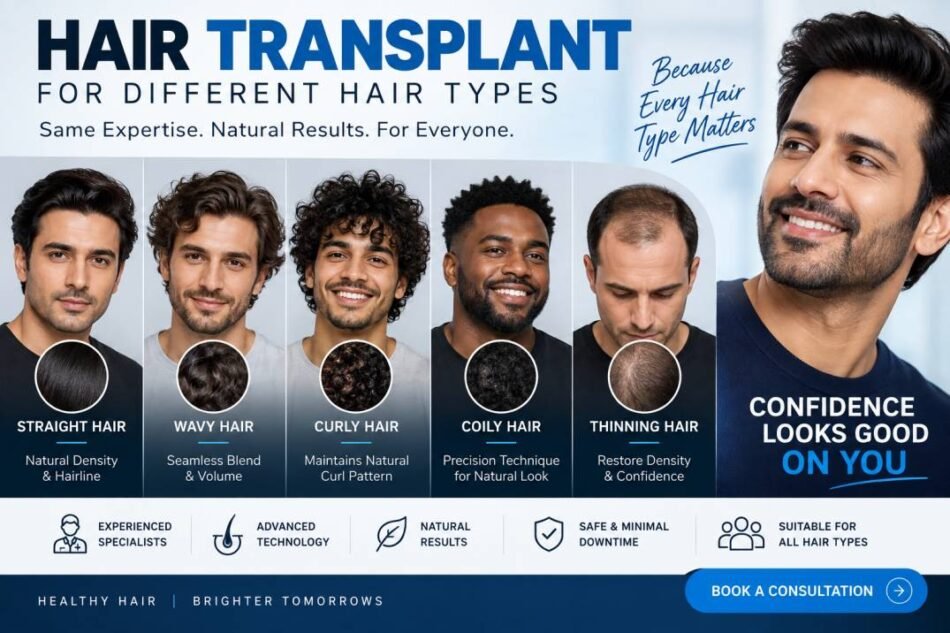
Hair loss can affect people with every type of hair, but hair texture and thickness can influence how thinning appears and how a hair transplant is planned. Straight, wavy, curly, coily, fine, and thick hair each have unique characteristics that may need to be considered during hair restoration.
Understanding Hair Transplant for Different Hair Types can help individuals learn how hair texture may influence treatment planning, graft placement, and the appearance of results.
What Is a Hair Transplant?
A hair transplant is a surgical hair restoration procedure that moves healthy hair follicles from a donor area, usually the back or sides of the scalp, to areas affected by hair loss.
Two commonly used techniques are Follicular Unit Extraction (FUE) and Follicular Unit Transplantation (FUT). The appropriate technique depends on factors such as donor hair availability, hair loss pattern, scalp characteristics, and individual goals.
Why Hair Texture Matters
Hair texture can influence the visual appearance of density. Curly and coily hair may create more volume because the strands naturally bend away from the scalp, while straight hair tends to lie closer to the scalp.
The shape and characteristics of the follicles can also be relevant during extraction. This is particularly important for tightly curled hair, where follicles may follow a curved path beneath the scalp.
Hair Transplant for Straight Hair
Straight hair generally lies close to the scalp, which can make thinning more visible. Careful graft placement and natural hair direction are important when restoring the hairline or increasing coverage.
The specialist may consider the angle, direction, and distribution of grafts to create a natural transition between transplanted and existing hair.
Hair Transplant for Wavy Hair
Wavy hair can provide natural movement and visual volume. The wave pattern may help create the appearance of fuller coverage after transplantation.
During planning, the natural direction and texture of the existing hair can be considered so that transplanted follicles blend appropriately with the surrounding hair.
Hair Transplant for Curly Hair
Curly hair can offer good visual coverage because the strands naturally create volume. However, the curved structure of some follicles can make extraction more technically demanding.
An experienced surgical team should carefully assess the donor area and follicle characteristics before performing a Hair Transplant for Different Hair Types.
Hair Transplant for Coily Hair
Coily or tightly curled hair requires particularly careful planning. The follicle may have a pronounced curve beneath the scalp, which can make extraction more technically challenging.
A detailed donor-area assessment can help determine whether transplantation is appropriate and which technique may be most suitable.
Read also: Daily Price Movement Data: What Intraday Percentage Change Means and How It Is Computed
Hair Transplant for Fine Hair
Fine hair has a smaller strand diameter and may provide less visual coverage. In these cases, graft distribution and hairline design can be especially important.
The number of grafts required depends on factors such as the size of the thinning area, donor density, hair characteristics, and desired coverage.
Hair Transplant for Thick Hair
Thicker hair can provide stronger visual coverage because each strand occupies more visible space. However, having thick hair does not automatically guarantee a particular transplant outcome.
Donor density, follicular unit characteristics, hair loss progression, and the condition of the scalp should all be considered during treatment planning.
Choosing Between FUE and FUT
FUE removes individual follicular units from the donor area, while FUT involves removing a strip of scalp and separating it into individual follicular units.
Neither technique is universally the best option for every hair type. The decision should be based on the individual’s donor supply, hair loss pattern, scalp characteristics, goals, and medical assessment.
Natural Hairline Design
Hairline design is one of the most important aspects of hair transplantation. A natural hairline should account for the person’s age, facial proportions, existing hair characteristics, and expected future hair loss.
The direction and angle of individual grafts can also influence how naturally transplanted hair blends with existing hair.
Factors That Determine the Best Hair Transplant
The best hair transplant approach is not determined by texture alone. Important factors include:
- Hair loss pattern and severity
- Donor hair density
- Hair thickness and texture
- Follicle characteristics
- Scalp condition
- Number of available grafts
- Hairline design
- Long-term hair loss risk
- Individual expectations
- Experience of the treating medical team
A personalized assessment is therefore more useful than choosing a procedure solely based on hair type.
Recovery and Hair Growth
Following transplantation, temporary redness, swelling, tenderness, or small crusts may occur. Transplanted hairs commonly shed during the early phase before new hair growth begins.
Hair growth takes time, and the final cosmetic appearance develops gradually. Patients should follow their medical team’s post-procedure instructions carefully during recovery.
How to Prepare for a Hair Transplant
Before considering transplantation, patients should discuss their medical history, current hair loss, medications, scalp health, and expectations with a qualified professional.
Understanding the available donor supply and potential future hair loss can help create a more realistic and sustainable treatment plan.
Conclusion
The best Hair Transplant for Different Hair Types depends on more than whether the hair is straight, wavy, curly, coily, fine, or thick. Hair density, follicle characteristics, donor availability, scalp health, hair loss pattern, and long-term goals all play important roles.
A personalized consultation with a qualified hair restoration professional can help determine whether transplantation is appropriate and which approach may provide the most natural-looking result for an individual’s hair characteristics.


