 WhatsApp Us Now

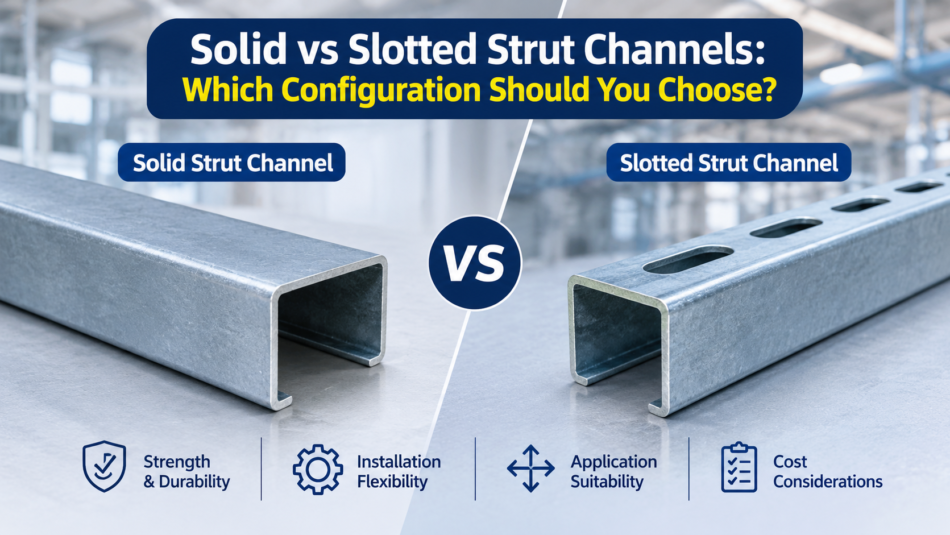
Solid and slotted strut channels serve different installation and support requirements. The right choice depends on how fittings attach, how much adjustment the run needs and how the channel performs under the specified load and span. Solid channels give a continuous surface and let installers create attachment points where required, while slotted channels use factory-formed openings that simplify positioning and adjustment on site. Support failures trace more often to unsuitable channel selection, connection details, loading, span or installation conditions than to the brand name alone, including profiles like Unistrut P2000.
What Are Solid and Slotted Strut Channels?
A slotted strut channel has pre-punched slots or holes, usually at regular spacing, in the web or at the back of the profile. A slotted strut channel has pre-punched slots or holes, usually at regular spacing, in the web or at the back of the profile.
These holes will affect the operation of the channel once installed. All attachment points must be made on a solid channel either by drilling on site or by employing fittings that clamp into the lips of the channel. The channels are slotted, so the points of attachment are already there, and bolts, channel nuts, and brackets may be placed without any field fabrication.
There is great variation in channel profile, overall dimensions, material thickness, and finish from product to product. Two channels with the same nominal dimensions can differ in gauge, opening pattern, material and finish. Always verify the manufacturer’s published dimensions and load data rather than assuming that nominal size indicates identical performance.
Solid Strut Channels: Features and Benefits
Key Features
- Uninterrupted solid profile with no pre-punched slots, giving a continuous surface where support elements double as bearing surfaces or where debris and moisture must not pass through the channel
- Flexible attachment along the full length using channel nuts that engage the lips, clamps or custom-drilled holes without restriction to a fixed slot pitch
Core Benefits
- Suits framing assemblies, machine bases and welded support structures where fabricators cut, weld or finish members after erection on a continuous profile
- Avoids the extra labour and touch-up work on cut edges that site drilling introduces, keeping installation time in check
Slotted Strut Channels: Features and Benefits
Key Features
- Pre-punched slots allow for quick placement, sliding and safe installation of equipment throughout the length of the channel without the need to drill on site or create new structural holes
- The size and spacing of the slots determine the exact channel nuts and fasteners needed to avoid loose connections due to ill-matched components.
Core Benefits
- Perfect for electrical support cable tray systems, pipe lines and modular frameworks where late routing changes in development can be absorbed effortlessly without costly rework
- Allows consecutive contractors to simply modify alignment and re-anchor hardware as field conditions change throughout protracted installation runs
- To ensure full mechanical load performance, the hardware specification must be directly related to the project fittings schedule, not visual resemblance
Solid vs Slotted Strut Channels: Key Differences
- Installation flexibility and adjustment: Slotted channel facilitates adjustment after erection. Solid channel secures attachment after drilling or clamping.
- Fastener compatibility: Slotted profiles take conventional channel nuts and slide-in fittings straight. Solid profiles rely more on clamping fittings or on drilled holes on site.
- Fabrication and modification: Slotted channel minimizes field construction. Solid channel will require drilling, deburring and often re-coating of the cut area.
- Load capacity and structural performance: Here, assumptions are the problem. Slots do not inherently make a channel stronger or weaker. Actual performance is based on channel cross section, perforation shape, material, span, loading, and manufacturer-published ratings. A heavier-gauge slotted channel can have greater capacity than a lighter solid channel. The effect of openings depends on their geometry, location and the loading condition. For this reason, channel capacity should be taken from the applicable manufacturer load tables rather than inferred from whether the channel is solid or slotted.
- Suitability for support arrangements: Trapeze hangers, cantilever brackets, and multi-tier racks all load the channel differently, and the arrangement should be based on the support geometry.
How to Choose the Right Strut Channel
Determining the suitable strut channel depends on the functional use and the number of attachment points required. High density or adjustable runs generally require slotted profiles. Structural requirements consist of design loads, span length, support conditions, and deflection limitations. Structural requirements need to be checked against manufacturer load tables for each individual profile before ordering material. Engineers must also ensure mechanical compatibility with the specified channel nuts, bolts, and fittings and select an adequate corrosion-resistant finish, such as pre-galvanized, hot-dip galvanized, or painted coating, commensurate with the site’s environmental exposure, particularly where cut edges expose raw steel.
Where Does Unistrut P2000 Fit?
The Unistrut P2000 is a 1-5/8 × 1-5/8 in. solid strut channel with a nominal 16-gauge, 0.060-in. (1.5 mm) thickness. 060 inches (1.5 mm), available in solid configuration. The permissible moment is 3,520 in-lbs (400 N·m). Standard lengths to 12 meters. Materials include stainless steel Type 304 and Type 316 to ASTM A240, pre-galvanized steel to ASTM A653 SS GR 33 G90, plain steel to ASTM A1011 SS GR 33 and aluminum to ASTM B221 Type 6063-T6.
The Unistrut P2000 series illustrates the configuration choice clearly because the same nominal channel size is available with different opening patterns. The P2000HS has round holes, 9/16-inch in diameter, on one side and 1-7/8-inch centers. The P2000KO comes with 7/8 in. knockouts on 6 in. centers. The P2000SL has large slots measuring 3 inches by 13/32 inches on 4-inch centers. The P2000T has slots measuring 1-1/8 inches by 9/16 inches on 2-inch centers. Same section, same gauge, four different ways to answer the fastening question.
So the useful question for buyers is not simply “solid or slotted?” It is which channel configuration provides the required connection flexibility and structural performance. The questions to consider are Will the selected Unistrut P2000 channel variation support the load at the proposed span? Will its apertures accommodate the fittings on the drawing? And will the finish be appropriate to the surroundings? Published tables of beam, column, and bearing loads cover the first part.
Conclusion
Do not choose solid or slotted channel based on appearance or habit. Base the decision on fastening requirements, installation flexibility and verified structural performance. Solid portions have their purpose where a continuous surface is required and there are few attachment sites. Slotted channels are useful where multiple fittings are required or attachment positions may need adjustment during installation. Neither configuration should be assumed to be stronger. The applicable manufacturer load data should determine the structural selection.
Companies sourcing strut channel systems can refer to suppliers such as Robexstrut for P2000 dimensional data, material options and configuration details. Reviewing these specifications alongside the applicable load tables helps buyers select a suitable channel before finalizing the support system.


