 WhatsApp Us Now

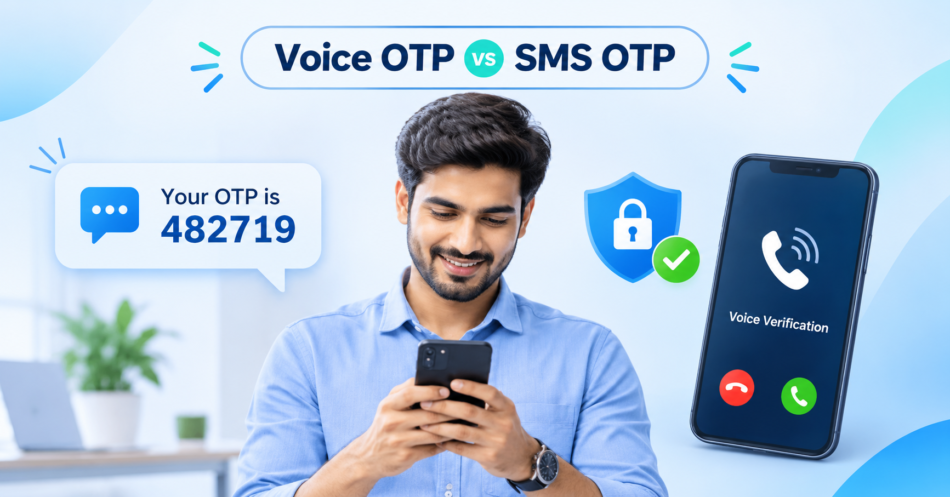
Last month I was stuck outside a login screen for ten minutes. I was in a moving train, there were no signals, and the OTP did not appear despite me clicking “resend” four times. Finally, I gave up and used another application to place an order.
If you own a company, this is what should really scare you. Not only does it upset the customers but it also redirects them elsewhere.
This is why we are going to consider the two most popular methods – SMS OTP and voice OTP.
SMS OTP: Fast and Familiar
The text code is the primary one since it is fast, cost-effective, and everyone knows how to deal with a simple six-digit code.
Quick check: What Is a Voice API for Business? Benefits, Use Cases, and How to Choose the Right Platform
However, SMS communication does have flaws such as delays, filtration as spam or poor reception, operator policies and DLT obligations included. When the user does not receive the message with the code, they never blame the operator but you.
Voice OTP: The Backup Plan That Works
Voice OTP involves a phone call from your company with a reading of the code. There is no need for an inbox or any special application or data connection since the user picks up the call and listens.
It is especially useful for those living in areas with poor signal coverage, older customers who have trouble texting and those visually impaired. Moreover, there is OTP voice call verification with multilingual voice outreach: you can provide the code in the language of the customer in such diverse countries as India.
Quick Comparison
| SMS OTP | Voice OTP | |
| Speed | Very fast | A little slower |
| Cost | Lower | Slightly higher |
| Weak network reliability | Moderate | Strong |
| Accessibility | Needs reading | Easy for everyone |
| Language options | Limited | Flexible |
So, Which One Should You Pick?
It all comes down to the stakes involved.
SMS-based delivery is ideal for high-frequency, low-stakes scenarios such as app registration, notifications of order status changes, and logins. For high-stakes scenarios like banking, insurance, health care, and fintech operations, voice-based delivery would be a much better choice.
The truth is, however, the right approach is usually a combination of both approaches – start with an SMS-based delivery. If after about 30 seconds there is no input, initiate an automated OTP call. You will be able to combine the convenience of texting with the reliability of voice communication and decrease the number of abandoned attempts.
For that purpose, you will need a reliable Voice API for business. A proper voice calling platform for business will enable you to deliver OTP codes, payment reminders, and other notifications from one console. Moreover, many such solutions offer outbound voice campaigns platform and voice broadcasting for enterprises capabilities.
Final Thoughts
SMS is more affordable and faster. Voice is more reliable, accessible, and credible. Why pick only one when you can have both? If you are interested in partnering up to do this the right way, consider working with Pingverse, a company that can provide voice-based solutions to make the process of verification seamless.
Looking for a solution to deliver verification codes via voice call? Contact Pingverse to learn about voice OTP services.
FAQs
Is voice OTP more secure than SMS?
It is free from some risks, but nothing is foolproof. It should be used in combination with other security methods.
Is it slower than SMS?
A bit yes, which is the reason why it serves as a good back-up mechanism.
Can it support different languages?
Yes, many voice OTP platforms provide support for multiple languages.
Is it costly?
Yes, a bit, but the cost will be lower because you use it only as a back-up mechanism.
Can the same platform be used for marketing calls?
Yes, in most cases. The platform supports other uses as well such as broadcasting messages.


