 WhatsApp Us Now

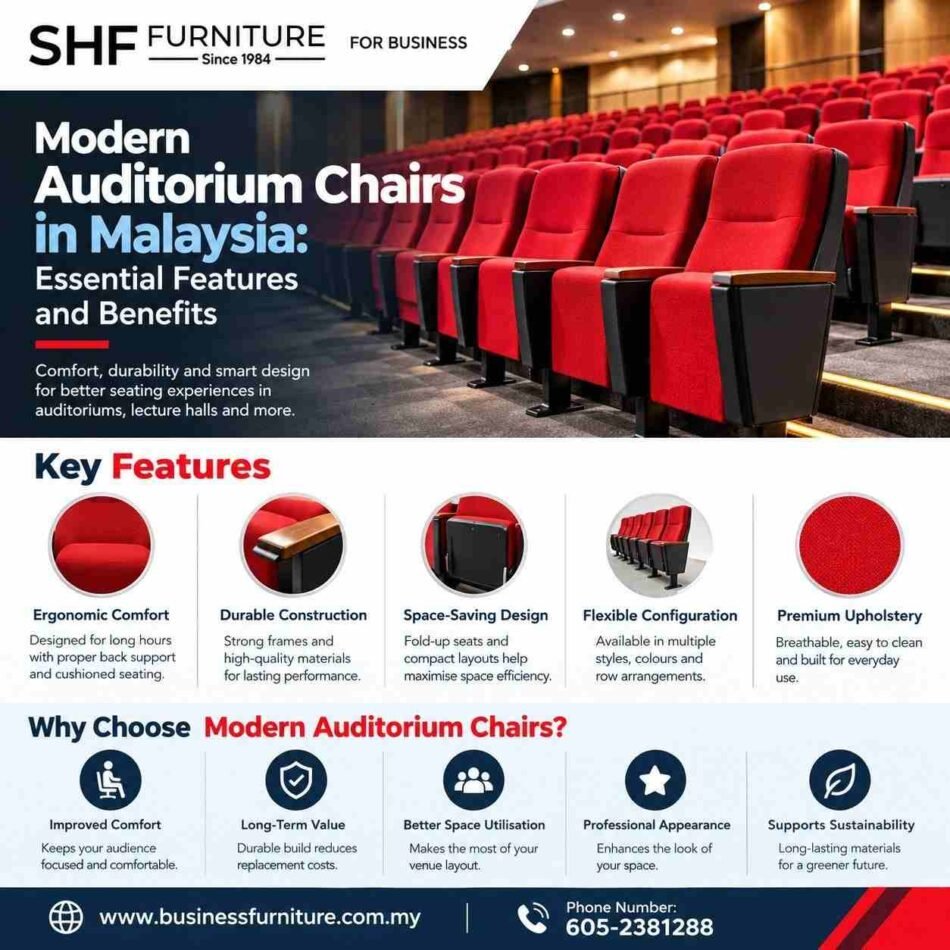
If you are searching for a reliable auditorium chair supplier in Malaysia, you need to focus on aspects like product quality, material durability, customisation options, safety standards compliance, and after-sales support. When engaging a supplier, procurement teams should first assess the supplier’s experience, project references, delivery timelines, and installation capabilities. For schools and large venues the choice of a supplier able to offer end-to-end project support will greatly reduce risk and long-term maintenance costs.
Why Supplier Selection Matters More Than the Chair Itself
It is easy to focus on aesthetics when specifying auditorium seating. The finish, the upholstery colour, the armrest style — these details matter. But the supplier behind the product determines whether your project is delivered on time, installed correctly, and supported years down the line.
Educational institutions, government agencies and commercial premises in Malaysia have been plagued by expensive delays and a poor after-sales experience from suppliers who underbid projects and underdelivered on execution. Buying the cheapest seats means you often end up with substandard seats that break down after a few years, fail safety inspections or simply are not what was advertized in the catalog.
Key Criteria for Evaluating an Auditorium Chair Supplier in Malaysia
1. Product Quality and Material Standards
Start with the basics. Chairs must meet structural and ergonomic requirements of your venue. Auditoriums in schools, universities and civic halls, which see a lot of traffic, require seating with durable frames, usually powder-coated steel or aluminum, and high-density foam, and commercial-grade fabric or leatherette upholstery.
Check with manufacturers for foam density specifications. For long periods of lecturing or performing, foam density of at least 40-45 kg/m³ is recommended to keep comfort and shape in time. Under normal use, the weak foam compresses in 12 to 18 months, leading to uncomfortable seating and expensive replacements.
Verify that the supplier’s products comply with SIRIM or any other relevant Malaysian Standards. Compliance means the product has been tested independently and meets local standards for safety and durability.
2. Experience with Educational and Institutional Projects
Not all furniture suppliers understand the unique demands of institutional projects. Schools, universities and government auditoriums are not corporate venues. They have different aisle widths , seating arrangements , row spacing , and accessibility requirements .
When considering an auditorium furniture supplier Malaysia, request a portfolio of previous educational or institutional projects. Verified project references, especially from local universities, polytechnics or government buildings, are a strong indicator of relevant experience.
If the venue is a public institution, look out for suppliers who are familiar with compliance with the Malaysian Standard MS 1184:2014 (accessibility design for persons with disabilities). Suppliers with less experience are often poor at planning where to place accessible seating and companion spaces.
3. Customisation Capabilities
Many auditoriums have their own spatial constraints. Tiered flooring, curved rows, narrow aisles or brand-specific color requirements all require a supplier who can offer customisation rather than simply off-the-shelf products.
- A good auditorium seating supplier should offer:
- Bespoke upholstery in institution colors or materials
- Seat numbering and row label options
- Adjustable row spacing to fit your layout
- Storage under the seat or writing tablet arms
- Folding or retractable seating systems for multi-purpose halls
Before placing any bulk order, request a sample or a visit to the showroom. What looks polished in a brochure can look very different in person.
4. Bulk Order Capacity and Lead Times
For large scale fit-outs, the procurement teams need to be assured that the supplier will be able to meet bulk orders for auditorium chairs on schedule for the project.
Ask them directly, What is the min and max order volume you can handle? What is the standard lead time for a 300 seat auditorium? Do you have stock locally or is everything made to order from overseas?
Suppliers that rely entirely on imported stock with no local buffer inventory introduce timeline risk, especially since port congestion and customs delays have been a consistent issue in Malaysia’s supply chain since 2020.
5. Installation Services and Project Support
Providing the product is half of the job. Installing auditorium seating – anchoring it to the floor, getting the rows aligned, load testing – requires skilled technicians, not just general laborers.
- Kindly confirm if the supplier supplies:
- Pre-manufacturing site measurement and layout planning
- Trained professional installation
- Project management support for phased/large scale installations
- Inspection and snagging post-installation
A supplier able to deliver a turnkey project – from space planning through to final handover – removes a huge amount of coordination work from procurement teams and minimizes the risk of errors in installation.
6. Warranty, Spare Parts, and After-Sales Support
Auditorium seating is a long-term investment. A 500-seat auditorium represents a significant capital expenditure, and you need confidence that the supplier will still be there when a component fails three years later.
Evaluate the supplier’s warranty terms carefully. A reputable educational furniture supplier should offer a minimum of two to three years’ warranty on structural components and provide access to spare parts such as replacement upholstery panels, seat mechanisms, and armrest assemblies.
Ask whether they have a local service team in Malaysia or rely on overseas support. Local service capability is critical for fast resolution of warranty claims and routine maintenance requests.
Supplier Evaluation Comparison Table
| Evaluation Criterion | What to Look For | Red Flags |
|---|---|---|
| Product Quality | SIRIM compliance, foam density specs, durable frame materials | No certifications, vague material specs |
| Project Experience | Verified institutional references, educational sector portfolio | No prior institutional projects, residential-only experience |
| Customisation | Flexible upholstery, layout, and configuration options | Fixed catalogue only, no bespoke options |
| Bulk Capacity | Local inventory or confirmed manufacturing capacity | Entirely dependent on overseas stock |
| Installation | Trained technicians, turnkey delivery, post-install snag support | Delivery-only, no installation offered |
| After-Sales Support | Minimum 2–3 year warranty, local service team, spare parts availability | Short warranty, overseas-only support |
Questions to Ask Before Signing Any Supply Agreement
Before committing to a supplier, procurement teams should request formal responses to the following:
- Can you provide three verified references from similar institutional projects in Malaysia?
- What is your lead time for a 400-seat order, and what contingencies exist for delays?
- Do you carry local stock, or are chairs manufactured to order?
- Who handles installation, and are your installers employed or subcontracted?
- What does your warranty cover, and how are claims handled locally?
- Can we visit a completed project site before finalising the order?
Suppliers who hesitate on any of these points, or who cannot provide documentation, should be treated with caution regardless of their pricing.
Local Procurement Considerations for Malaysian Institutions
In Malaysia, public universities and government-linked institutions must often source from Bumiputera-certified suppliers or Ministry of Finance procurement guidelines. Procurement teams should check if a supplier has the relevant MOF registration and can provide the necessary tax invoices and delivery documentation for audit purposes.
Private institutions have more leeway but should still give priority to suppliers who can show they are based locally, have a registered business address and a steady record of service in Malaysia. Sourcing from a local supplier reduces currency risk, and makes dispute resolution easier, and response times faster than sourcing from a foreign manufacturer directly.
Making the Final Decision
Identify 2-3 vendors that satisfy the evaluation criteria outlined above. If you can, ask for physical samples or visit a showroom to get a feel of the build quality yourself. It is good procurement practice for large projects to do a pilot order of 20 to 50 units before full commitment.
Look at the total project cost, not just the unit price. Also remember to consider delivery, installation, any floor preparation needed and the value of post sales support. A supplier who charges 10% more for a chair but offers full installation and a three-year warranty is often better value for the life of the product.
SHF Furniture provides a range of auditorium seating solutions for institutions and contractors seeking a reliable local partner. We have project experience in the Malaysian educational sector, and we offer customisation options and professional installation support to meet the needs of different venues.
Frequently Asked Questions
What should I look for in an auditorium chair supplier in Malaysia?
Find suppliers with institutional project references, strong specifications of products, ability for customisation and local installation team. Before signing any supply contract, check warranty terms and availability of spare parts.
How do I evaluate the quality of auditorium chairs before bulk purchase?
Ask for physical samples. Check foam density (minimum 40-45 kg/m3 for institutional use). Check frame materials and upholstery quality in person. If you can, visit a completed project site to see how it has stood up over the long haul.
Do auditorium chair suppliers in Malaysia offer installation services?
A lot of established suppliers offer full project support from on-site measurements, floor anchoring, row alignment to post-installation inspections. Always check if installation is included or charged separately before you finalize your quote.
What warranty should I expect from a reputable auditorium seating supplier?
Look for a reputable supplier that provides a minimum two to three years’ warranty on structural components, with local spare parts availability and a Malaysian-based service team that can respond quickly to claims and maintenance requests.
Can auditorium chairs be customised for school or university branding?
Yes. Most established suppliers offer custom colors for upholstery, seat numbering, writing tablet configurations and row spacing changes. Check for customisation options at the quotation stage and ask for samples before approving bulk production.
Are there procurement regulations for educational institutions buying auditorium furniture in Malaysia?
Public institutions are subject to Ministry of Finance procurement guidelines and may be required to purchase from suppliers registered with the MOF. Private institutions have more freedom but still have to check the registration, tax documents and local business credentials of the suppliers.


