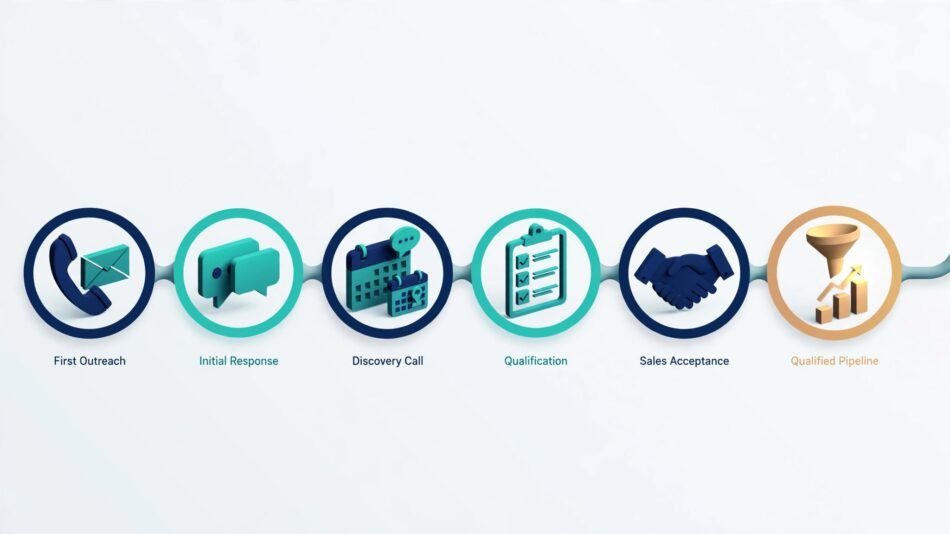
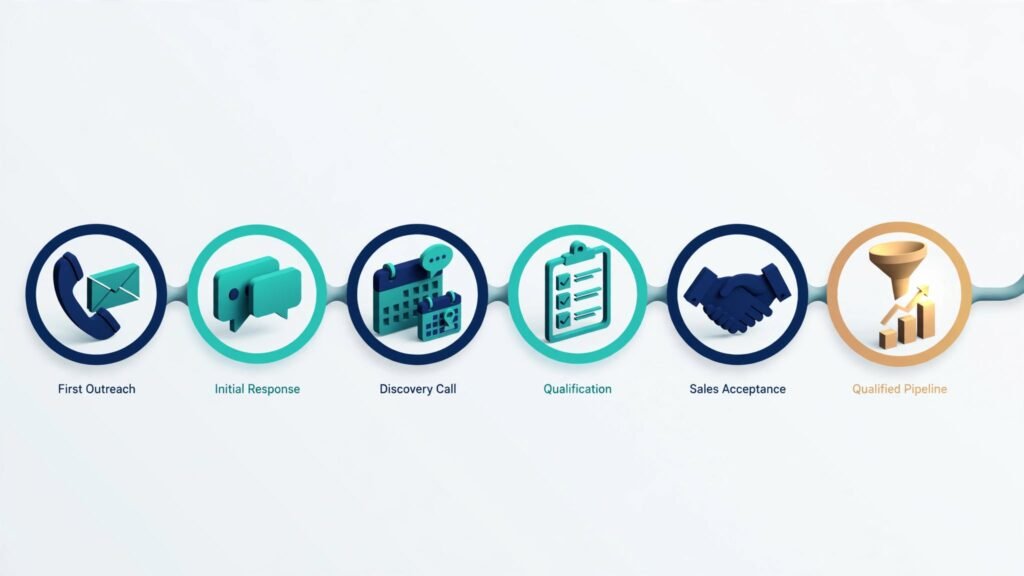
B2B lead generation services turn a first call or email into qualified pipeline through six handoffs: outreach, reply, discovery conversation, qualification, sales acceptance and opportunity creation. Pipeline is only “qualified” once a seller accepts the account against agreed criteria. Anything earlier is activity, not pipeline.
Most disappointment with lead generation happens at the handoffs, not at the first call. Replies go unanswered, meetings are held with the wrong person, or sellers and providers define “qualified” differently.
This guide follows one account from first touch to pipeline and shows what should happen at each step.
What Does “Qualified Pipeline” Actually Mean in B2B Lead Generation?
Qualified pipeline is the value of opportunities that a sales team has accepted after checking fit, need, authority, and timing against written criteria. Effective B2B Lead Generation Services should distinguish qualified pipeline from leads or booked calls. The provider and client must agree on the definition before outreach begins; otherwise, their numbers will never match.
What is the difference between a lead, a meeting and an opportunity?
A lead is a contact showing possible interest. A meeting is a held conversation. An opportunity is an account the seller has accepted as a real buying possibility, with a stage, an owner and an estimated value. Each stage should carry its own count in reports.
Common labels follow the same ladder. Marketing-qualified leads, sales-qualified leads and sales-accepted opportunities describe progressively stronger evidence.
Which lead qualification framework should you use?
Use the simplest framework your sellers will actually apply. BANT checks budget, authority, need and timeline. MEDDICC adds metrics, economic buyer, decision criteria, decision process, pain and champion, and suits complex deals. Pick one, write it down and train on it.
Frameworks fail when they live in a slide deck. They work when every meeting brief and acceptance decision uses the same fields.
How Does the First Call or Email Create a Conversation?
A first touch earns a reply when it names a specific reason for contact, reaches the right role and asks one easy question. Most first touches do not convert alone. Sequences across email, LinkedIn and phone, spaced over several weeks, give a busy buyer more than one chance to respond.
What should a first call actually accomplish?
A first call should confirm the person owns the problem, test one hypothesis and agree a clear next step. It is not a pitch or a demo. If it ends with a booked discovery meeting, a referral to the right colleague or a clear “not now,” it has done its job.
Teams often search for cold calling services near me when they want faster conversations. Local presence can help with time zones and language, but call quality depends on research, script flexibility and training.
How many touches does it take to reach a buyer?
There is no universal number. Most programs use a multi-touch sequence over several weeks, mixing channels. The right count depends on deal size, role seniority and list size. Track replies by touch number in your own data rather than copying a published benchmark.
What Happens Between a Positive Reply and a Booked Meeting?
Between reply and meeting, someone must answer quickly, confirm fit in a few lines, offer calendar options and send a short confirmation. Delays here lose more interested buyers than weak copy does. One named owner and a response-time target for replies close this gap.
How fast should interested replies be answered?
As quickly as your team can reliably manage, ideally within the same working day. A widely cited 2007 MIT and InsideSales.com study found the odds of qualifying a lead were 21 times higher at five minutes than at 30 minutes. It studied inbound inquiries, so treat it as direction, not an outbound benchmark.
How Does Discovery Turn a Meeting Into a Qualified Opportunity?
Discovery is a structured conversation that tests fit, pain, authority, timing and next steps. The seller records answers against the agreed framework, then accepts or rejects the account. A meeting only counts as qualified if it passes that check, not simply because it happened.
What should a meeting brief include?
A strong brief includes firmographics, the contact’s role, the trigger behind outreach, the reply history, objections raised and the agreed next step. Sellers who read it first skip basic questions and use the call for the buyer’s real situation.
A usable brief has these fields:
Account name, size, industry and region
Contact name, role and likely influence
The trigger or hypothesis that prompted contact
What the buyer said in their own words
Objections or concerns raised
Agreed next step and date
Who decides whether a meeting is qualified?
The receiving seller decides, using criteria both sides signed off in advance. The provider can pre-screen, but acceptance belongs to sales. A short written reason for each rejection teaches the provider what to change and keeps disputes factual.
How Should Handoffs Between Provider and Sales Team Work?
A good handoff has a defined format, a named recipient, a response-time target and a feedback loop. The provider sends a brief within hours of booking, the seller acknowledges it, and rejections return with reasons. Without these four parts, qualified meetings leak out unnoticed.
What should a handoff agreement cover?
Cover brief delivery time, seller acknowledgement time, rescheduling rules, an acceptance or rejection window, and who owns follow-up if the buyer goes quiet. Keep it to one page. Review the numbers together every month.
Many buyers look for B2B lead qualification services near me to speed up this step. Proximity helps with shared calendars, but a written handoff format matters more than the provider’s address.
Want to see what a handoff brief and acceptance criteria look like for your market? The Global Associates can share a sample structure and adapt it to your sales process. Request a sample handoff brief →
How Do You Measure Progress From First Touch to Pipeline?
Measure each handoff separately: delivered messages, replies, positive replies, meetings held, accepted opportunities and pipeline value. The conversion between stages shows where the process leaks. Reporting only meetings hides whether those meetings were any good.
Which stage-to-stage rates matter most?
Watch positive reply rate, meeting-held rate, meeting-to-opportunity rate and opportunity-to-customer rate. Compare each with your own earlier results rather than a generic benchmark, since healthy rates vary by market, deal size and region. A drop at one stage points to a specific fix.
What is a sensible reporting rhythm?
Review activity and reply themes weekly, stage conversion monthly, and pipeline and revenue quarterly. Weekly checks catch deliverability or messaging problems early. Quarterly reviews judge whether the pipeline is turning into customers, which is the only proof that matters.
How Does a Provider’s Quality System Affect Pipeline Quality?
A mature quality management system makes lead qualification repeatable: criteria are written, data checks are routine and corrective actions are logged. Process maturity cannot guarantee results, but it reduces random variation between campaigns and between team members. Review certification scope, audit cycle and data handling together.
Standards such as ISO 9001 are audited by an accredited certification body, often one accredited through an IAF MLA signatory, with a surveillance audit each year. ISO 27001 covers information security management, which matters when a provider handles contact data.
Neither standard replaces a compliance framework for privacy law. They show how the provider manages its own work, not whether your pipeline will grow.
Which questions reveal real process maturity?
Ask how qualification criteria are written, how contact data is checked before sending, how a bad batch is traced and fixed, who reviews meetings before handoff and how often the process is audited. Specific answers with examples show maturity. General answers do not.
Which Engagement Model Fits: Appointment Setting Only, Full-Funnel or Hybrid?
Appointment setting only suits teams with strong sellers and a defined ICP. Full-funnel adds research, outreach, qualification and nurture under one accountable partner. Hybrid splits tasks between provider and in-house staff. Choose by who owns qualification and follow-up.
An appointment-only model is the lightest. It books meetings and leaves qualification and nurture to you, so it works when your team can screen quickly.
Full-funnel work covers more of the path, but it needs clear acceptance criteria. Hybrid arrangements work when you want to keep control of qualification and outsource research and first touches.
The Global Associates is a B2B lead generation company specializing in AI-powered outbound engines for predictable pipeline growth. Its TGA Outreach™ Engine includes human verification of every contact before outreach begins, and the company holds ISO 9001:2015 certification.
What Is the Fastest Way to Start Building Qualified Pipeline?
Agree the definitions first, then run a small test with named owners, handoff rules and stage reporting. Starting with definitions prevents most disputes later. A small test shows which segment and message deserve more budget before you commit to scale.
Write down what counts as a lead, a meeting and an opportunity. Name who answers replies, who accepts meetings and who reviews the numbers.
If those pieces exist, outreach has somewhere useful to land. If they do not, more outreach will only add volume to a leaky process.
Ready to map your stages from first touch to accepted pipeline? Talk to The Global Associates about definitions, handoffs and reporting for your sales process. Map your pipeline stages with us →
What Are the Most Common Questions About B2B Lead Generation Pipelines?
These answers cover definitions, ownership, local versus remote delivery and pipeline quality. Each one stands alone, so you can jump to the question that matches your situation.
How long does it take to turn a first call into qualified pipeline?
It depends on your sales cycle and how fast replies are handled. A first accepted opportunity often takes several weeks after the first touch, while revenue follows the buyer’s approval process. Track the time between stages in your own data and look for the slowest handoff.
What is the difference between an MQL, an SQL and a sales-accepted opportunity?
An MQL shows interest that marketing judges promising. An SQL has passed a sales-side check for fit and need. A sales-accepted opportunity is an account a seller has formally taken on, with a stage, owner and value. Each step adds stronger evidence.
Who should own lead qualification: the provider or the client?
Usually both, at different points. The provider pre-screens against written criteria, and the client’s seller makes the final acceptance decision. Shared ownership works only if the criteria are agreed in advance and every rejection returns with a short reason.
Is cold calling still effective for B2B lead generation?
It can be, especially when combined with email and LinkedIn and aimed at roles that answer their phones. Results depend on list quality, research and the first-call goal. Treat calling as one channel in a sequence, and measure it against your own reply and meeting data.
How do you reduce no-shows for qualified meetings?
Confirm the meeting right after booking, send a short agenda and a reminder, and make rescheduling easy. Share the buyer’s context with the seller beforehand. A buyer who knows why the call matters is more likely to attend than one who accepted a vague invite.
Does a provider’s location affect first-call quality?
Slightly, through time zones, language and accent fit. Searches such as inside sales outsourcing near me return local firms, which may help with live-hours coverage. But research quality, training and scripts shape the call more than the office address does.
What should you do with leads that are not qualified yet?
Record why they were not ready, such as timing, authority or budget, and set a date or trigger to revisit them. Move them to a nurture list instead of deleting them. Many accounts become relevant after a hire, funding event or contract renewal.
How can you tell whether pipeline is real or inflated?
Check the acceptance rate, the written stage definitions, the rejection reasons and the share of pipeline that reaches closed-won. If meetings are high but acceptance is low, the qualification criteria are not being applied. Pipeline that never closes deserves a closer look.
 WhatsApp Us Now