 WhatsApp Us Now

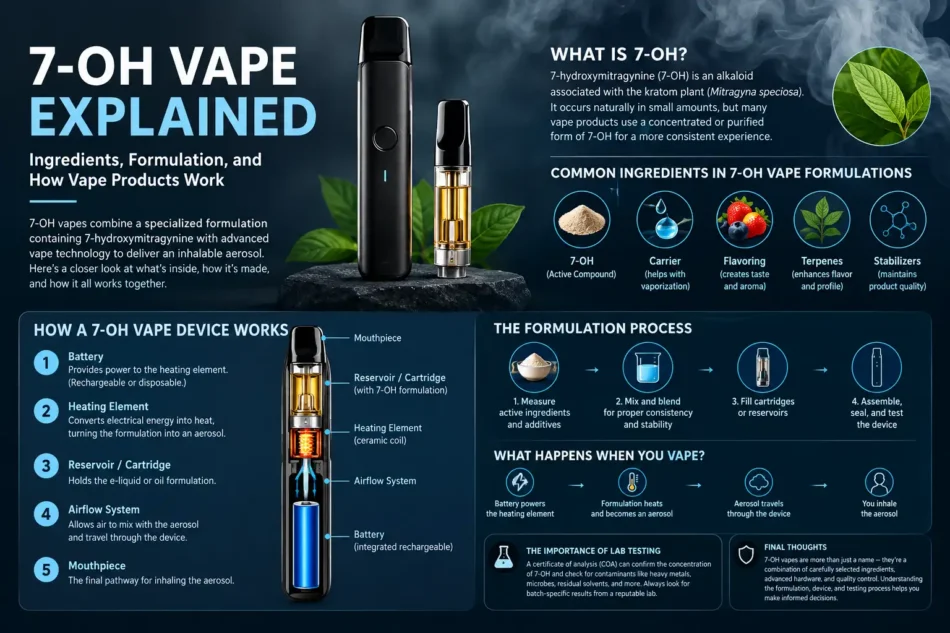
The growing interest in 7-OH products has also brought attention to vape formulations containing 7-hydroxymitragynine. These products can look similar to other disposable or cartridge-based vape products, but their formulations may be quite different.
Understanding what is inside a 7-OH vape starts with examining the active compound, supporting ingredients, concentration, and manufacturing process.
The Active Ingredient: 7-Hydroxymitragynine
7-hydroxymitragynine is an alkaloid associated with Mitragyna speciosa, commonly known as kratom. It is one of the naturally occurring alkaloids identified in kratom and is structurally related to mitragynine.
Although 7-OH occurs naturally in the plant, products marketed specifically as 7-OH products may use concentrated material.
This distinction matters because the chemical composition of a concentrated product can be substantially different from that of raw botanical material.
Formulation Is More Than the Active Ingredient
A vape formulation needs a medium that can be heated and aerosolized. As a result, the final product may contain several ingredients beyond the primary active compound.
Depending on the product, these may include:
- A carrier or base
- Flavoring ingredients
- Botanical-derived aromatic compounds
- Stabilizers
- The active 7-OH component
The exact formulation should always be determined from the manufacturer’s ingredient disclosure and laboratory documentation.
Why Carrier Ingredients Matter
Carrier ingredients are used in many vape formulations to help create a liquid that can be delivered through a heating system.
However, an important distinction exists between ingredients designed for oral consumption and ingredients intended for inhalation. The fact that a substance is commonly used in food or cosmetics does not automatically establish that it is appropriate to inhale after heating.
For this reason, the intended route of administration should be considered when evaluating any vape formulation.
Flavoring and Aromatic Compounds
Some 7-OH vape disposables are offered in different flavor profiles. These flavors may come from food-grade or other commercially available flavoring compounds.
Again, “food grade” does not necessarily mean “safe to inhale.” Heating can change the chemical behavior of some compounds, and the resulting aerosol may contain substances that were not present in the original liquid.
Consumers should therefore look for manufacturers that clearly disclose ingredients and provide appropriate product testing.
How Concentration Is Reported
Concentration can be presented in several ways, including milligrams per milliliter, total milligrams per device, or percentage by weight or volume.
These measurements should not be confused.
For example, the total amount of a compound in an entire device is different from its concentration in each milliliter of formulation. Understanding the label requires checking exactly what unit the manufacturer is using.
A batch-specific certificate of analysis can help verify the stated concentration.
What Does a Laboratory Report Show?
A certificate of analysis, commonly called a COA, is intended to document laboratory testing performed on a particular sample or batch.
Depending on the laboratory and testing program, a report may provide information about:
- 7-OH concentration
- Other detected alkaloids
- Heavy metals
- Microbial contamination
- Residual solvents
- Other chemical contaminants
Not every COA tests for the same substances, so the testing panel matters.
A report that only confirms cannabinoid or alkaloid concentration, for example, does not necessarily establish the absence of every possible contaminant.
How the Vape Hardware Works
The hardware generally consists of a battery, heating element, reservoir, airflow pathway, and mouthpiece.
When activated, the battery sends power to the heating element. The formulation is heated and converted into an aerosol, which travels through the device and is inhaled.
Some devices are draw-activated, while others use a button. Rechargeable models may use USB charging, while disposable products may have a fixed battery.
Why Temperature Is Important
The heating temperature can influence how a formulation behaves.
Too little heat may result in inefficient aerosol production, while excessive heat can potentially contribute to degradation of ingredients or the formation of unwanted compounds.
The actual temperature reached by a device can depend on its heating element, battery output, airflow, resistance, and design.
Because consumers generally cannot measure the internal coil temperature during normal use, product design and manufacturing controls become important considerations.
Product Quality and Manufacturing
Two products carrying similar labels can have very different formulations and manufacturing standards.
Factors such as raw-material purity, batch consistency, hardware quality, filling accuracy, storage conditions, and laboratory testing can all affect the finished product.
This is why a product name alone does not provide enough information to determine its composition.
Legal and Safety Considerations
The legal status of 7-OH and products containing it differs across jurisdictions and can change as regulations develop.
There are also important differences between inhaled products and products intended for oral use. Consumers should check current local requirements and carefully review product labeling and laboratory documentation.
Final Thoughts
A 7-OH vape is more than an active ingredient inside a disposable device. Its formulation may include a carrier, flavoring components, and other ingredients, while the hardware controls how that formulation is heated and aerosolized.
For a clearer understanding of a specific product, examine its complete ingredient list, concentration information, device specifications, and batch-specific laboratory testing rather than relying on the product name alone.


