 WhatsApp Us Now

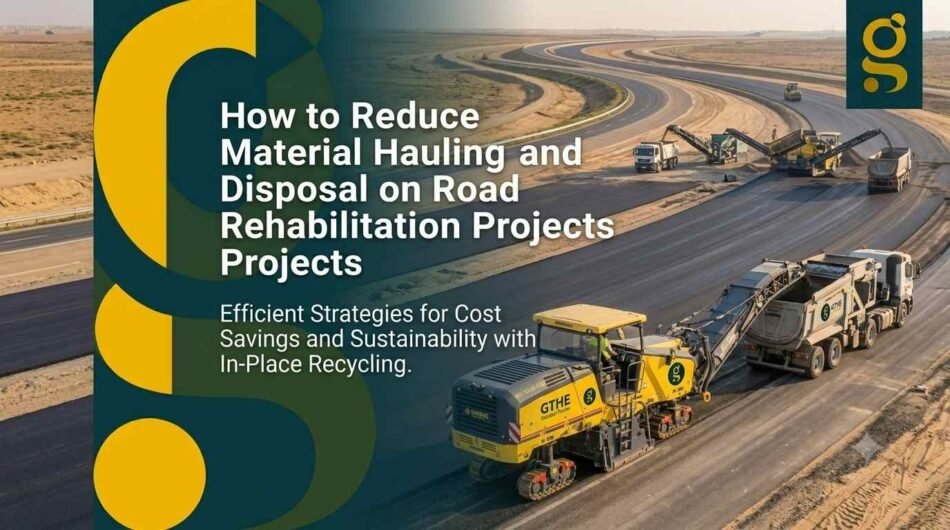
Road rehab contractors waste money hauling waste. Discover how a soil stabilizer machine and in-place material recycling can cut disposal costs, reduce truck traffic, and improve project logistics on your next road rehabilitation job.
Every road rehabilitation project has the same hidden cost that most contractors underestimate: hauling and disposal. Truckloads of excavated material leaving the site, tipping fees, disposal permits, and the need to import fresh material to replace what was removed. It’s a double hit to the budget and the timeline. But what if you could recycle 80–90% of the material already on site? A soil stabilizer machine makes this possible, turning waste into usable base and subbase layers without leaving the jobsite.
The economics are compelling. For a typical 2-mile road rehabilitation project, eliminating import/export hauls saves contractors tens of thousands in transportation and tipping fees. The environmental footprint shrinks. Project timelines compress. And the work quality actually improves because you’re optimizing the material you have rather than relying on generic off-site stockpiles.
The Real Cost of Hauling and Disposal
Let’s be direct: most contractors treat hauling and disposal as a line item to be minimized. In reality, it’s one of the largest uncontrolled expenses on a road rehab project.
Here are the typical pain points:
🚛
Truck Logistics
Coordinating haul-off operations, waiting for trucks, managing traffic control around removal activities
💰
Tipping Fees
Landfill or disposal facility charges—often $15–$50 per ton depending on material type and location
📦
Import Costs
New base and subbase material sourced from quarries, plus transportation and placement labor
⏱️
Timeline Drag
Excavation, haul-off, waiting for imported material, and placement all add days to the critical path
On a 2-mile road with a 12-foot pavement width, you might need 3,000–4,000 tons of material moved. At typical tipping fees and transport costs, that’s $40,000–$80,000 in disposal and replacement alone. Some projects see even higher numbers depending on regional hauling rates and landfill availability.
Real Example
A contractor working on a 1.5-mile urban street rehab in a congested area faced $85,000 in hauling costs alone—not including tipping fees. The project timeline was stretched because trucks were queued all day. By switching to in-place recycling with a soil stabilizer machine, they cut hauling to a single day of final disposal, saved $60,000+, and compressed the overall schedule by 2 weeks.
How a Soil Stabilizer Machine Changes the Equation
A soil stabilizer machine works on a simple principle: pulverize and remix existing road material in place, add a stabilizing agent (cement, lime, or polymer), and create a compacted base layer that meets design specifications. Nothing leaves the site. Nothing expensive is imported.
The typical workflow looks like this:
1Excavate existing pavement and subgrade material (typically 6–10 inches deep)
2Stabilizer machine operates on the excavated material, pulverizing and mixing it evenly
3Stabilizing agent injected (cement or lime slurry) during the mixing process
4Compacted layer created in place, meeting CBR (California Bearing Ratio) requirements for your design
5New asphalt layer placed directly on the stabilized base—zero off-site material needed
This approach works well when the existing material is suitable for stabilization—most recycled asphalt, granular bases, and suitable subgrades qualify. Even material with some fine content can be stabilized effectively with the right additive dosage.
The Economics: Where You Actually Save Money
Here’s a cost comparison for a typical road rehab scenario (2-mile section, 12-foot width, 8-inch base layer):
| Cost Factor | Haul-and-Replace Method | In-Place Stabilization |
|---|---|---|
| Excavation | $8,000 | $8,000 |
| Hauling & Disposal | $55,000 | $2,000 (final cleanup only) |
| Imported Base Material | $42,000 | $0 |
| Stabilizer Machine Rental | N/A | $12,000 |
| Stabilizing Agent (Cement) | N/A | $5,000 |
| Compaction & Labor | $18,000 | $16,000 |
| TOTAL | $123,000 | $43,000 |
In this scenario, in-place stabilization saves roughly $80,000—a 65% reduction. Even accounting for equipment rental and stabilizer agent, the math is overwhelmingly in favour of recycling existing material.
Beyond Cost: Logistics and Schedule Benefits
The financial savings are obvious. The operational benefits are equally important:
Reduced traffic disruption: Instead of weeks of dump truck queues, the stabilizer machine works in a continuous forward pass. Fewer trucks, less congestion, faster completion.
Improved CBR performance: Material stabilization actually improves the load-bearing capacity of the base layer. You’re not just recycling—you’re engineering a stronger foundation.
Consistent material quality: Stabilized layers have uniform properties throughout. No surprises from variable quarry material or inconsistent placement.
Reduced environmental footprint: No landfill waste, no quarry extraction, no long-distance hauls. The carbon impact is measurably lower.
Frequently Asked Questions
Can you really recycle all the old pavement, or does some of it have to be hauled away?
Most of it can be recycled, typically 80–95% depending on the material composition. Asphalt chunks, granular base, and compacted subgrade material all respond well to stabilization. What doesn’t typically get recycled: extremely contaminated material, concrete rubble with reactive aggregates, or clay-heavy subgrades that don’t meet grading specifications even after stabilization. A soil engineer can assess the existing material on site and tell you what percentage is suitable for in-place recycling. That said, even in challenging conditions, you can usually recycle more than 60% of what’s excavated—which still provides substantial cost savings compared to hauling everything away.
How long does it take for stabilized material to cure before you can pave over it?
With cement stabilization, you typically wait 3–7 days for the material to develop adequate strength before placing the asphalt layer. Lime stabilization takes longer—usually 7–14 days—because lime works more slowly than cement. Modern specifications often allow prime coat application after 3 days if weather conditions are good. Hot-mix asphalt can go down slightly sooner than cold-mix overlays. The exact timeline depends on your engineer’s design and local DOT specifications. In most cases, this 3–7 day cure window doesn’t add time to the overall project schedule because other work (final grading, side work, utility coordination) can proceed in parallel.
Is soil stabilization cost-effective for smaller projects, or only for major highway work?
It works for projects as small as a few blocks of city street. The break-even point is usually around 0.25–0.5 miles of road when you factor in equipment mobilization. Below that, the equipment rental and setup costs eat into savings. Above 0.5 miles, the payback is rapid and compelling. For parking lots or smaller commercial paving (under 20,000 square yards), traditional haul-and-replace might still make sense. But for any municipal street project longer than a few blocks, stabilization is almost always the smarter economics. Talk to local equipment rental companies about day-rates and mobilization fees to calculate your break-even for project scope.
Do you need special permits or environmental approvals for in-place stabilization?
Fewer permits than traditional haul-away, actually. You’re not generating truck traffic or using a disposal facility, which eliminates some regulatory requirements. However, you may need to notify your state’s environmental agency about the stabilizing agent (cement or lime additions) if there are strict material tracking rules in your jurisdiction. Most state DOTs and municipalities have embraced in-place recycling and have streamlined approval processes. The real key is getting your design engineer to specify stabilization in the contract documents and having the soil bearing test data available for inspection. Some cities require pre-project notification, but approval is usually routine for established methods.


