 WhatsApp Us Now
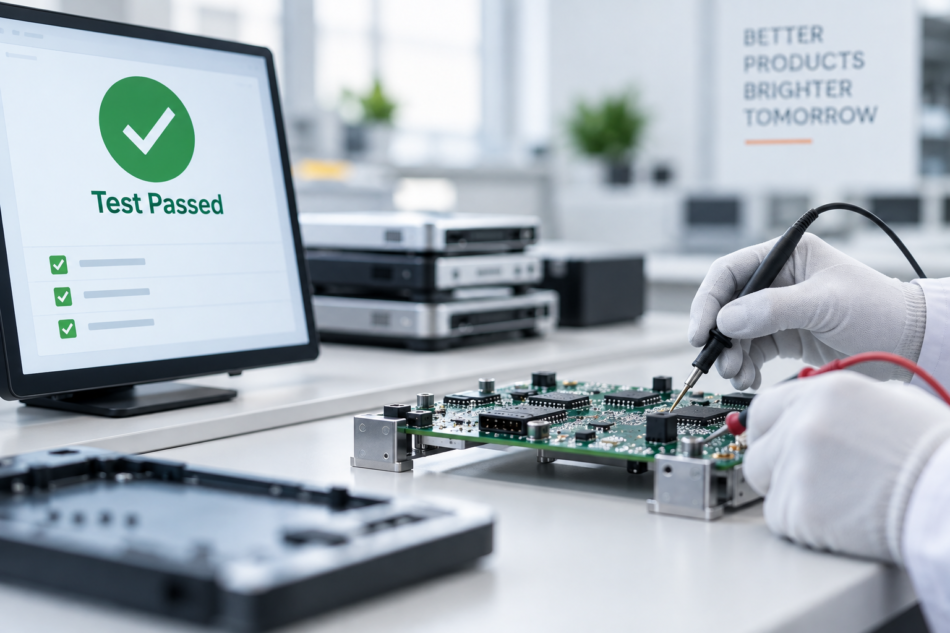
A prototype can look perfect on the workbench and still fail when production starts. A connector may loosen under vibration, a power section may run hotter than expected, or a component that worked reliably in a small batch may become difficult to source at scale.
Finding these problems after tooling, procurement, and production commitments are in place can get expensive fast. That is why hardware testing services need to be part of the path to mass production, not an afterthought.
Testing before scale changes the economics
Validation for OEMs is not about proving that a board works but about understanding the way a board behaves in operating and manufacturing environments.
A useful testing plan typically covers:
- Electrical performance: Voltage, current, power consumption, signal integrity, and functional behavior.
- Environmental testing: Temperature, humidity, vibration, shock, and other conditions relevant to the application.
- Safety and compliance: Checks related to EMC, ESD, insulation, thermal performance, and applicable standards.
- Manufacturing validation: PCB assembly quality, solder joints, connector fit, programming, and functional test coverage.
- Reliability testing: Running products through stress conditions to expose weaknesses before customers do.
For instance, an embedded controller that is incorporated into an industrial device may pass the initial function test conducted at room temperature. Subject such a device to thermal cycling, vibration, and long run times, and a latent defect like a poor solder joint will reveal itself. That information is far more useful when the design team can still make changes.
Look beyond the PCB
Hardware validation should not stop at the circuit board. Mechanical and electrical decisions affect each other throughout the product.
A tightly packed enclosure can restrict airflow and create unexpected hotspots. A mounting point can transfer vibration directly to a PCB. A poorly chosen connector can make assembly harder while increasing the risk of field failures.
This is where product enclosure design becomes part of the testing conversation. Before proceeding with the production tooling process, teams must assess clearances, thermal paths, cable routes, fasteners, and service access.
The same principle applies to the BOM. The test results may reveal that a certain part is technologically suitable; however, its low availability or long lead times will make the production hard to scale. BOM optimization, approved alternates, and supply chain visibility should therefore sit alongside technical validation.
Turn test results into production decisions
The most effective test procedure does not just provide a pass-fail report; it gives useful information for engineering, sourcing, and manufacturing personnel to work with.
Before approving mass production, ask:
- Which components have the highest technical or sourcing risk?
- Are test points and fixtures sufficient for production volumes?
- Can the PCB assembly process consistently reproduce the prototype’s performance?
- Does product enclosure design support thermal, mechanical, and assembly requirements?
- What happens if a key component becomes unavailable?
- Which failures are acceptable, and which require a design change?
DFMA principles are particularly useful here. A design that works in a prototype shop may need changes to improve automated assembly, inspection, test access, or yield at higher volumes.
Good hardware testing services help uncover these issues while engineering changes are still relatively inexpensive.
Elecbits: From Hardware Testing to Production-Ready Electronics
Testing often uncovers issues that extend beyond the test report. A component may need to be replaced, the BOM may need an alternate part, a PCB layout may require changes, or the assembly process may need to be adjusted before production can move ahead.
Elecbits is a full-stack electronics design and manufacturer that brings these activities together across product engineering, component sourcing, PCB manufacturing, assembly, and testing. This gives hardware teams a connected workflow where findings from validation can be carried into the next stage instead of being passed between separate vendors.
Elecbits XOR, its AI-based BOM analysis solution, can help teams evaluate component availability, pricing, supplier information, and alternatives as designs evolve. Combined with its electronics engineering and manufacturing capabilities, this helps OEMs address technical and supply chain risks before they become production bottlenecks.
The practical gain for those teams that are preparing to scale is that testing is not just an end activity within the development process. It now forms part of a much broader feedback loop linking design with manufacturing and sourcing.
Conclusion
Mass production leaves little room for discovering basic design weaknesses. Once tooling is complete and thousands of components are committed, even a small failure can create rework, delays, or costly field returns. The better approach is to use hardware testing services to expose those risks while the design is still flexible.
From an OEM perspective, validation is not just an exercise in quality control. It provides assurance that future engineering, procurement, and manufacturing will be smoother when production goes into high gear.


