 WhatsApp Us Now

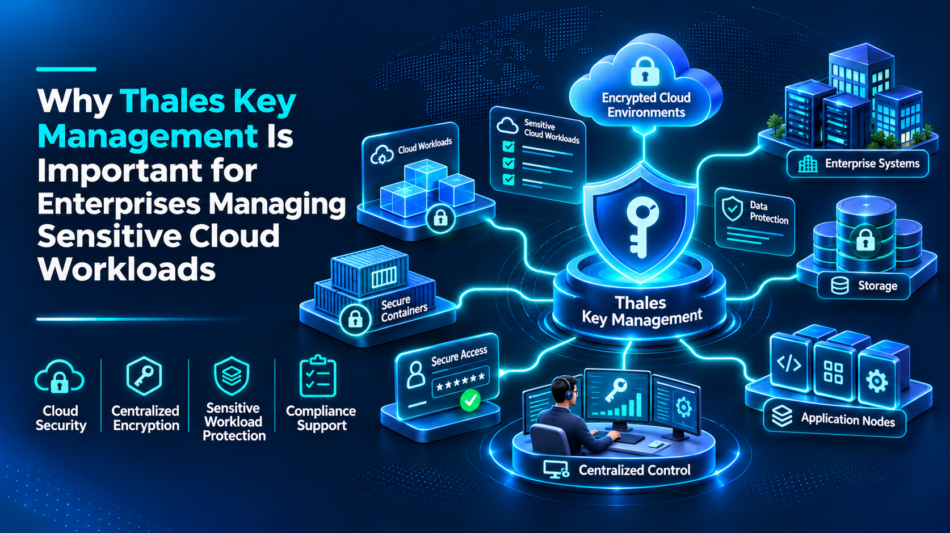
Cloud workloads increasingly process sensitive customer, financial, operational, and business information across distributed enterprise environments.Thales key management can help organizations establish centralized control over the cryptographic keys that protect these workloads
Introduction
Cloud computing has become an important part of enterprise IT infrastructure. Organizations use cloud platforms to host applications, databases, analytics systems, storage services, APIs, and other business workloads.
These workloads can process highly sensitive information.
A cloud-based application may handle customer records, financial transactions, employee information, intellectual property, or confidential business data. Protecting this information requires multiple security controls, including identity management, access control, monitoring, network security, and encryption.
Encryption provides an important layer of protection.
However, encryption relies on cryptographic keys. Organizations must therefore protect and manage these keys throughout their lifecycle.
This makes Key management essential for enterprises operating sensitive cloud workloads.
Thales key management can support organizations that require centralized management and governance of cryptographic keys across complex enterprise environments.
What Are Sensitive Cloud Workloads?
A cloud workload can include an application, database, service, virtual environment, or collection of cloud resources that performs a business function.
Sensitive workloads may include:
- Customer-facing applications
- Financial systems
- Payment platforms
- Enterprise databases
- Analytics platforms
- Healthcare-related business systems
- HR applications
- Backup environments
These workloads require strong protection because they process valuable information.
Why Encryption Matters for Cloud Workloads
Cloud environments store data across different infrastructure layers.
Organizations may encrypt:
- Databases
- Cloud storage
- Backups
- Application data
- File systems
- Communication channels
Encryption helps reduce the risk associated with unauthorized access.
However, cryptographic keys determine how encrypted information can be accessed.
Organizations must therefore protect the keys independently from the data.
Understanding Key Management in Cryptography
Key management in cryptography covers the lifecycle of cryptographic keys.
This includes:
- Key generation
- Key provisioning
- Key storage
- Key access
- Key usage
- Key rotation
- Key backup
- Key recovery
- Key retirement
- Key destruction
A cloud security strategy should consider every stage.
Why Centralized Key Management Matters
Cloud environments can become fragmented as organizations adopt multiple services and platforms.
Different applications may create different keys.
Without centralized governance, security teams may struggle to determine:
- Which keys exist
- What they protect
- Who owns them
- Which applications use them
- When they require rotation
- Whether they remain necessary
Centralized Key management can improve this visibility.
Thales Key Management
Thales key management can support organizations seeking centralized control over cryptographic keys across enterprise environments.
A centralized approach can help security teams establish policies for:
- Key ownership
- Access control
- Rotation
- Lifecycle management
- Monitoring
- Recovery
This can be valuable when sensitive workloads operate across cloud and hybrid infrastructure.
Protecting Cloud Databases
Cloud databases often contain highly sensitive information.
Organizations may encrypt:
- Customer records
- Transaction data
- Financial information
- Employee records
- Business information
The associated encryption keys require strong controls.
Key management can help organizations control these keys independently from the database infrastructure.
Protecting Cloud Storage
Cloud storage may contain documents, backups, application files, and business records.
Encryption can help protect this information.
Organizations should understand which keys protect each storage environment and who can access those keys.
A centralized approach can help security teams maintain better visibility.
Managing Application Keys
Cloud applications may use cryptographic keys for:
- Data encryption
- API authentication
- Digital signatures
- Secure communication
- Service-to-service authentication
Developers should not embed sensitive keys directly in source code.
Applications should use approved cryptographic services and controlled access mechanisms.
Least Privilege
Sensitive cloud workloads should follow least-privilege principles.
Users and applications should receive only the permissions necessary for their functions.
The same principle applies to cryptographic keys.
An analytics application should not automatically have access to encryption keys used by financial systems.
Key Rotation
Organizations should establish key rotation policies.
Rotation may depend on:
- Key age
- Security requirements
- Data sensitivity
- Risk
- Application architecture
- Suspected compromise
Security teams should understand application dependencies before rotating keys.
Key Backup and Recovery
Critical cloud workloads may depend on specific encryption keys.
If a key becomes unavailable, authorized users may lose access to protected information.
Organizations should maintain secure key backups and establish recovery procedures.
Recovery operations should require appropriate authorization.
Monitoring Key Activity
Security teams should monitor cryptographic activity across sensitive cloud workloads.
Important events include:
- Key access
- Key creation
- Key rotation
- Failed access attempts
- Administrative changes
- Key retirement
Monitoring can help identify unusual behavior.
Managing Multi-Cloud Workloads
Enterprises may use several cloud platforms.
One cloud provider may support customer applications while another hosts analytics or disaster recovery workloads.
This creates additional Key management requirements.
Organizations should establish common enterprise policies while adapting implementation to each cloud platform.
Protecting Backup Workloads
Cloud backups can contain large amounts of sensitive information.
Organizations may encrypt backup data to protect it.
The keys used for backup encryption should receive the same security attention as production encryption keys.
Businesses should also ensure that recovery procedures work before relying on them during an incident.
Supporting Governance
Centralized Key management can support enterprise governance.
Security teams can maintain records related to:
- Key ownership
- Access permissions
- Lifecycle status
- Rotation history
- Administrative actions
This information can support internal security reviews.
Common Challenges
Key Sprawl
Cloud environments can create large numbers of cryptographic keys.
Fragmented Management
Different cloud teams may follow different practices.
Excessive Permissions
Applications may receive unnecessary key access.
Limited Visibility
Security teams may not know where all keys reside.
Complex Recovery
Organizations may struggle to recover keys across distributed environments.
Best Practices
Organizations should:
- Maintain a centralized cryptographic inventory
- Assign key ownership
- Apply least privilege
- Separate keys from protected data
- Establish rotation policies
- Automate appropriate lifecycle processes
- Monitor key activity
- Protect key backups
- Test recovery procedures
- Review cloud application permissions
- Retire obsolete keys
- Integrate Key management with cloud security governance
Conclusion
Sensitive cloud workloads require strong protection because they process some of an organization’s most valuable information.
Encryption provides an important security layer, but cryptographic keys require dedicated lifecycle controls.
Thales key management can support centralized management and governance of cryptographic keys across cloud and enterprise environments.
Key management in cryptography provides the framework for managing keys throughout their lifecycle, while effective Key management improves visibility, access control, rotation, recovery, and monitoring.
By integrating centralized cryptographic controls with cloud security, identity management, least privilege, and continuous monitoring, enterprises can strengthen protection for sensitive cloud workloads.


