 WhatsApp Us Now
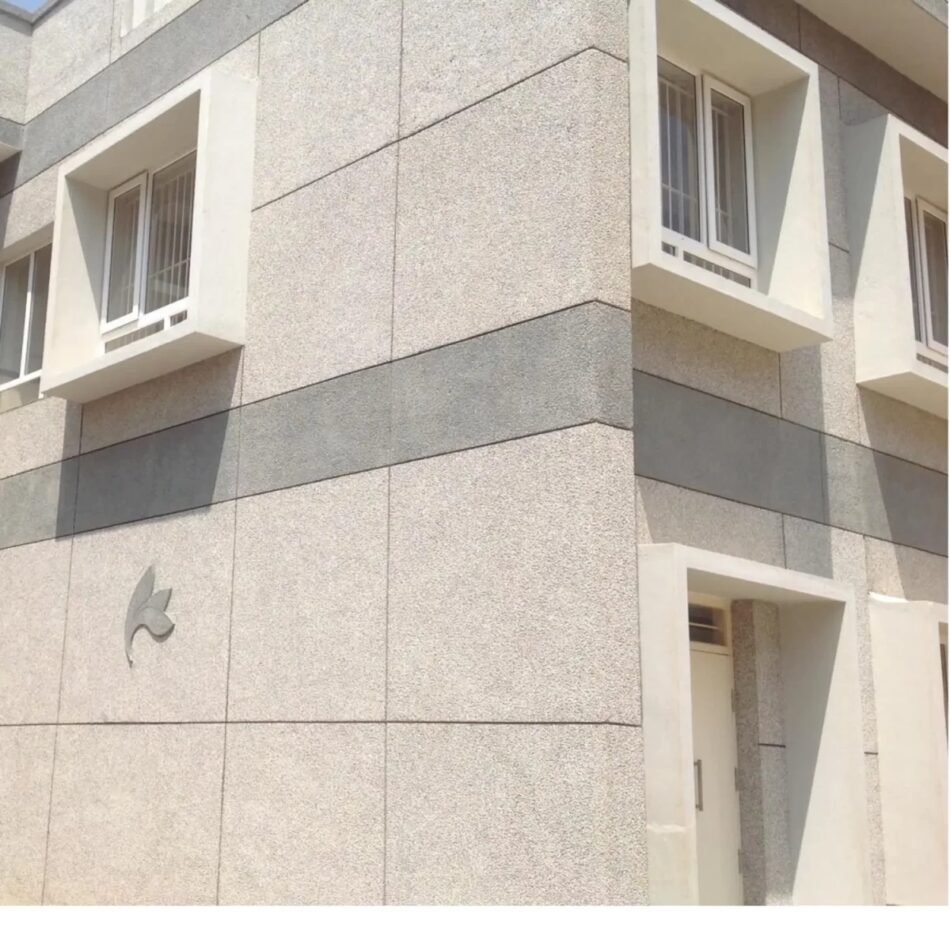
Exterior finish decisions get pushed to the last minute more often than they should. Structure gets all the attention, MEP gets all the attention, and then someone asks “what are we doing on the facade?” three weeks before handover. That’s usually too late to do it well. This is one reason more architects and builders in Karnataka are looking at stonecrete plaster for exterior walls in Karnataka while the project is still on paper, not after the walls are already up.
Here’s a plain look at what stonecrete plaster actually is, where it works well, where it doesn’t, and what’s worth checking before putting it on a drawing.
What Is Stonecrete Plaster and How Does It Work?
Stonecrete plaster is a textured exterior finish that mimics the look of natural stone, but it’s applied like plaster, not fixed like cladding. No cutting stone blocks, no mechanical anchors, no crane work for panels. Just layers of material troweled and textured onto a prepared wall.
That’s the whole appeal in one line: stone-like look, plaster-like process. Cheaper to move around a site, faster to apply, and it doesn’t add the dead load that stone cladding does.
The actual application is usually three stages: a base coat that levels the surface and helps everything stick, a textured middle coat that creates the stone pattern, and often a top coat for color and some weather protection. Every manufacturer’s version is a little different, so don’t assume one brand’s system behaves exactly like another’s. Ask for the data sheet. It matters more than the brochure photos.
Why Is Stonecrete Plaster Suitable for New Construction Projects in Karnataka?
It works well on new builds because it can be planned in from day one, applied by a normal plaster crew without special stone-fixing tools, and adjusted a bit for whatever substrate the site actually has.
Karnataka isn’t one climate. Mangalore is humid and salty. Bengaluru is dry most of the year with a couple of wet months. The Western Ghats get properly hammered by the monsoon. A finish that’s mixed and applied on-site has a small advantage here — the crew can adjust for local heat and humidity as they go, which isn’t really possible with a factory-made panel cut to one fixed spec.
The bigger point, though: putting stonecrete plaster on during original construction, not as a later add-on, means it can be planned alongside waterproofing and expansion joints. Retrofitting it onto an already-finished building is where many of the failures actually occur.
How Can Developers Use Stonecrete Plaster Across Different Project Types?
It doesn’t get used the same way on every project. Scale and budget change the approach quite a bit.
Residential Developments
Most residential use is on compound walls, entrance gates, ground-floor facades, and feature walls inside gated communities. It’s a common move in mid-to-premium housing — gives the elevation a distinct look without cladding the whole building in real stone, which gets expensive fast.
For apartment towers, it’s usually applied selectively: base of the building, balcony fronts, clubhouse structure. Covering every single elevation top to bottom is rare, and honestly, rarely needed.
Commercial Developments
Office parks, retail buildings, showrooms — stonecrete shows up here when the developer wants the facade to look put-together and durable. Bigger, uninterrupted wall areas mean texture and color consistency across the whole surface matters a lot more than it does on a small villa wall. A batch mismatch on a 200-foot office facade is very visible.
Institutional and Other Projects
Schools, hospitals, public buildings — stonecrete often ends up on boundary walls and entrance structures, places that need to look decent without repainting every couple of years. For these projects, easy future touch-up and color matching usually matters more than the initial texture design.
How Does Stonecrete Plaster Help Developers Create Distinctive Exterior Designs?
There’s more than one texture and finish option, and that’s the actual value — not just “it looks like stone,” but “it can look like different kinds of stone in different parts of the same building.”
A rougher texture at ground level and a smoother one higher up creates a visual hierarchy that a single flat finish can’t. Colors can also be blended to sit well next to glass, metal cladding, or real stone accents elsewhere on the facade.
That’s why stonecrete usually gets specified alongside other materials rather than as a replacement for all of them. Layered facades tend to look better than single-material ones anyway — that’s a fairly safe opinion in this industry.
What Should Karnataka Developers Consider Before Choosing Stonecrete Plaster?
Don’t pick it just because a sample panel looked good in the site office. A few things matter more than that:
- Exposure conditions: Coastal or high-rainfall sites usually need extra protective coating and more frequent upkeep than dry inland sites.
- Substrate type: Brick-and-cement plaster, AAC blocks, whatever the wall actually is underneath — it changes how the system should be primed and applied.
- Project scale: Bigger facades need real planning for batch and color consistency. A small compound wall doesn’t need the same level of coordination.
- Timeline: Curing time between coats has to be in the schedule, not squeezed out to hit a handover date. This is where a lot of finishes go wrong.
- Maintenance access: High-rises with limited scaffolding access later on should plan for how repairs actually happen, not just assume it’ll be fine.
Weigh these against what the project actually needs, not against what looks best in a catalog photo.
Why Does Professional Application Matter for Stonecrete Plaster?
This is probably the single biggest factor in whether a stonecrete job looks good five years later or looks patchy after one monsoon. Application skill matters more than most developers expect going in.
Bad application shows up as visible lines between work sessions, uneven texture depth, early cracking from rushed curing, or poor adhesion from skipped surface prep. None of that is easy to fix afterward — textured finishes don’t patch invisibly the way flat paint does.
Experienced crews also know how to work around Karnataka conditions specifically — humid mornings, hot afternoons, both of which change drying time. For developers, checking an applicator’s past work and references is honestly as important as picking the plaster brand itself.
Frequently Asked Questions
Is Stonecrete plaster suitable for new construction projects?
Yes, and it’s usually easier to get right on new builds than on retrofits, since it can be planned alongside waterproofing and curing schedules from the start.
Can Stonecrete plaster be used on residential buildings?
Yes. Compound walls, entrances, feature walls, and ground-floor facades are the most common spots, in both individual homes and gated communities.
Is Stonecrete plaster suitable for commercial projects in Karnataka?
Yes, with more care taken on consistency. Larger facades need tighter control over batching and color so the whole surface reads as one uniform finish.
What factors affect the performance of Stonecrete plaster?
Substrate prep, curing time, primer choice, climate exposure, and how skilled the applicator is. That last one gets underrated the most.
Why is surface preparation important before Stonecrete plaster application?
Because a rushed or damp base surface is where most cracking and delamination starts. Good prep isn’t glamorous, but it’s the part that actually determines whether the finish lasts.
Conclusion
Exterior finish is not just a look-and-feel decision. It’s a scheduling decision, a maintenance decision, and a skilled-labor decision, all wrapped into one line item on the drawings. Stonecrete plaster gives Karnataka developers a way to get a stone-like exterior without the cost and logistics of full stone cladding, but only when the application is treated with the same seriousness as any structural finish — not rushed, not shortcut.
Firms like Balaji Wall Texture LLP, working directly with developers, architects, and contractors on exterior finish work, tend to be a useful checkpoint when deciding if this material actually fits a specific project. As with most construction decisions, the right call depends on the building, the site, and the crew doing the work — not on which finish looks best in a photo.
Need a durable and low-maintenance exterior plaster finish? Contact Balaji Wall Texture LLP today.
Call for a Free Consultation: +91 83104 46686 / +91 82176 77251
WhatsApp for Project Assistance: +91 81231 65781
Explore Our Projects & Services: www.balajiwalltexture.com
Schedule Your Free Site Visit Today.


