 WhatsApp Us Now
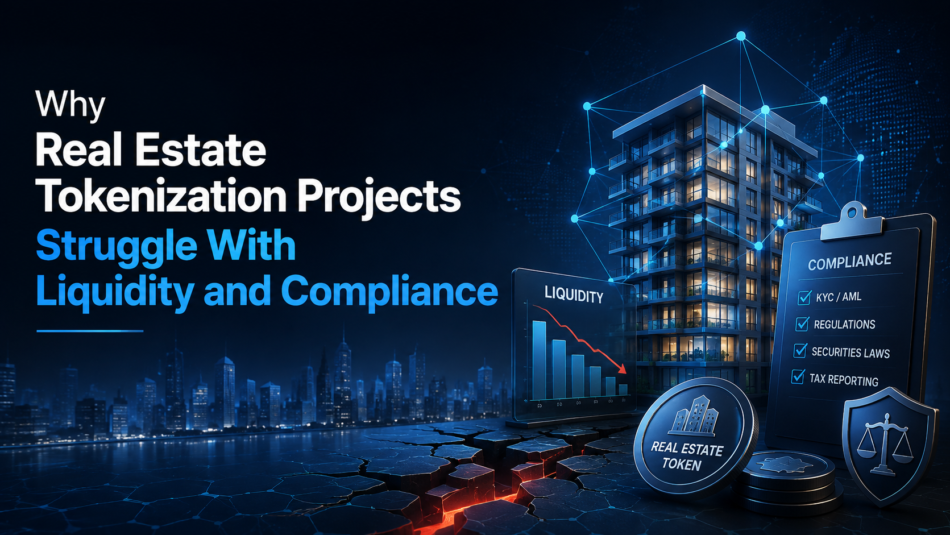
Real estate tokenization is usually touted as the solution for greater access, more fractionalization and greater liquidity found in real estate investment. Businesses can tokenize real estate assets and generate new investment opportunities in the real estate market through blockchain.Blockchain Tokenization can streamline real estate investment processes and provide businesses with new opportunities for investors to participate in the real estate market.
However, the tokenization of a property doesn’t always mean that it’s liquid.
A token may be able to be transferred in just seconds via a blockchain, but the underlying asset might not be easy to sell if there are not enough eligible buyers, a suitable secondary market or a well-defined legal framework supporting the token. Meanwhile, tokenised real estate includes securities, investor qualifications, KYC and AML, transferability and jurisdiction-specific regulations.
This creates two of the biggest challenges for real estate tokenization projects: creating meaningful liquidity and maintaining compliance throughout the asset lifecycle.
Why Real Estate Tokenization Does Not Guarantee Liquidity
Traditional real estate is like any other market: fluid. Valuation, negotiation, legal documentation, financing, due diligence, and registration are required components that might be necessary when selling a property.
While tokenization can help make ownership or investment interest more divisible and digitally transferable, it does not remove the need for market demand.
A significant difference that emerged from real-world asset market research is that tokenization is not equal to liquidity. There can be many assets on-chain that aren’t heavily traded or have a strong trader base.
That’s why we need to consider business liquidity as a market design matter, and not only a blockchain technology aspect.
1. There May Not Be Enough Buyers and Sellers
The first liquidity issue is easy: A token must have a market.
Let’s say there’s a business structure that has been broken apart into 100,000 digital tokens. The tokenization process could enable this fractionalisation, but investors will still require a purpose for acquiring tokens. Of course, by the same logic, existing investors must have an eligible buyer if they want to cash out.
Without sufficient demand, token holders may face:
- Limited trading opportunities
- Longer exit periods
- Wide differences between buying and selling prices
- Low trading volume
- Difficulty establishing reliable market prices
So, don’t assume that every one of the thousands of tokens will create a thousand active investors.
2. A Secondary Market Must Be Designed
Another common misconception is that tokenization automatically creates a secondary market.
It does not.
There are two stages, primary issuance and secondary trading. The primary market refers to the first place that anyone buys or sells the interest tokenized investment. This interest may be transferable or sellable in the future in the secondary market to any eligible investor.
Secondary-market infrastructure thus must be part of the mix from the outset as a key part to a successful tokenization model.
As controlled real estate tokenization moves from issuance to controlled resale, the importance of this is beginning to emerge. For example, Dubai Land Department announced the second phase of its real estate tokenization project in February 2026, enabling controlled secondary-market resale as part of a regulated pilot.
Liquidity requires real life markets, not a token contract.
3. Investor Eligibility Can Limit the Market
Depending on the jurisdiction and the structure of the offering, real estate tokens can be securities or other regulated financial interests.
This means that any given crypto wallet owner doesn’t necessarily qualify to buy or receive the token from the issuer.
Investor eligibility may depend on factors such as:
- Identity verification
- Investor classification
- Jurisdiction
- Offering rules
- Holding periods
- Transfer restrictions
- Applicable securities regulations
These requirements limit the short list of buyers who may be interested immediately.
This can not be a disadvantage. Compliance controls are used to help safeguard investors and to make sure that trading is compliant with the relevant rules. However, they must take them into consideration when structuring a liquidity plan.
4. Property Valuation Is Different From Crypto Price Discovery
Real estate is not a highly-traded cryptocurrency.
A property’s value can depend on:
- Location
- Rental income
- Occupancy
- Property condition
- Local market conditions
- Interest rates
- Comparable transactions
- Professional valuations
Therefore, on-chain investment of a real estate asset does not guarantee real-time and reliable price discovery.
While tokenization can help to make ownership histories and transfers more digital, credible valuation methods are still needed for the underlying property.
5. The Legal Structure Behind the Token Matters
Investors have to know what rights they’re getting with a token for it to be valuable.
One of the most common forms of tokenization models involves the association of digital tokens with an interest in a legal entity, like a special purpose vehicle (SPV), that holds the property.
This creates an important relationship:
Real Estate → Legal Structure → Token → Investor Rights
The technology cannot supplant the legal connection between the investor and underlying asset.
Companies thus must have to define the nature of the investment, whether that means an investment in the company’s shares, an economic interest, income rights, debt investment, or some other contractual right.
Why Compliance Becomes a Major Challenge
Liquidity is but one problem.
A tokenized real estate platform must also decide who can access the platform, the location of the investors, how to verify and the conditions in which the tokens can be transferred.
Compliance should thus be considered as an element of the platform architecture and not as a checklist.
1. Determining What the Token Represents
The first compliance question doesn’t have to be a technical inquiry.
It is legal:
What exactly does the token represent?
It can be a position of interest to an entity in which it has a proprietary interest in real estate, a debt interest, interests in revenue, or other financial interest in a financial interest holder.
That puts in play rules that impact investor access, issuance, disclosures and transfers.
So, the legal framework needs to be fixed first, preceding the design of the technical token.
2. KYC and AML Cannot Be Ignored
These include the Know Your Customer (KYC) and Anti-Money Laundering (AML) protocols, which are especially crucial when a platform also handles investment funds and gives traders access to transact among them.
A compliant platform may need processes for:
- Identity verification
- Sanctions screening
- Investor eligibility checks
- Transaction monitoring
- Wallet screening
- Suspicious activity detection
- Ongoing compliance monitoring
Important – the compliance period is not ended with the purchase of the token.
Compliance requirements might exist throughout the lifecycle of the tokens in the event their transfer is possible between investors. Transfer restrictions and verification criteria for assets can be embedded in the very token infrastructure thanks to the technology of blockchain tokenization of assets.
3. Cross-Border Investment Creates Additional Complexity
Real estate tokenization platforms can make it easier for businesses to reach investors across different markets. But broader access can also create additional regulatory considerations.
Different jurisdictions can have different requirements for:
- Securities offerings
- Investor eligibility
- Marketing
- Data protection
- KYC and AML
- Taxation
- Token transfers
Therefore the platform and its regulation must specify both types of investors and jurisdictions before it allows access to the investors.
It may be risky to make an “available anywhere” token without knowledge of any restrictions in different jurisdictions.
4. Compliance Needs to Be Built Into the Technology
One of the largest errors is considering compliance as a function away from the blockchain platform.
Today’s tokenization infrastructure can consist of rules baked into the technical stack.
For example, smart contracts can support:
- Whitelisted wallets
- Restricted transfers
- Investor eligibility rules
- Holding-period restrictions
- Automated distributions
- Ownership tracking
- Role-based permissions
This can help with consistency on compliance as some rules can be automated, and not depend on manual processes.
How Businesses Can Solve the Liquidity and Compliance Challenge
The answer does not lie solely with selecting a quicker blockchain.
Real estate tokenization requires businesses to consider the legal, financial and compliance aspects, in addition to the technical framework.
1. Establish the Legal Structure First
Before selecting a blockchain or creating a token, determine:
- What asset is being tokenized?
- What legal entity holds the asset?
- What rights does the investor receive?
- Which jurisdictions are involved?
- Which investors are eligible?
This then gives the groundwork for technical design.
2. Design Compliance Into the Platform
When designing your platform architecture consider KYC, AML, assess investor eligibility and consider transferring restrictions.
This can help to avoid a situation where a token is already created and subsequently requires significant changes due to compliance.
3. Plan the Secondary Market Before Launch
There are many questions to ask when it comes to a tokenization project, but one that should have an answer:
Where can investors exit their positions?
This may be an acceptable regulated marketplace, trading venue, broker-assisted model, or other transfer mechanism that is compliant.
The solution is to provide the liquidity in advance of the design of the exodus itinerary.
4. Improve Transparency Around the Underlying Asset
Investors require a more substantial amount of balance in a wallet.
They must be assured in the asset(s) that back the investment.
Platforms should provide appropriate information about:
- Property details
- Ownership structure
- Valuation
- Income
- Fees
- Token rights
- Risk factors
- Distribution mechanisms
- Exit conditions
This would help investors identify the tokenized market with confidence, and make their decisions on the basis of greater transparency.
5. Use Smart Contracts for Controlled Transfers
Smart contracts can be used to execute some of the operational processes automatically and to mandate specific rules.
For instance, a restriction can be applied when a receiving wallet is not eligible for a transfer.
This process can help minimise manual handling, as well as provide easy tracking of transactions.
6. Treat Liquidity as a Long-Term Strategy
You can’t just “turn on” a liquid without a “startup liquid”.
It develops through:
Investor demand + market access + compliant transfers + reliable pricing + trust + trading infrastructure
Therefore, a tokenization project should have liquidity as a measurable metric dependent on real market participation instead of token release numbers.
Conclusion
Real estate tokenization can make property interests more accessible, but tokenization alone does not guarantee liquidity or compliance. The projects must have a solid market infrastructure, credible prices, adequate legal frameworks, investor verification, and controlled transfers.
It’s not about bringing real estate onto a blockchain, it’s about creating a secure, compliant, and market-ready digital assets ecosystem. BlockchainX empowers businesses to build real-estate tokenization infrastructure and create investor platforms that meet global compliance requirements and provide liquidity-focused capabilities.


